Creating a Power Center?

johnd651

Member
Hello

I have been looking through threads, and noticed that people have built "power centers" using plywood and power receptecles. I do know a little about the electrical side of things but I have questions.

I wanted to build a power center with:

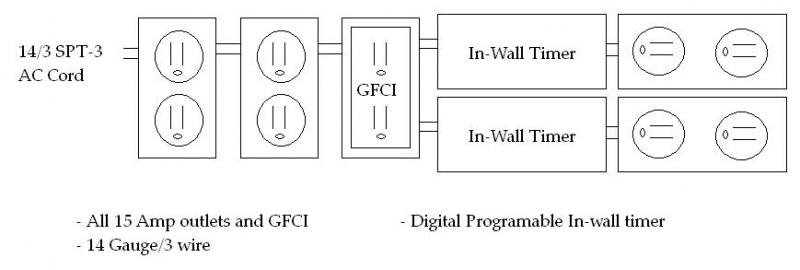
120V In -> 4 outlets -> 2 GFCI outlets -> spilt into 2 timers -> each timer has 2 outlets

4 outlets for filters and pumps
2 GFCI for heaters
1 timer for day lights (GFCI protected)
1 timer for night lights (GFCI protected)

First of all, what amp receptacles should i use? what gauge wire? (I was thinking of doing it all 20Amp, 12 gauge or 15Amp, 14 gauge)

Second of all, the 120V in, i was thinking about making it either a plug in outlet type thing, or hard wiring it into the house electric. Again which is better, and if i was to go with either option which wire should I use, and how long of a total run is possible?

thanks

PS- does anyone know what the electrical gang boxes are called that I can use to screw down to a piece of plywood. The store by me only has the side nail ones
 
Last edited:
I just got done building my power center which is pretty close to what you have outlined. I'll try to take some pictures and post them later tonight.

I used 14ga wire on mine(15amp breaker)

Basic outline is 120V in -> 15amp GFCI(everything else was connected to the load terminal on the GFCI so the whole power center is covered by it) -> 1 constant outlet ->1 switched outlet -> 3 timers, each with their own outlet

I have my skimmer and return pump on the switched outlet so I can turn them on and off as needed for feeding, maint. etc.

I have two timers to control dawn/dusk and the 3rd controls my fuge light and moonlights for the main display.

and the type of electrical boxes you are looking for are generally called "retro" or old work boxes
 
sounds good ... cant wait to see the pictures

-as for the GFCI, i have heard of them tripping many times for "no reason" and just thought i would keep the pumps off GFCI, and have the heaters and lights on GFCI ...any thoughts?
 
Here's mine for inspiration, in the little cabinet under my 15g long reef:

Image158.jpg


It's got a plexi glass door on the front to protect it from water spray from the sump, but no bottom panel, so cords simply run through the bottom:

Image164.jpg


Here's the door opening on the hinge:

Image159.jpg


And a pic from when I was making it. It's just 1x4 select pine, painted in gray epoxy:

Image125.jpg


The whole thing is just plugged into a GFCI outlet thing on the wall, which is easy to test regularly. Hope it provides some inspiration. :)
 
Not to deter anyone, but my assumption is that this:

hard wiring it into the house electric

would make the fish tank's wiring subject to local electrical codes. And heaven forbid you didn't get it inspected, then had a fire and your homeowner's insurance denied the claim.

VS. using an off-the-shelf plug in product (a la' American DJ power strip) or something home-made that was safe and plugged in, which wouldn't be subject to code.

Can one of the resident electricians correct me if I'm wrong? I'll be checking in with my electrician uncle when I build the power center for my big tank, it might be worth anyone else doing a similar project consulting with a local electrician, too.
 
home owners whom do there own elcectrical work are not required to pull permits nor get inspections. Now with that being said there have been many homes that have burned down from faulty elctrical installations and i have not heard of insurance not paying a claim. The issue would be probable issues causing electrical shock or electrocution. .2 amps or 20 milliamps. YES that is a point in front of the 2.... ( .02 amps) will stop a heart. 120Volts is the number one killer of all voltages from electrocutions in the United States. With this all known would you pass up a little bit of protection? Now i do not lead by example because me nor my business partner run GFCI's on our tanks but i would definatly want anyone whom is not licensed for electrical to run GFCI's ALWAYS.. Never direct connect anything to the house electrical wire. There needs to be a way to service the equipment within the line of sight which a plug would be that by unplugging it. The reason would be , what if you shut the breaker off and worked on it and either you got the wrong breaker or someone decided to turn it on? Codes are made because it happens and i would try to adhere to them when you can but you are not forced to unless you are not the home owner and working under a contract.
 
Perfect...one question down. I will not be hard wiring it for sure, just using a plug. From what i have seen, the AC cords look like they might be perfect for the job.

I do like the idea of a cover to keep the water out.

I attached something to show what i am actually thinking of.
 

Attachments

  • powerpanel.jpg
    powerpanel.jpg
    27.4 KB · Views: 11
Here's a picture of mine, still have a little clean up to do on all the wires though.

IMG_2607.jpg

This is such a great Install!!! But I have not heard that many good things about those in-wall timers though. Great concept, but they get reset easily, or get stuck on or off, have you heard anything about them? What a great inspiration though...Thx so much for sharing this!!! :beer:
 
hmm yea those timers have had issues in the past. Some have an internal battery while others do not. The ones with the internal small battery work because durign an outage or a surge they keep everythign like it is suppose to be. I run those same timers on lights for my outside area and they have been in manual mood for awhile now because of power outages.

i love the clean and professional look though.
 
Yes, I have heard of these timers having issues in the past. I figured I would give them a shot anyhow and see how they do work out. They have internal coin style batteries as well so the settings are not lost during power outages etc.

In the grand scheme of things, the power center itself was just meant as a temp fix for awhile till I could come up with some extra cash to blow on a neptune apex or an RKE w/net controller(haven't made my mind up on which im going to get yet).
 
Great ideas in this thread.

The plexi door/splashguard is nice.

2 very nice clean installs - inspiring.

I tried a setup for my nano with one of those timers with a relay. Timer on would trip the relay to circuit #1 - main tank lights, timer off would release the relay to circuit #2 - refugium lights.

Bench testing for this worked well, but after a month of use I did have problems with the timer periodically resetting. Changing the battery didn't help. It was unreliable in use so I just ran my lights off a Coralife power bar.
 
American DJ 8 at Guitar Center for $25

American DJ 8 at Guitar Center for $25

I was thinking about building my own power center as well until I stumbled on the American DJ 8 at Guitar Center for $25. This unit can handle 1800 watts and has a 15 amp circuit breaker. I plug it into a GFCI for added security.

100_0625.jpg
 
Last edited:
thanks for all the info on the timers. i might just skip them and install the rotary timers then, at least i know they are more reliable.

only reason i really liked the in-wall timer was because my moonlights have a plug in transformer that doesn't fit into one of my timers, and takes up a lot of room when plugged into the other timer.
 
Your better off buing a used Acjr than building a power center. I was going to build my own power center but after you total all your boxs,outlets,timers,faces,wiring for a little bit more money your can have a controller.
 
thanks for all the info on the timers. i might just skip them and install the rotary timers then, at least i know they are more reliable.

only reason i really liked the in-wall timer was because my moonlights have a plug in transformer that doesn't fit into one of my timers, and takes up a lot of room when plugged into the other timer.

Oh I agree on the looks department, and the concept is awesome, but it would really suck if they failed in a year or two and they look so integrated into you system, that replacing them would be a major pain when the whole system is up and running, just a thought, and I didn't want to deter you in your designs or anything, just a little warning on others peoples experiences with the in-wall timers.
 
Back
Top