Cyano Algae - At my wit's end!!

monkeysee1

Member
Hi again, guys!
Okay - here's the deal:
About three weeks ago now there was a sudden bloom of this hideous green (I'm talking a REALLY vivid green here, follks - no red or brown in it at all) Cyano algae in my tank, mainly on my sand bed. It just won't go away! I have tried these manuevers to get rid of it, but to NO AVAIL:
1. Using Purigen
2. Raising the alkalinity
3. Turning the lights off
4. GFO.
5. GAC.
6. Reducing my feedings to he point where my fish hate me and
7. Changing my RO resin.

It's such disgusting stuff. I am approaching the point of taking everything out of my tank, deconing the damned thing and starting over fresh with new live sand and dry rock - I'm that fustrated.:mad2:
This problem is also occurring in addition to the problem of bubble algae - but that's a story for another day (and YES - I tried the scrubber trick - THAT didn't help).
Any advice?
If so thanks, all!
 
Last edited:
Sometimes, sometimes a sea hare will devour it. It's a craps shoot though.

Your best bet is to increase flow. I had an issue years ago and blasting the areas with more flow solved it.
 
Increase flow, check your lighting, be patient. 3 weeks is no time at all in the world of reefing.
 
I also had an outbreak of cyno, vivid green just like yours on the sand bed,
Did everything I was told, increase flow, water changes, siphon out etc etc.
7 weeks later still bad, and starting to grow on rocks too.
Then it started affecting corals, not wanting to open and sulking.
You have to remember its a bacteria not an algae. If bad enough can become toxic to tank inhabitants. including corals.
Thats why NO cuc will eat it. it is toxic to them.
I gave up and researched Polylab Chemiclean.
I followed the directions to the letter and 48 hrs later it was completely gone, 7 months late never seen again.
Within 48 hours my corals picked up, everything just looked so much better and healthier.
I have bta's, shrimp,coral banded and pep. abalone, sea cucumber and this product was 100% reef safe. I have also put a few friends onto chemiclean and they too have had great results with no losses.
Read up on the product, use it if you feel you need to, there is no shame it doing so.
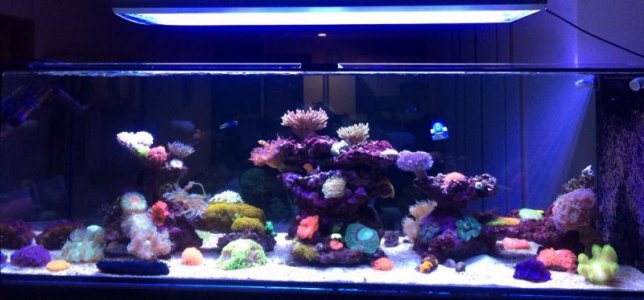
I have included a pic of my tank purely to show the $$$ i risked in using the product and to show you nothing has been damaged or hurt in doing so.
 

Attachments

  • FullSizeRender (3).jpg
    FullSizeRender (3).jpg
    47.7 KB · Views: 4
If it's bad enough Chemclean works well with no ill effects to anything in your tank. You can also let the bacteria run it's course and it will go away on it's own IF it's cyano. I've never seen any green cyano only red. It lasted about 4-6 weeks in my 20 L tank and finally went away. I would vacuum it up weekly and do wc's every two weeks.

Don't let it get to you as there is only so much you can do about it. Once it's gone it doesn't come back as far as I know. At least I've never had it come back
 
I've been fighting cyano for better part of a year. I doubled the amount of phosphate remover that I was using, switched from gfo to phosguard, and added some rock/ton of cleanup crew from someone else's awesome tank. I can't pinpoint which of the three did the truck but my tank looks a lot better. I've actually been feeding a bit more
 
I had a bad problem with it also in my 20 gallon L. It was the red kind. At first, I had no clue what it was, thought it was pretty and in short order it started to consume my tank. Can you try manual removal? Increasing flow can also help. Mine slowly died out. Bubble algae on the other hand is a pest I still deal with. It is the devil of reef algaes IMHO.
 
DON'T TEAR DOWN YOUR TANK THIS IS NOT SOMETHING THAT REQUIRES NUKING YOUR TANK.

Ok now that thats out of the way, Cyano happens too almost everyone and it happens because of excess nutrients. You need to starve the tank of nutrients, along with more frequent and larger water changes, you should also feed less and shorten your photoperiod. Another method because cyano is so light hungry you can do a three day lights out period. Here is a step by step for the lights out period.http://reefcentral.com/forums/showthread.php?t=2279039

Finally if none of this cures your problem then you can try chemi clean. Just know that if you don't solve the nutrient issue it will come right back.
 
DON'T TEAR DOWN YOUR TANK THIS IS NOT SOMETHING THAT REQUIRES NUKING YOUR TANK.

Ok now that thats out of the way, Cyano happens too almost everyone and it happens because of excess nutrients. You need to starve the tank of nutrients, along with more frequent and larger water changes, you should also feed less and shorten your photoperiod. Another method because cyano is so light hungry you can do a three day lights out period. Here is a step by step for the lights out period.http://reefcentral.com/forums/showthread.php?t=2279039

Finally if none of this cures your problem then you can try chemi clean. Just know that if you don't solve the nutrient issue it will come right back.

Cyno is not always caused by high nutrients. It can be caused ( and often is) by an imbalance between nitrates & phos. One or the other is a fair bit higher than the other. That is why it's very common to have a breakout when you are trying to balance carbon dosing or nop-pox. Or when tank is in the uglies stage and not balanced. If this is the cause , and I think it is imbalance - then water changes etc won't get rid of it. I used chemiclean on 2 tanks ( both around the 9 month mark ). Cyno cured never to return on either occasion. So it doesn't have to come back.
 
:wavehand:Thanks so much everyone!
Cyano doesn't like vigorous flow? Interesting!
Okay - I just picked up some ChemiClean at my LFS and I purchased some nice VorTec powerheads on line (a fortune - but I've been meaning to get them anyway) and I'm expecting them this week!
Their claim to fame is that they deliver powerful flow for such small powerbeads!
Hopefully THAT will take care of the problem, once and for all!
Again, thanks all! Very MUCH!
 
My favorite saying "Only Bad things happen fast in a reef tank" you willm get past the problem is you work on it over time, keep studying the problem and the possible solutions, keep track of what you do and so not try to do to many things at one time as then you will not be sure what really worked. this is marine biology, a science; follow the rules of science. control, theory, test, disprove wrong theories and in time you will have the answer.
 
Back
Top