Deep Sand Bed -- Anatomy & Terminology

I'll be happy to do what I can Tom. Right now your whole grasp of the anaerobic sequence is above mine - I've got some reading to do to catch up with you.

I do have another questions that perhaps longfellow or whoever can comment on. My question revolves around what I believe was your statement Tom, that phosphate binds up into the sand. My question is, if the phosphate is binding into the sand (which would explain some issues I'm having with one of my multiple tanks), why do we see the increased nuscience algae growth on the rock and plastic (esp. powerheads) of the system rather than the sandbed? It seems to me (and here is where my understanding of the leaching/removal of chemicals from substrate is weak) that if the phosphate is bound in the sand grains, then the growth should occur there. If its occurring on the rock rather than the sand, is this an indication that our LR has bound up phosphates and do we need to consider some process to remove it from the rock? Or is it simply that the phophate is leached into the water column from the sand and the rock provides an area that is more protected from flow and on which growth is easier?
 
I don't know what that means. :confused: If you're trying to say that I don't back up what I'm saying with documented research, I'm really confused. I posted two links in the post you quoted.


You're a scientest that believe nitrogen and oxygen are not nutrients????? Serously????? Here's some more reading.
http://www.tutorvista.com/topic/oxygen-nutrient-cycle
And a quote from the link.
"The nutrients required by plants for their healthy growth are 16 in number. They are carbon, hydrogen, oxygen, nitrogen, phosphorus, potassium, calcium, magnesium, sulphur, iron, manganese, copper, zinc, boron, molybdenum and chlorine. "

http://www.google.com/search?hl=en&...e&sa=X&ei=wDEATdufDMWt8AbT7sHoBw&ved=0CBsQkAE
And one of the definitions of nutrient cycle from the link.
""¢Chemical transformation of nitrogen, phosphorus and silica compounds in continuous cycles of organic and inorganic phases in an ecosystem."


What export methods are you using to remove these fixed nutrients? The Shemik sand bed is not an export method. It is a nutrient sink method.


How is that possible? Okay, lets look at this. Cyanobacteria take nutrients out of the water, and they use them to reproduce. A worm eats some cyanobacteria. It later poo's. Then microbes feed on the poo and liquifies it. Now the nutrients from the poo, that were once in the cyanobacteria, are once again available in the water to fuel more cyanobacterial growth. This is how nutrient cycles work. This process does not remove cyanobacteria.


So Shemik took photos of his own system, when it was failing, and posted them in his article???????

The problem with everything that you're saying is that you are treating it as a closed system when it is not. Also the pathways that you imply are overly simplistic. If we were to detail all of the metabolic pathways present in our tanks it would make all of our heads spin. Some cyano is produced and during PHASES not FAILURE, they will be a noted feature. The availability of this food source will then encourage the growth of those creatures that consume it. Normal operation sees it in equilibrium (just as much being produced is being consumed) just like in nature. Anyway the point is the overall balance of nitrogen flux not where all it stops along the way. It is being added as food and removed as inorganic nitrogen as well as organic nitrogen when we export.

I'm not sure where you're getting your information of a DSB being a nutrient sink, or who exactly you think is advocating a DSB without any other export. Again we go back to the concept of equilibrium. The total amount of nutrients present at a given time is most certainly more in a DSB versus a SSB. But the point is that with proper fauna to aid in nutrient processing, things will be in balance. It not being in exact balance is a fair point of dispute and should be researched and documented, not assumed. By the way, Dr. Shimek has done research on this and warns of trace metal slow accumulation (happens in LR as well). This is why he recommends changing out a DSB every 10 years or so, though this has not been proven to be necessary.

http://www.reefkeeping.com/issues/2002-12/rs/feature/index.php

The point is that Dr. Shimek supports aggressive export in addition to the DSB. The DSB aids in detrital processing, stability, and some N export. Other sources of nutrient export such as macro, ats, and skimming, are vital no matter what your sand depth is.

When I was in school I would learn a great deal one year and get all excited that I understood that aspect of science. The following semester I'd be in a new class that would tell me to forget what I had learned because it was false (oversimplified). This happened more times than I can count. In general the higher the education the more this happens. If you have not been through this process, you don't have a good appreciation for the limitations of our knowledge. To be clear I am talking about everyone here. This is why we must rely on those who are experts in their fields to help us understand that which is too complex for those who have not had 8 years of schooling and 30 years of research to fully comprehend. And how do we know who the experts are? In science that is clear. Those who have built a reputation for truthseeking by publishing well documented research and who have demonstrated broad knowledge that takes into account a high level of complexity.

Those who would use new research and well devised analysis to dispute the research of others are an asset to the general accumulation of knowledge. Those who would slander, or use rudimentary understanding (and elementary documentation) of a concept to argue with those more educated (not talking about me, but Dr. Shimek) and experienced, only discredit themselves.

JD
 
So Shemik took photos of his own system, when it was failing, and posted them in his article???????

While few of us are particularly fond of Cyano, by itself it's not an indicator of a failed system, same with algae. Cyano can and will show up in any tank that has light and a food source. This is true no matter what type of tank setup you have. It can also be found in very healthy ocean reefs. It's presence says nothing about the viability of a deep sand bed one way or the other.

One thing a living sand bed does do is provide competitors to Cyano for the food that the fish and corals did not eat. More competition means less Cyano. It also provides potential habitat for fauna that eats Cyano directly. Unfortunately our hobby is woefully behind on identifying and importing animals that do eat Cyano directly. There are a couple which have been talked about before on this thread like some Sea Cucumbers.

The competition for uneaten food is the main reason why keeping a deep sand bed in your display verses a refugium is highly recommended. The display tank is where your food is introduced, and where most of the uneaten food collects. Right there on the bottom where the sand bed fauna can eat it. One of the most common sand bed problems arise when sand bed predators are introduced like shrimp, crabs and some Gobies. Suddenly you no longer have the populations needed to keep up with left over food. At least the Gobies do a half decent job of keeping the sand looking clean.
 
BTW , I think the thread is a good read but if you are in a hurry for the study which includes several other references ,I was able to find the link:

http://www.advancedaquarist.com/2005/6/aafeature#h5

Just a quick comment on this research. I think it offers great insight into some aspects of what can happen in our tanks. For example it answers the question (to me at least) of diffusion of nutrients without the aid of mechanical water movement. It answers depth and particle size questions as well, at least in the short term. What it doesn't answer is:

What happens when bactrial films begin to cement particles together, which will happen in any sand bed without agitation by fauna or mechanical means?

What happens to the fauna that would prevent such cementation if substrate particle size and shape is not properly selected?

To my knowledge Dr. Shimek is the only one who has attempted to answer those questions. The complexity of these questions, limits the answering of it to a marine biologist/ecologist. We should all be extremely grateful that one so educated sees fit to apply their knowledge and skills to a hobby. We may have more entrants that fit that description if we treated them with more respect and cultivated a culture that values such research.

JD
 
While few of us are particularly fond of Cyano, by itself it's not an indicator of a failed system, same with algae. Cyano can and will show up in any tank that has light and a food source. This is true no matter what type of tank setup you have. It can also be found in very healthy ocean reefs. It's presence says nothing about the viability of a deep sand bed one way or the other.

One thing a living sand bed does do is provide competitors to Cyano for the food that the fish and corals did not eat. More competition means less Cyano. It also provides potential habitat for fauna that eats Cyano directly. Unfortunately our hobby is woefully behind on identifying and importing animals that do eat Cyano directly. There are a couple which have been talked about before on this thread like some Sea Cucumbers.

The competition for uneaten food is the main reason why keeping a deep sand bed in your display verses a refugium is highly recommended. The display tank is where your food is introduced, and where most of the uneaten food collects. Right there on the bottom where the sand bed fauna can eat it. One of the most common sand bed problems arise when sand bed predators are introduced like shrimp, crabs and some Gobies. Suddenly you no longer have the populations needed to keep up with left over food. At least the Gobies do a half decent job of keeping the sand looking clean.

Good points.
 
I'll be happy to do what I can Tom. Right now your whole grasp of the anaerobic sequence is above mine - I've got some reading to do to catch up with you.

I do have another questions that perhaps longfellow or whoever can comment on. My question revolves around what I believe was your statement Tom, that phosphate binds up into the sand. My question is, if the phosphate is binding into the sand (which would explain some issues I'm having with one of my multiple tanks), why do we see the increased nuscience algae growth on the rock and plastic (esp. powerheads) of the system rather than the sandbed? It seems to me (and here is where my understanding of the leaching/removal of chemicals from substrate is weak) that if the phosphate is bound in the sand grains, then the growth should occur there. If its occurring on the rock rather than the sand, is this an indication that our LR has bound up phosphates and do we need to consider some process to remove it from the rock? Or is it simply that the phophate is leached into the water column from the sand and the rock provides an area that is more protected from flow and on which growth is easier?

I don't know how phosphate leaches from substrate rock or other surfaces or why it sticks there in the first place.
Broadly ,the buildup and leaching is attributed to equilibration via diffusion with the water. Aragonite such as live rock or coral sand, exposed to high PO4 will adsorb some and desorb some depending on the level of PO4 in the surrounding water. Maybe PO4 just pools up on the rock without actual adsorbtion and simply diffuses over time. Whatever the mechanism , when you put aragonite from a tank with high PO4 into new saltwater with very low PO4 , the PO4 levels in the new water will rise. If the surrounding water is kept at near 0 PO4 via gfo, lanthanum chloride , water changes ,etc. the rock will stop leaching at some point in time, usually a week or two ,ime.
It is known that PO4 species of phosphate( inorganic) take a spot on a forming calcium carbonate crystal normally taken by calcium slowing or stopping eh growth of the crystal This is why elevated PO4 is harmful to stony corals(lps, sps) as it inhibits calcification at levels above 0.1ppm to .25ppm . Corals and other calcifying organisms sink some PO4 in their skeletal mass and it will stay there unless ph drops enough to melt the calcium carbonate( around 7.6 depending on alkalinity ) . Maybe PO4 adsorbed to surface areas of rock and sand is loosely bound and not fully sunk in calcium carbonate crystals and thus is pulled off by diffusion into the water with lower levels or maybe its just lying there and diffuses.

I've seen nuisance green algaes form on sand ; cyanobacteria seems to form there more than in other areas as well. Perhaps competing bacteria like the nitrifying and denitrifying bacteria take up the PO4 that may leach form the sand more quickly than in other areas. leaving less for algae in those areas or the phosphate on the sand may be more organic than that in the water due to bacterial activity. If it's bound to refractory organics it may be harder for the hair algae( derbasia, bryopsis, etc) to access it right away.

Plastic products may hold some phosphate residue from the manufacturing process.
Usually a wipe with vinegar and a rinse is sufficient to remove it. Powerheads and other sources of heat make calcium carbonate less soluble ecouraging localized a biotic precipitation of calcium carbonate and ph variations in the vicinity . Powerheads also draw water to them and detritus buildups near them/ in areas under them are not uncommon. I also suspect the density of particulates near them is also higher, just like a drain screen on a sinkl.
 
I am enjoying the discussion, but I studied the wrong stuff in school to help. But maybe a little levity. Longfellow you reminded me of a couple old saying that I will probably misquote :)

We go to school so we can learn nothing about everything - BS (Bull S***)
We continue to go to school so we know a little about a few things - MS (More S***)
Even more school until we know everything about nothing at all - PhD (Piled Higher and Deeper)

Please keep up the discussion - Thanks
 
By the way, Dr. Shimek has done research on this and warns of trace metal slow accumulation (happens in LR as well).

I remember when Dr Schmeck wrote this and I had a discussion with him about it. My gravel is dolomite and it has been in my tank since it was brackish water about 45 years ago continousely. I have never removed or really cleaned it. My tank is a reef and if there is metal accumulation in there, the corals don't seem to know.
I also use a large portion of NSW from NY right after it passes Manhattan so you would think metals would be present. I am not a scientist but I think that 45 years should be long enough to test the theory that metals accumulate or don't accumulate in substraits.
I have pictures of the tank from then to now with the same gravel and probably some of the first water is still in there from Nixon's term in office.
I think his theory is flawed. I feel many of his theories are correct but only for a period of time. I don't feel it is metal that crashes a DSB but an accumulation of "muck" that eventually clogs the thing.

We go to school so we can learn nothing about everything - BS (Bull S***)
We continue to go to school so we know a little about a few things - MS (More S***)
Even more school until we know everything about nothing at all - PhD (Piled Higher and Deeper)

I did not to to college, the draft and Viet Nam took care of that, But I am self taught (like Lincoln)
(I did have to go to about 12 years of school to be an electrician though)
I have a cousin who is a marine biologist professor and when he looks in my tank he has no idea what he is looking at but on a page in a book he can give you the scientific name of every worm.
He never had a tank of anything and for his tital he had to SCUBA dive exactly once.
This is a hobby so there are no experts, no degrees and no courses you could take.
When I started there were no books, "experts" computers, internets, ASW, liquid copper or anything else. We bought fish and when they died we bought more fish and tried something else.
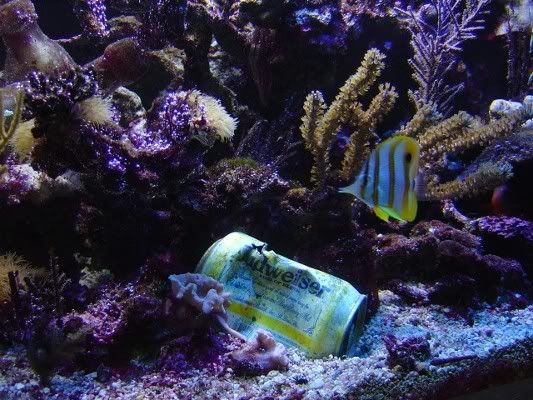
That is the best way to learn. I also believe that too much formal education reduces your creativity, of course that is just my theory. It is also probably why I have a beer can in my reef. ;)
 
Last edited:
"It is also probably why I have a beer can in my reef" talk about heavy metals. I hope you drank it first :)

I also believe that too much formal education reduces your creativity+1

I think there is some cross between learning it all the hardway, a learning from someone else. IMHO in this hobby an expert is only someone that had more time (to get published) and money (for some sort of research). They may get more fan fare, but I am not sure they know more than folks who have been doing it for a while.
 
Paul, I think the metals can accumulate and be held in place by refractory organics( that don't readily breakdown) but when localized ph changes occur in clogged areas and they are then disturbed, it can be a problem. The "muck" probably contains them and they are likely held relatively harmless, likely adsorbed to fulvic and humic sustances which don't readily pass through cellular walls as free heavy metals do. The flow through the rugf pobably prevents these scenarios. I think the ozone you use helps too as it breakdown organics and encourages export by skimming and gac and your algae turf scrubber.

Fishman:
The learning process put another way:
Level one: unconscious incompetence- not knowing what I don't know.(blissful)
Level two: conscious incompetence- knowing what I don't know.( anxious)
Level three: conscious competence- knowing what I do know.(boring/tedious)
Level four: unconscious competence- performing in an apparently competent way without thinking about it.( self assured, blissful)
Level five: return to level one.
 
I agree ^, it would be roughly equivalent to what occurs when we dredge in a bay or harbor area and thereby release harmful elements into the water column at toxic levels. Research has shown that these substances are carried by rivers into these bays or harbors, in the reduced flow they settle out, and accumulate in the bottom substrate, where for the most part they can remain harmlessly until or unless they are disturbed. Once disturbed they can be released in toxic quantities.

Granted our systems are not the same as nature, but certainly we all agree that nutrients (in one form or another) accumulate on the bottom of the tank - therefore it only makes sense that other things do also.

It seems to me however that if a person is using RO/DI water the accumulation of these elements (other than those we are mixing in with our salts) should be extremely minor.

FYI; Research has shown that we forget approximately 95% of what we learn through formal education.

And I do agree that Paul's self-taught education is every bit as valuable and valide as the PhD; in someways perhaps more so, as his has been learned/applied directly to the subject area of discussion. My degree is in both the biological and chemical sciences, but other than indirectly I use very little of the chemical information and therefore remember very little of it as well. Also, much of my hard earned school knowledge applies only in a general sense to discussions revolving around reef tanks, so its of little value. I relie much more on what I've learned through application or direct experience since leaving school than I do on what I learned in school. I am BTW, in no way taking shots at anyone else, just sharing my own experience.
 
Last edited:
In addition to the metals in salt mixes , quite a bit comes in with foods.
 
It's not really a "heavy" metal, it's aluminum. :o

And to throw another wrench in this discussion, this is an old picture but you see all of that cyano? Well it is not cyano. Yes I know it looks like it in the picture but that particular red algae covers the rocks on the bottom of the Long Island Sound at certain times of the year. When I collect water (and mud) from there I sometimes get this short red algae that looks like cyano.
I don't have any now but I have not collected in the Sound in 3 years.

Budcanandcopperband.jpg


Now I know all of you biologists, scientists and other doubters will say, "is he nuts? thats classic cyano"
here is a picture of a couple of rock anemones I collected in the Sound on the rock I collected them on. See the red growth on it? That is the stuff and it is not cyano. I do have a little cyano but this is not it. I put that rock and anemones right in my tank as I always do. The stuff is probably not tropical and only lasts a couple of months.

Anemone1.png
 
I agree ^, it would be roughly equivalent to what occurs when we dredge in a bay or harbor area and thereby release harmful elements into the water column at toxic levels. Research has shown that these substances are carried by rivers into these bays or harbors, in the reduced flow they settle out, and accumulate in the bottom substrate, where for the most part they can remain harmlessly until or unless they are disturbed. Once disturbed they can be released in toxic quantities.

Granted our systems are not the same as nature, but certainly we all agree that nutrients (in one form or another) accumulate on the bottom of the tank - therefore it only makes sense that other things do also.

It seems to me however that if a person is using RO/DI water the accumulation of these elements (other than those we are mixing in with our salts) should be extremely minor.

FYI; Research has shown that we forget approximately 95% of what we learn through formal education.

And I do agree that Paul's self-taught education is every bit as valuable and valide as the PhD; in someways perhaps more so, as his has been learned/applied directly to the subject area of discussion. My degree is in both the biological and chemical sciences, but other than indirectly I use very little of the chemical information and therefore remember very little of it as well. Also, much of my hard earned school knowledge applies only in a general sense to discussions revolving around reef tanks, so its of little value. I relie much more on what I've learned through application or direct experience since leaving school than I do on what I learned in school. I am BTW, in no way taking shots at anyone else, just sharing my own experience.

The article in question shows measurements from ASW mixes and it is scary how much is there compared to NSW. So Paul you are probably off the hook there. It also shows actual measurements of aquariums (a sampling). The question do heavy metals accumulate is answered, but what effect it has is debateable. He speculates that it may be the cause of otherwise unexplained shortened lifespans.

Concerning everyone's comments on the education process. I believe any education is only the foundation, it is the decades of field work that I respect. Decades of field work alone is worthy of respect too, Paul. I think the combination is when you can start calling yourself an expert though.

JD
 
Indeed Paul, you clean up rather nicely.

Had a chance to read completely through the first article, but have read only the summary of the second article. Definitely some interesting results; I'm not sure that I agree with all their conclusive statements. To say that sandbed depth has no effect, when you are basing that conclusion only two depths seems a bit extreme. I wish their DSB had been a bit deeper as I believe the aquarium standard is 4" to 6" inches rather than the 3.5" they used in the experiment. Regardless however, one certainly cannot argue the fact that shallow sandbeds are also effective in nutrient breakdown.

It was interesting to see that the inclusion of a plenum produced not statistically significant effects in nutrient breakdown, but did, combined with a DSB have a statistically significant effect on pH and alkalinity levels.

Have to admit I was surprised with the conclusion that the biofauna also had no effect on the breakdown of nutrients, and look forward to reading through the second article completely.
 
I have no faith at all in the second article. You cannot measure the effectiveness of fauna on a tank fed only with ammonia. It does rather effectively measure how fast you can kill sand bed animals in a tank fed only on ammonia.
 
The tanks with the fauna in the second article were not dosed with ammonia. They had a large bioloads for their size and were fed pelletized foods.
 
It took four months before my tank showed visible worm tunnels around all four glass sides and I could begin to call my sand bed alive. Their experiment ended at 118 days, about the time that a sand bed is beginning to get properly established. They also included hermits, known sandbed fauna predators. The surface area of the sand beds were also well under the 6 square feet recommended. So the experiment does not inspire confidence.
 
Back
Top