Diagnosis 2nd opinion Coral Beauty

Medic2014

New member
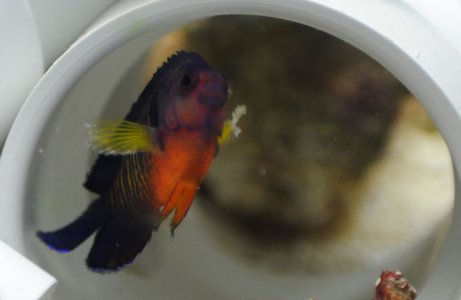
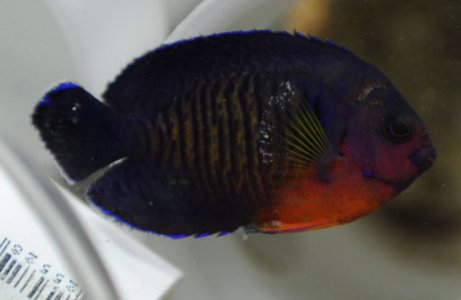
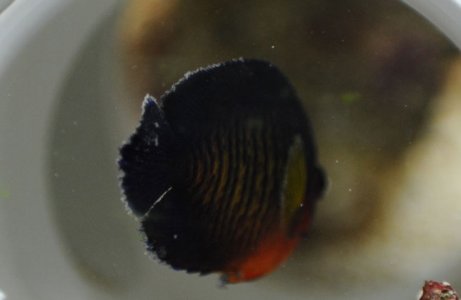
Coral Beauty, Marine ich broke out 5 days ago, Then I think Lymphocystis got her good.

- In QT
- In Hyposalinity 1.008
- Daily water changes 25%
- 2 rounds of Erythromycin planning a total of 4 rounds to prevent infection
- Air stone tank
- Vitamin C and selcon
- Eating very well and active.

Is this Lymphocystis and am I on the right antibiotic to prevent secondary infection? OR is this something other than Lymphocystis Anything I can do more of?
 

Attachments

  • DSC_0336.jpg
    DSC_0336.jpg
    24 KB · Views: 6
  • DSC_0334.JPG
    DSC_0334.JPG
    27.9 KB · Views: 7
  • DSC_0340.JPG
    DSC_0340.JPG
    30.9 KB · Views: 6
Yep, looks like lympho. My coral beauty had it as well. Sounds like you are doing what needs to be done. It's just going to take time for the lympho to go away.
 
The problem is that the timing isn't right for Lymphocystis - hypertrophic cell growth can't progress that much in less than 5 days. If I read it correctly, the fish had Cryptocaryon 5 days ago and THEN these growths showed up. I've seen a condition where there is hyper mucus production on the fins that resembles Lymphocystis, but I don't know the cause. There is probably some Lymphocystis involved, but if it is ALL Lmypho, it is one of those very serious, acute cases where the fish's immune system is knocked out by something.

Two other general observations: 25% water changes are not likely enough to control ammonia in an airstone only tank, you'll want to monitor to ensure that levels are <.25 ppm ammonia-N Also, personal preference, but I would never expose a Centropyge to 1.008 SG units, maybe 1.009 -- but I would be really careful to determine that the SG measurement technique I was using matches a laboratory standard!

Bill
 
The problem is that the timing isn't right for Lymphocystis - hypertrophic cell growth can't progress that much in less than 5 days.

Correct.

If I read it correctly, the fish had Cryptocaryon 5 days ago and THEN these growths showed up. I've seen a condition where there is hyper mucus production on the fins that resembles Lymphocystis, but I don't know the cause. There is probably some Lymphocystis involved, but if it is ALL Lmypho, it is one of those very serious, acute cases where the fish's immune system is knocked out by something.

Two other general observations: 25% water changes are not likely enough to control ammonia in an airstone only tank, you'll want to monitor to ensure that levels are <.25 ppm ammonia-N Also, personal preference, but I would never expose a Centropyge to 1.008 SG units, maybe 1.009 -- but I would be really careful to determine that the SG measurement technique I was using matches a laboratory standard!

Bill

Excessive mucus on body or gills
Research:
a) Brooklynella (parasite)
b) Marine Flukes (parasite)
c) Uronema (parasite)
 
Snorvich,

I was thinking of benign mucoid development. I've seen it perhaps five times - always on the trailing edges of the soft fin rays. Biopsy shows mucus cells only. It is definitely a response to *something* just don't know what.
So for a differential diagnosis rule-out:

a) Brooklynella (parasite) - creates more diffuse mucus, always with elevated respiration and inappetence after even a day or two.

b) Marine Flukes (parasite) - Trematodes don't focus their location on soft fin edges of teleosts like that (Sometimes Elasmobranchs do show this though)

c) Uronema (parasite) - more commonly seen inter-cellular, and when external, is more diffuse. Once it reaches this severe of a level, there would also be open-mouthed breathing and innapetence.

I looked at the images again. I do think there is some Lymphocystis involved, but it just doesn't look like all of the lesions are from that cause.


Bill
 
Snorvich,

I was thinking of benign mucoid development. I've seen it perhaps five times - always on the trailing edges of the soft fin rays. Biopsy shows mucus cells only. It is definitely a response to *something* just don't know what.
So for a differential diagnosis rule-out:

a) Brooklynella (parasite) - creates more diffuse mucus, always with elevated respiration and inappetence after even a day or two.

b) Marine Flukes (parasite) - Trematodes don't focus their location on soft fin edges of teleosts like that (Sometimes Elasmobranchs do show this though)

c) Uronema (parasite) - more commonly seen inter-cellular, and when external, is more diffuse. Once it reaches this severe of a level, there would also be open-mouthed breathing and innapetence.

I looked at the images again. I do think there is some Lymphocystis involved, but it just doesn't look like all of the lesions are from that cause.


Bill

Bill, you have good eyes and good ideas. I did see issues beyond Lymphocystis but the pictures are not good enough for me to hazard a guess. I have never seen benign mucoid development but would suspect it is a reaction to something, it is just not clear what it might be. For options a] or c] above we should see reclusive behavior. For option b] there is likely to be twitching.
 
Snorvich,

I was thinking of benign mucoid development. I've seen it perhaps five times - always on the trailing edges of the soft fin rays. Biopsy shows mucus cells only. It is definitely a response to *something* just don't know what.
So for a differential diagnosis rule-out:

a) Brooklynella (parasite) - creates more diffuse mucus, always with elevated respiration and inappetence after even a day or two.

b) Marine Flukes (parasite) - Trematodes don't focus their location on soft fin edges of teleosts like that (Sometimes Elasmobranchs do show this though)

c) Uronema (parasite) - more commonly seen inter-cellular, and when external, is more diffuse. Once it reaches this severe of a level, there would also be open-mouthed breathing and innapetence.

I looked at the images again. I do think there is some Lymphocystis involved, but it just doesn't look like all of the lesions are from that cause.


Bill

Also, since you seem to be very knowledgeable, we would welcome your continued participation in this forum. There is a group of us who try to help, but burn out is prevalent and we take breaks frequently.
 
Back
Top