
You are using an out of date browser. It may not display this or other websites correctly.
You should upgrade or use an alternative browser.
You should upgrade or use an alternative browser.
Diy ato?
- Thread starter 710Reefer
- Start date


uncleof6
Active member
Looking to make my own auto top off system. Anything will work for me, just need to save a few bucks. Link would be nice, or Post what you have on here. Thanks everyone.
Robert
Well, sometimes it should not be about money, rather reliability.... lot of ideas on this subject, some good, some not so good... at any rate....
http://www.aquahub.com/store/product27.html#
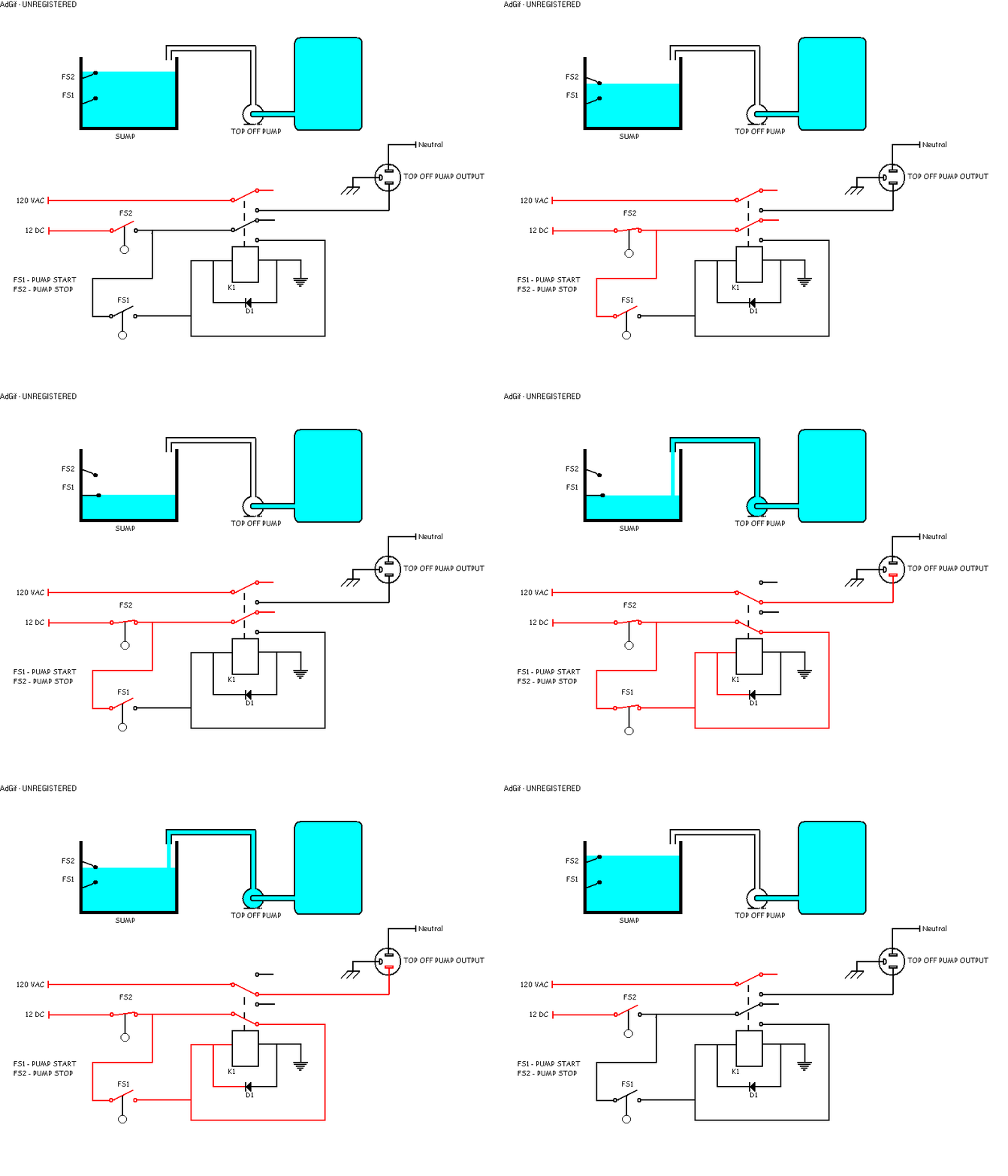
And the most reliable way to wire up a system such as this. You would also need a mechanical fail safe, which is not quite as simple.

710Reefer
New member
Well, sometimes it should not be about money, rather reliability.... lot of ideas on this subject, some good, some not so good... at any rate....
http://www.aquahub.com/store/product27.html#
And the most reliable way to wire up a system such as this. You would also need a mechanical fail safe, which is not quite as simple.
At the moment, i wish it wasn't about money! It is though, i wanted to know of a way to make one for the time that i don't have one. I've seen some ATO for $100, going to get one once i get my new tank set up. I could always use something to do after work. Cant sleep too good haha. seems simple enough, ill have my cousin help me with the wiring.. Thanks
710Reefer
New member
use the search feature, or use google.
I would think someone in this community, would have made their own. Just wanted to post something here and possibly help anyone in the same situation, thats all. Used search but nothing..
RocketEngineer
Space is big.
uncleof6
Active member
We do. Most of us use This Kit which has all the parts and is cheaper than buying them individually plus has that nice handy box to hide it in. All you need is a pump and you are good to go.
That is the 'little' brother of the kit I posted, same supplier...
 I just recommend wiring it up a bit different.
RocketEngineer
Space is big.
That is the 'little' brother of the kit I posted, same supplier...
One diode and you are golden. Too bad I'm an Mechanical engineer instead of an Electrical engineer otherwise I could recommend the proper diode to use.

Redman88
New member
Well, sometimes it should not be about money, rather reliability.... lot of ideas on this subject, some good, some not so good... at any rate....
http://www.aquahub.com/store/product27.html#
And the most reliable way to wire up a system such as this. You would also need a mechanical fail safe, which is not quite as simple.
the next one i build wont be connected to 120v it will be strictly 12v due the addition of a 12v solenoid, with the water line coming straight from house water due to it going into a freshwater tank. with the float switches set this way it wouldn't be to hard to take a piece of acrlic and a mechanical float valve and connect it across the front of the switches

Last edited:
uncleof6
Active member
One diode and you are golden. Too bad I'm an Mechanical engineer instead of an Electrical engineer otherwise I could recommend the proper diode to use.
Hmmmmmmmmmm, lemme see....
The circuit is a latching circuit, and is different from the standard wiring for the ato kits we are linking to. It is far more reliable, in terms of cycling and reed switch/relay contact wear. (over cycling)
The diode is refered to as a 'flyback diode,' 'snubber diode,' 'clamp diode,' 'catch diode,' 'suppressor diode,' 'suppression diode,' and/or several other names. It is used to provide a path for 'flyback voltage' (a voltage spike) caused when power is suddenly removed from a coil, so the coil (in this case a relay) draws current from itself, till the power is dissapated due to wire resistance. The fly back voltage can be 10x the supply voltage. This protects the switches. When the switches are closed, the diode is reverse biased against the power supply, and does not exist in the circuit, for practical purposes. Only the reverse bias is animated in the gif image.
Which diode, hmmmmmmmmm, sometimes a 1N4007 is called for...might be overkill, but it works. A 1N4001 or 1N5400 series diode will do the job.
This can cause a delay in the opening of relay contacts, so if it is critical that the contacts open quickly, a low value resistor can be placed in series with the diode, to speed up the dissipation. But in an ATO the instant on/off, is not really critical.
uncleof6
Active member
the next one i build wont be connected to 120v it will be strictly 12v due the addition of a 12v solenoid, with the water line coming straight from house water due to it going into a freshwater tank. with the float switches set this way it wouldn't be to hard to take a piece of acrlic and a mechanical float valve and connect it across the front of the switches
Just for you info, it is considered a less than excellent idea to connect up an ATO system directly to the house water supply, regardless of the number of hoops it has to go through. This is a big flood waiting to happen. Don't rely on an electro/mechanical device to shut off when it should...the only safety is in a manual on/off valve you physically have to turn.
Last edited:

super_steve85
Member
autotopoff.com also has everything you need to make one.
what's not simple about a $8 float valve from usplastics or ebay or where ever as the mechanical fail safe?
my static house water pressure, and subsequently that of my RO/DI is over 90psi and a simple float has no problem shutting off water should it be needed......a small ATO pump couldn't come close to generating that amount of pressure.
my static house water pressure, and subsequently that of my RO/DI is over 90psi and a simple float has no problem shutting off water should it be needed......a small ATO pump couldn't come close to generating that amount of pressure.
Last edited:
Similar threads


- Replies
- 8
- Views
- 368
