diy led lights

I do have some cash, but I would like to keep it as cheap as I possibly can. I think I would rather use one 48 led kit, its cheaper, and should get the job done with using the lenses. I appreciated everyones advice from the other forum, but I wanted some others opinions before I dove right into this project!

Dude, that's always the smart thing to do. To be honest I get flooded with pm's sometimes, almost to the point where it feels like I have a second job trying to reply to all of them and it's hard to pack 2 years worth of research into a couple of messages. You should have a build that when is finished will be something that you're going to be happy with. That's all that counts. There are lots of smart and experienced folks here that have a lot of good ideas that you can benefit from.

Will be following along. Just don't forget the pics, eh? :D
 
I was wondering, since I was using less leds than my original design, could I get smaller heat sinks, I was really using bigger heat sinks, so I could space the leds further apart, and get more coverage area.

I want to figure this out before I order them.
 
Personally I would not go smaller. In fact, with fewer, optic-equipped LEDs, getting an even distribution and total coverage is a bit more of a challenge, so you definitely don't want less heatsink surface area to play with as you'd probably find it harder to get edge-to-edge coverage even though intensity was sufficient.

We kinda touched on this above, but what sort of hood/fixture will the LEDs eventually end up inside once things are done? Unless they're going in a "thermally-challenged" enclosure you really don't need the massive heatsinks - you can just use the angle aluminum channel for the "frame" AND for the heatsinks. This is cheaper, lighter, and takes up less room. From a thermal perspective, it'll be more than adequate unless airflow is a huge problem and/or you're expecting really high ambient temperatures or some other unusual circumstance.
 
It's very difficult to make recommendations to other people when it comes to lighting as was pointed out...everybody has different tastes. And there are a million and one ways to skin a kitty.

Amen to that! The best we can do on a DIY forum is get someone pointed in the right direction. :)
 
I was looking at using flat pieces of aluminum to mount my leds to instead of a heatsink, but I wasn't sure. for right now, i'm going to build legs for them to stand on the sides of my tank for now, but I was thinking about building a hood that would be open on the back and the top, so airflow should be fine.

If I used flat aluminum stock to mount the leds to, I could run them the whole length of the fixture and get even better coverage correct?
 
I was wondering, since I was using less leds than my original design, could I get smaller heat sinks, I was really using bigger heat sinks, so I could space the leds further apart, and get more coverage area.

I want to figure this out before I order them.

I built my 72 LED array with 40 degree optics using (2) 10 x 19" heatsinks and the same kits you described, in a ratio similar to what willie laid out with a mix of CW, NW, BB, RB. The fixture is 18" over the water of a tank that is 30" deep. The temp on my heatsinks before the fans (in the open air of my home) was about 110 degrees...after one fan on each, it was closer to 90 degrees running full blast.

If I were you, on a shallow(er) tank with lower mounting height, I might consider keeping the large heatsinks. This would allow you plenty of room to add moonlights, or customize further down the road. You wouldn't need fans unless it is to be enclosed. I'd also just use the wider optics (or none at all)...it seems that LED owners can fry their corals at will.

HTH
 
Last edited:
Sorry to hijack the thread but me new to led also. I have a 110 gallon sps tank, how many led would you recomend and what type and colour?
 
If I used flat aluminum stock to mount the leds to, I could run them the whole length of the fixture and get even better coverage correct?

Yup, that would definitely be possible (and desirable, in some cases). It depends really on how much light spill you are OK with vs how much edge-to-edge coverage you really need. Most people don't have corals RIGHT at the glass on all four sides so they're OK with intensity dropping off a LITTLE bit. I like the aluminum channel concept because it provides a bit more flexibility - if you decided you wanted more (or fewer) LEDs down the road you could easily move the bars farther apart or closer together to adjust things accordingly. You can't easily do that if the LEDs are all glued to the same piece of heatsink.

I built my 72 LED array with 40 degree optics using (2) 10 x 19" heatsinks and the same kits you described, in a ratio similar to what willie laid out with a mix of CW, NW, BB, RB. The fixture is 18" over the water of a tank that is 30" deep. The temp on my heatsinks before the fans (in the open air of my home) was about 110 degrees...after one fan on each, it was closer to 90 degrees running full blast.

HTH

IMHO those temperatures are both totally fine though of course heatsink temperature isn't a pure surrogate for die temp.
 
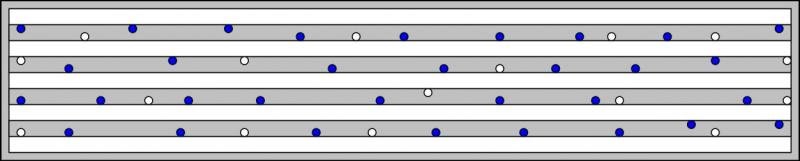
Here was a quick draw up of an idea using no heat sinks. This isn't even close to scale, and the led are just scattered, dimensions are 47"X9"

4 1" strips running the length, space 1" apart and 1" from the edges. Doing this, that would mean each led would need to be 4" or more apart on the strips, but If I offset them from one another it should give good coverage, let me know what you think.
 

Attachments

  • Picture2.jpg
    Picture2.jpg
    25.9 KB · Views: 26
Yup, that would definitely be possible (and desirable, in some cases). It depends really on how much light spill you are OK with vs how much edge-to-edge coverage you really need. Most people don't have corals RIGHT at the glass on all four sides so they're OK with intensity dropping off a LITTLE bit. I like the aluminum channel concept because it provides a bit more flexibility - if you decided you wanted more (or fewer) LEDs down the road you could easily move the bars farther apart or closer together to adjust things accordingly. You can't easily do that if the LEDs are all glued to the same piece of heatsink.


IMHO those temperatures are both totally fine though of course heatsink temperature isn't a pure surrogate for die temp.

That is what I was thinking, have the rectangle shaped frame built out of L aluminum and have the strips run across, both don't attach them just let them sit, so they are easily adjustable. I think though, like you said there isn't much kept up against the glass, so on each strip I think I will start the led 4" or more in off the edge.

I could even build the frame bigger than 9" wide, that way I have even more control over where each led strip goes!

With this fixture being in the open there should be plenty of air flow to keep it cool correct. My tank is in my basement where it stays rather cool 65-70 all the time.

I really appreciate all the help!
 
Okay, so heres what I need

2-48" L shaped aluminum stock
2-10" L shaped aluminum stock
4-48" flat aluminum stock
1-10" flat aluminum stock

All for a total of $32.46

Less than what I was going to pay just for heatsinks!
 
LEDs 4" apart, with the angle stock in free open air, should be fine thermally.

I would absolutely build wider than 9". Though I would also pull the LEDs in closer from the ends of the tank than it looks like you have shown there.

And if you do leave the bars "free" instead of screwing them down, I'd at least restrain them somehow (loose zip ties?) to prevent disaster (a strip falling in the tank). Also, be SURE to provide strain relief on the wiring.
 
Yeah, on the design I Just kinda threw some leds on there lol, I was thinking of starting them atleast 4-6" off the edge. What I could do is make a channel on the the L shaped beam, and drill a hole in each long strip at the ends, run a bolt down through the strip and into the channel I made, that way it can be slide, then tighten down to be held in place.

Not sure how to make the channel, could probably cut it out with a dremel, or I could just drill multiple holes and do it that way.
 
Yeah, on the design I Just kinda threw some leds on there lol, I was thinking of starting them atleast 4-6" off the edge. What I could do is make a channel on the the L shaped beam, and drill a hole in each long strip at the ends, run a bolt down through the strip and into the channel I made, that way it can be slide, then tighten down to be held in place.

That's similar to what I did on my big fixture, it works well. I bet if you bolted two L's so they were "facing" each other, with a suitable gap between them, you could use that for your slot instead of having to make a slot by cutting the metal.
 
That's similar to what I did on my big fixture, it works well. I bet if you bolted two L's so they were "facing" each other, with a suitable gap between them, you could use that for your slot instead of having to make a slot by cutting the metal.

hi der_wille_zur_macht sort of understand this kind of lay out... but does that means the solder part where the wire and Led dont they touches the "L" channel?
 
That's similar to what I did on my big fixture, it works well. I bet if you bolted two L's so they were "facing" each other, with a suitable gap between them, you could use that for your slot instead of having to make a slot by cutting the metal.

That sound likes a much easier solution! Once my frame is together, i'm going to order my leds and two more pieces aluminum stock.
 
Back
Top