Duplex sump concept

I used plastic 80˚ fog nozzles from this place. http://cloudtops.com/misting_systems_misting_nozzles/mistingnozzles.php

Here is a drawing...

MangroveSystem.jpg
 
Ok, nevermind the no substrate question, after some more looking, I can see substrate, I think in the planters. but another question occurred to me... after some googling on the subject of red mangrove care I came across the idea of tying up the propagules w/flexible tape to some type of support so they are suspended, fat end down of course, above the substrate in the water, in order to "train" them to form the "walking" / elevated root system, rather than a standard branching net horizontal roots when they are buried in substrate. Have you ever tried this? If accomplished, that is what I had in mind as the ideal benthic zone surface area expander system - sort of a natural egg-crate, with additional benefits.

Spacey :)

You can slowly raise the plants to expose more wet zone roots to make them "woody" and "leggy". I tried that with a couple plants in this planter and they fell over and dried out. The problem is they are top-heavy and require a significant bracing system... perhaps pantyhose and bamboo stakes :)
 
Your mangrove wall always amazes me, well done.
What do you so to control humidity?

We have a dedicated HRV unit as well as a separate intake and exhaust vent to outside with a fan on each, governed by a temp. & humidity controller. In summer months, it gets pretty humid up here so we don't use the air intake much. The HRV does most of the work. The fish room is usually 35-40% humid.
 
Hello all,

I'm a new member to RC, but I've been around the hobby for a while. I worked in a large LFS for a little over 5
years back in the 90's, and I've had tanks off and on since. So much about reef keeping has changed since then!

My brother-in-law recently gave me his 54 bowfront FOWLR setup. It included about 70 lbs of relatively porous
live rock, an ETSS skimmer, and 2 large tomato clowns. I discarded the course crushed aragonite substrate
and most of the water because it was just easier in transit, and I wanted sand anyway.

The smaller of the two clowns (male?) didn't make it through the move, so it was just the larger one for a few
weeks. During that time, the phosphates were high enough to begin causing unwanted microalgae problems
in the DT (5 ppm) while everything else remained pretty good (Ammonia, Nitrites, Nitrates, pH) I believe the
tank was relatively neglected, that's why he was getting rid of it, and I believe the phosphates were probably
leaching from the LR.

His setup used a 10 gallon tank under the stand for essentially just a place to house the skimmer. I set it up
that way for a few days, but it was very loud, and I got the OK to plumb the filter into the basement, a floor below).
I took this as an opportunity to implement some of the suggestions posted throughout this informative thread. I
bought a 40 gallon tank through craigslist, and went to work.

I created 3 chambers. The first, on the left, is where the drain from the DT enters and is skimmed. The divider
for that first chamber is toothed at the top to maintain a constant water level for consistent skimmer operation.
I originally planned to have the outlet of the skimmer dump directly into the second chamber, but the flows
didn't match, and the water level in the skimmer chamber would drop. I will revisit that idea shortly. The second
chamber is the duplex sump as suggested by this thread. I only have a little bit of LR rubble there for now, so
the lower part intended as a benthic zone is not even close to dark yet, but it will be. The cheato up top has
done a wonderful job of pulling the phosphates from the water. Within two weeks of cheato use, the phosphates
dropped by more than half. The second divider has lots of small holes no lower than the horizontal eggcrate
separator to let water through. It's also toothed at the top, just in case. The last chamber is for the return pump
and any chemical media if needed.

Here is a pic of the sump:

nuMuc.jpg


The canister filter on the left is only in place for polishing. I hope to be able to remove it once the natural polishers
ramp up. I've already seen a few feather dusters on the rubble in the refugium.

Anyway, I wanted to pass along a big thank you to everyone, especially to Mr. Wilson for his
amazing patience and ability to convey his expertise. I hope to be able to contribute more to this community as time
goes on.

Here is a quick pic of the DT. It doesn't look like much now, but only because I'm being patient. I've had the tank for
only about 6 weeks now. I added a small clarkii clown, a small royal gramma, and a lawnmower blenny. My cuc
consists of a nassarius snail, 2 turbo snails, and about a dozen smail blue-leg hermits. I need to work on taking more
flattering pictures of the tank, even though there is not much there, this doesn't do it justice.

4nUFT.jpg
 
I just came across this old picture of the mangrove wall. It really looks like Charlie Brown's Christmas tree :)

IMG_7529.jpg


file-2.jpg
 
this is a fantastic thread!
very informative and thought provoking..
i remember reading the beginning of it way back when and just happened upon it again.
i will be sure to go back and read the pages i missed!
I love the idea of the mangrove wall (or single plant) as an isolated home design feature/point of interest and would consider putting one in a dark spot of my basement, connected to my tank via a long run of pipe.
i am only concerned because i seem to remember reading somewhere that mangrove roots are incredibly strong and may crack glass or split acrylic seams as they expand and grow into a confined space.... does anyone know if there any truth to this??
thanks!
 
First off, great thread, I read this a couple of times. Question; is there a benefit to having each zone separate? I like the idea of having the macro/rubble/benthic in one area not only for space reasons but makes sense to help the beneficial organisms. If separate is ideal then how deep would the benthic be, is deeper better?
 
I enjoy learning new things in our hobby and finding great threads such as this one puts a smile on my face:)
Although most of my sump is finished and close to start up after reading i will make some changes and feel better about the type of system i built.
Thanks to all +1 Mr Wilson!

Few pics before changes:
IMG_0313.jpg

IMG_0285.jpg

IMG_0284.jpg

IMG_0283.jpg

IMG
 
:eek2:
wow wow!
colour matched right down to the ties! wild!!
very interesting. i didn't even know all that plumbing came it those colours..
could you share your motivation for all of the design elements in that sump?
i would like to know what the individual boxes are for and why there are the flat perforated plate sections on top..
thanks!
 
I enjoy learning new things in our hobby and finding great threads such as this one puts a smile on my face:)
Although most of my sump is finished and close to start up after reading i will make some changes and feel better about the type of system i built.
Thanks to all +1 Mr Wilson!

Few pics before changes:
IMG_0313.jpg

IMG_0285.jpg

IMG_0284.jpg

IMG_0283.jpg

http://i1187.photobucket.com/albums/z383/RipTide54/IMG_0333.jpg[/IMG[/QUOTE]

You get the Lego prize for that sump :thumbsup:
 
First off, great thread, I read this a couple of times. Question; is there a benefit to having each zone separate? I like the idea of having the macro/rubble/benthic in one area not only for space reasons but makes sense to help the beneficial organisms. If separate is ideal then how deep would the benthic be, is deeper better?

I coined the term "Duplex sump" for just that reason. When real estate is tight, you need to go vertical. Algae grows best in a shallow zone, so it works out well as a top layer. The upper algae section shades the lower benthic zone. You just need to make sure you don't end up with detritus from the algae down below. You can go as deep as you have room for. I have used 55 gallon drums with good results. It also adds extra water volume to your system.
 
:eek2:
wow wow!
colour matched right down to the ties! wild!!
very interesting. i didn't even know all that plumbing came it those colours..
could you share your motivation for all of the design elements in that sump?
i would like to know what the individual boxes are for and why there are the flat perforated plate sections on top..
thanks!

The boxe's are a combo pump stand, ATS(algae turf scrubber), and low light area for some filter feeders. All the color gate valves run different reactors that match in color.
My sump will have all real live rock while my DT will have all dry rock that way i can grow all kinds of stuff on my sump rock that i don't wish to have grow out in the main tank. My sump lighting will come from a window at one end of the sump so i can have a natural filter area with natural lighting. Thats the plan anyway:) I still have alot of egg crate that goes under live rock for filter feeder grow out areas around 12 sq. ft. once running.

Thank you for the kind words!
 
Pics. of my Duplex "Fuge"

Pics. of my Duplex "Fuge"

Been following this Thread since before I designed my new system, and did incorporate this design into my build. My system consists of a 210g in wall DT, with 2 stand alone 40g sumps and a stand alone 70g Refugium. If you would like to follow the system build you can find it at:

http://www.reefcentral.com/forums/showthread.php?t=2137506

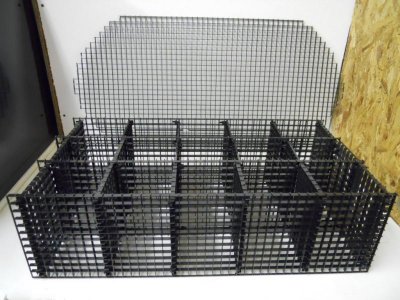
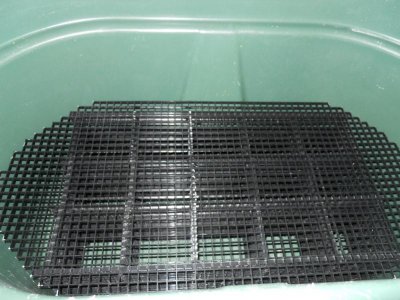
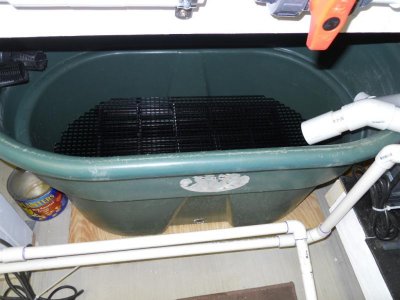
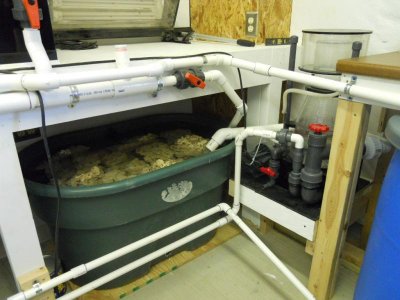
but today I would like to show ya'll my Duplex Refugium set-up. I used a 70g. stock tank and plumbed it to the system using (2) 2" PVC flow through drains to the return sump. I have also plumbed a 1" overflow drain to the return sump from the "Fuge". Flow is provided by 600gph branch off the return pump and 600gph effluent return from the skimmer. I have used 20#'s of dry rock rubble and 20#'s of live rock rubble to help seed the system. The benthic structure is 8" tall, the rock tray that sits on the benthic structure will support about another 8" of live rock rubble and nano size rocks, leaving about 8" of surface space for Macro Alge. I will use a 2' compact florescent fixture for light. controlled by my Reef Keeper controller, running a 16 hr. light period. 1200gph should provide enough flow to minimize build up of dietrus in the benthic zone. I have included pictures of the components and the Refugium installed in the system. The system is currently cycling giving me time to catch up with my fellow Reefsters. If you've got comments, let me know..............................Budster:bum:

DSCN0213.jpg

DSCN0215.jpg

DSCN0214.jpg

008.jpg
 
What a great thread! Hoping to keep it alive, as I finalize plans for my new 600G system. Currently have a 150G display with another 100 in a 2-tank sump, 56G refugium, 20FG xenia tank and 90G frag tank. Lots of neat life across all of these tanks (lit or unlit), which to me has value well beyond their cleaning/filtering capacity. It actually pains me to drain my first sump during water changes, which exposes to air so many of the sponges stuck to the walls. Being a resident of Burlington and having gotten to know Mr. Wilson, I have to say he's got to be the most knowledgeable and forthcoming reefer I know.

Andrew
 
mr Wilson as always your a wealth of knowledge

I have been following for some time and have put in place some of the ideas you talk about and I see them implemented in nineballs tank as well, this is going to be a experience for me as I am a old school reefer since the late 80's and I am finally moving into the 21st century but not leaving behind what I know and all but adding new tech to my design now

I am glad capn put all these threads together to make it easier to read and gain the wisdom that you have
 
Lots of food for thought here, and ties in with a new study linking sponge poop to reef fertility. I was wondering how far these lil benthic beasties grow away from the eggcrate theye attached to? Im wondering how close plates of eggcrate can be placed to one another before they'd start to overlap. Has anyone noticed any difference in growth rate or what types of organisms attach to the eggcrate thats submerged vertically vs. Horizonally? I was reading that some sponges prefer a vertical substrate to attach to but that may only be if there lots of sedimentation going on.
 
Back
Top