
Dying Anthias

MammoDoc

New member
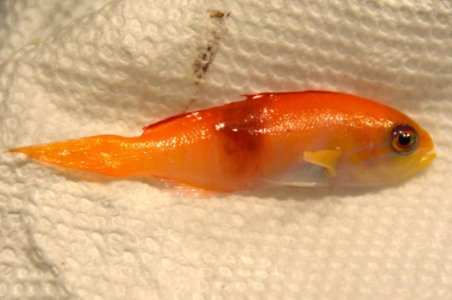
Hi All. I'm looking for some help to identify what killed 5 of 6 Ignitus Anthias that I received from LA 1 week ago. Please see the attachment. The 6 small Anthias went into a cycled 40 gallon QT together with a linespot flasher wrasse and a Hooded wrasse. 1 of the Anthias arrived with a small hemorrhagic spot on its side but all of the others initially looked good. Slowly, 1 by 1, they all developed the same pattern of hemorrhage and died. My 1 remaining Anthias had a small hemorrhagic spot but it has resolved. The only remaining Anthias was the only one that really ate well. I treated with ParaGuard thinking it might be bacterial, and I treated with PraziPro to deworm them. Ammonia remained 0.

The 2 wrasses are fine and showing no signs of disease. Do you think this is septicemia from a bacterial infection? Uronema? Any help would be appreciated regarding further treatment of the remaining Anthias, if any now that it seems a little better. I would like to try another batch of Anthias - would you bleach the QT tank?

Thanks
 

Attachments

  • DSC_3514_edited-1.jpg
    DSC_3514_edited-1.jpg
    46.3 KB · Views: 5
thanks for the threads guys.. I'm going to wait awhile before ordering anthias from LA.. almost placed an order. Have you guys contacted them regarding this possible issue?
 
I called them and told them of the deaths, and was promptly credited for them, but it may be worth a call to inform them of this trend. I don't know if they can contact the wholesaler regarding this? I want to place another order sooner than later given that it is getting colder, but I'm nervous.
 
LA sources their livestock from Quality Marine. In addition to informing LA, it might be worth dropping the QM folks an email for good measure.
 
It seems Quality Marine has a bad Uronema outbreak in their fish system.
I guess I better isolate the 2 pipefish I'm getting from them via LA on Tuesday...
 
Well I called LA. The person on the phone was very polite, but, as I suspected, didn't really seem to grasp what I was saying. I asked if there was someone who was more experienced with fish husbandry, but she said no. She did say that she would hand this off to someone and they would get back to me, so hopefully we can inform Quality Marine of the problem. I'll email them too.

My 1 surviving Anthias looks better with almost complete resolution of the hemorrhagic spot. It looks lonely in the QT tank all alone. I guess I'll just watch it and see how it does. Being alone may stress it more?
 
I had purchased 3 Waitei Anthias from LA like 2 months ago that had Uronema. I had performed the TTM on them initially, but the disease showed its ugly head a few days after they were in my QT. All three perished within 72 hours, even with dosing Metro.
 
Spoke to someone in Quality Control at Quality Marine today. He said that they sometimes see an increase in Uronema when the seasons change from warm to cold or cold to warm. He said they saw what they thought was a transient increase in Uronema in their lyretails a few weeks ago. I think they ship fish that look good in their system but the act of shipping may make the fish more susceptible to the Uronema. Was hoping to get more Anthias this week, but may be prudent to wait a few weeks.
 
Spoke to someone in Quality Control at Quality Marine today. He said that they sometimes see an increase in Uronema when the seasons change from warm to cold or cold to warm. He said they saw what they thought was a transient increase in Uronema in their lyretails a few weeks ago. I think they ship fish that look good in their system but the act of shipping may make the fish more susceptible to the Uronema. Was hoping to get more Anthias this week, but may be prudent to wait a few weeks.

Thanks for sharing! I was thinking to order a bunch of lyretails, as they are on a really good sale now.

Did the QM person mention how they clean their system out, or is it prudent to expect all QM fish to be uronema carriers for near future?
 
I think fish like Chromis and Anthias and other small fish from the outer reef zone require higher oxygen levels and cleaner water and are therefore more prone to be negatively affected by shipping than fish from the inner reefs and lagoon areas where water can be stagnant at times.

It also seems smaller fish are more affected than large. This is likely because they are packed into relatively smaller bags than larger fish.
 
I didn't ask him how they clean their system -- didn't want to get pushy :fun2:. He said they don't prophylactically treat their fish, they observe and treat if necessary.

I'd also like to take advantage of their sale, and they have no problem crediting for lost fish, but the anguish of losing fish is no fun.
 
does anyone know if Bluezoo order from QM??? I planned to order some anthias.. but seems like I should wait..
 
Bluezoo is close enough for me to local pick up. I guess I could check on these Uronema issues.
 
Spoke to someone in Quality Control at Quality Marine today. He said that they sometimes see an increase in Uronema when the seasons change from warm to cold or cold to warm.

Interesting. I talked to Kevin Kohen (Directory of LiveAquaria) about Uronema at last year's MACNA and he stated the same thing.
 
I have seen other threads on this same-thing all of a sudden lately and I dont believe they are all from live Aquaria.
 
Interesting. I talked to Kevin Kohen (Directory of LiveAquaria) about Uronema at last year's MACNA and he stated the same thing.

This is interesting. Did he share any details, i.e., is shipping stress worse? Parasites bloom in collection waters? Different counties exporting fish? Rapid temp swings from electric heaters stressful?
 
Back
Top