
Effluent with Phosphate reading 2.0

melev

Well-known member
Hi Randy,

I've been asked why PO4 is such an issue in my tank, and it was suggested I test the effluent.

Tank: .5 (nice drop for 24 hours)
Effluent: 2.0 (assuming the test is accurate with higher alk and lower pH)

Assuming the test is reading accurately even though pH is lower and alkalinity is higher in the effluent gathered in a cup.... (Visible below)
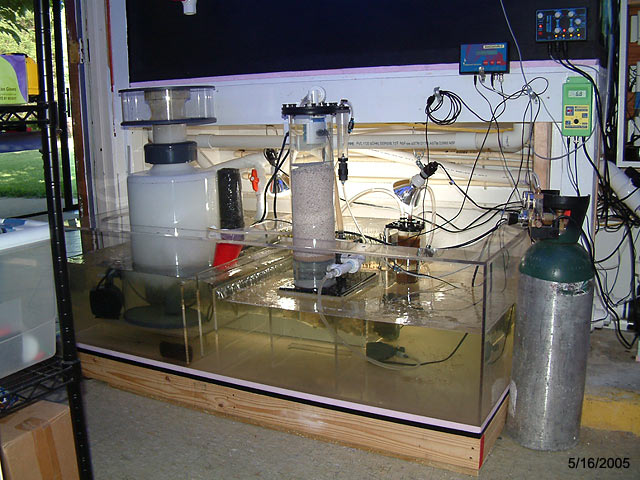
my_sump1.jpg


Now here's what I'm thinking. I have a nice tube that reef putty comes in (Two Little Fishies for mounting frags). Why not fill that up with some type of media and let the effluent drip through that and into my 'beer cup' that measures effluent (for the CO2 solenoid).

I don't like aluminum-based phosphate removers like Kent's Phosphate Sponge because it really affects leathers badly, but I don't know that it would be a problem using it in this way versus a typical canister filter.

What would you suggest? I remember reading a thread about a month ago about how one person took ARM and put it in RO/DI water to soak for a week, then rinsed it well before using it to remove PO4 for the media. Which is better? Starting anew or removing it from the effluent as it drips out?
 
Okay, while waiting on RHF to reply to my thread, I decided to pursue my idea for now.

I took the tube that the reef putty came in, and drilled a bunch of tiny holes near the sealed end. I used the smallest drill bit I owned, and drilled about 15 or more holes around the perimeter.

Next I took some filterfloss batting, and rolled it up until it was thick enough to fill the inside diameter nicely without being incredibly dense. This was pushed down the tube to the base with a wooden spoon handle.

I added about 3 heaping teaspoons of Pura PHOSlock, then poured RO water through it until the water come out of the tiny holes completely clear.

Here was my cup before I started. The effluent drips into this cup 24 hours a day, and a pH controller probe measures the value. As necessary, the controller opens the valve to add CO2 to the Calcium Reactor, then shuts it off again when appropriate.

beercup_effluent.jpg


Here is the modification in place.

po4_mod4.jpg


From another angle.
po4_mod1.jpg


Here you can see the effluent dripping off the base, into the cup.
po4_mod3.jpg


Since the effluent drips into the tube, I don't see it having a problem exiting with plenty of time.
po4_mod4.jpg


(10 minutes later....)

Before posting this message, I decided to double check on my mini phosphate filter. It isn't draining quite as quickly as necessary, since the cup is full of effluent now.

However, I tested the effluent for PO4 and it is 0! :D :bounce1:
 
I think the question is that will the low PH in the effluent break down the PO4 removal media into something that could potentially harm the tank?
 
Habib has suggested that phosphate kits often give inaccurate results at very high alkalinity. I think he suggested an upper limit of 18 dKH for his (IIRC). If your effluent is higher than that, try diluting it first.

It may still be significantly elevated, however.

In generral, I would not prefer to pass the effluent itself over a binder as the low pH may accelerate dissolution of the binders, in many cases.
 
Since the first test showed PO4 and the subsequent one showed none, I imagine that it is an accurate reading.

I'll go check the alkalinity of the effluent. Thanks for the response. I was sitting here waiting in line for your reply. :D
 
I was also very interested in Both questions.

Randy have you heard of Biophos? Were there be any advantage of passing the effuent over this media verse a iron base phosphate binder?
 
Since the first test showed PO4 and the subsequent one showed none, I imagine that it is an accurate reading.

Well, I'd assume it indicates that there is substantial phosphate, but perhaps not correctly how much. :)
 
The alkalinity tested 14.7 dKH, under Habib's limit. :D

I know I could use Kent's Phosphate Sponge instead, but... :(

So let's say I stay with this process for a while. What indicators do I want to watch for? My goal of course is 0 phosphate. Would the media do something negative, which is why you are recommending against it?

You don't run a Calcium Reactor, so I suppose you can't do any kind of test to establish this one way or the other with any degree of certainty. Correct?
 
Randy Holmes-Farley said:
In generral, I would not prefer to pass the effluent itself over a binder as the low pH may accelerate dissolution of the binders, in many cases.
What are the ill-effects of this? Also, if the media in the MelevTube ( :D ) was changed out weekly rather than the standard monthly?
 
Dissolution means it no longer absorbs phosphate, correct? So testing the effluent for PO4 weekly would determine if it is working or not, especially if the effluent was diluted the proper amount to get an accurate set of results, I think.

I was reading another thread where Habib talked about testing for PO4, but I think it was in Kalk and not Calcium effluent. It would be good if our scientific leaders could give us a definitive answer or guideline to follow.

Tossing out the ARM and replacing it with new media is another option. I found a post an hour ago abut soaking the media in RO/DI water for a week, stirring it occasionally and changing out the water twice will result in 'safe' media.
 
What are the ill-effects of this?

That depends on what impurities may be in the binders, but low pH may accelerate release of iron, and impurities such as zinc. I've become concerned enough about this issue even for normal use that I may test some commercial samples before too long.
 
:lol:

I think not. :D

Dissolution means it no longer absorbs phosphate, correct? So testing the effluent for PO4 weekly would determine if it is working or not, especially if the effluent was diluted the proper amount to get an accurate set of results, I think.

If 1% of it dissolved, that is a lot of metal added to the water, but no sigificant impact on phosphate binding capacity.
 
You know how long I've been trying to conquer the tank's PO4 level. To think it has been coming out of my Ca Reactor all this time is extremely unsettling. I've reduced feeding, reduced bioload, skim hard, and grow macro algae like its a contest. And my numbers never go away.

If this is a source, we need a workable solution.
 
Randy Holmes-Farley said:
If 1% of it dissolved, that is a lot of metal added to the water, but no sigificant impact on phosphate binding capacity.

Iron is good for macro algae, and Kent sells it by the bottle. Maybe this tiny amount will be a boon to my tank.

"Hobbyist is determined to convince scientist that he's right. News at 11."


:rolleyes:
 
I am almost scare to say, but I think for the first time in history I may be one ahead of you on this one Mark :lol: :lol: :lol:

About ayear ago, I saw someone post something similar and they had a little reactor built for it. Basicaly it holds the pH probe in it and it also has some PO4 absorbing media in it too for the same reasons. I can't take credit for the idea, but I'll take credit for showing it to you as I have one also. Given you are so handy with acrylic, maybe you should build me a dual one so I can use one for the Ca reactor effluent and the other chamber for te kalk reactor (just for testing pH).:lol: ;) :lol:

effluent-reactor.jpg


By the way, I know that Randy does not recommend running the low pH water over the PO4 absorbers, but I've never had issues from doing so. When I run only kalk, my PO4 tends to cake in over time, but this one never do due to the low pH of the effluent. I know several people using this method without problems either. PO4 is high in the effluent with ALL media, so it only makes sense to me.
 
Cool! Now explain how it works to me. Where's the pH probe? What media are you using to remove PO4?

Let's see if Randy chews you out. He's being nice so far, but the day is young. ;)
 
Could you post that any more vaguely? :lol: We want specifics. What's your poison of choice?
 
Dang, you mean the media in the Ca Reactor and not in my effluent tube? Okay, which media do you recommend? According to an article you wrote that I saw mentioned a few hours ago, your tests indicated that ARM was the least problematic media.
 
Back
Top