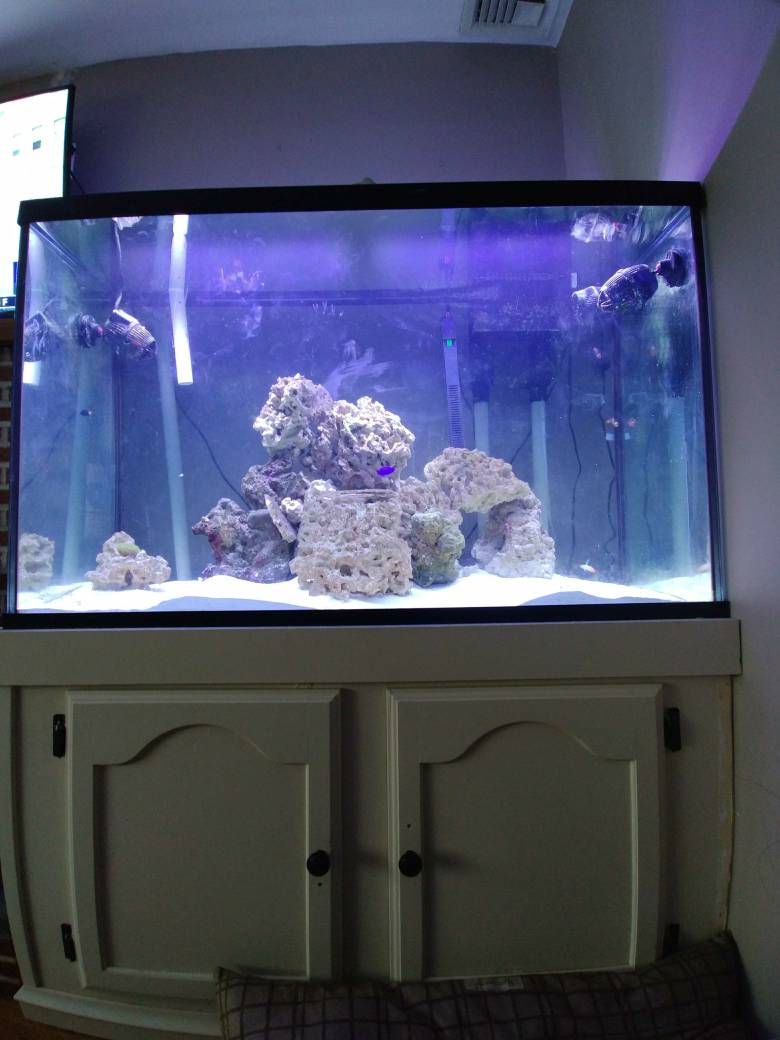
I'm about to write some really long advice that you probably know already but just in case you didn't

The first thing you need to do is cycle the tank. Ammonia, which is toxic to fish and corals, comes from organic waste like food, poop, dead things etc. In order to control this ammonia, you need to have beneficial bacteria in the tank. The live rock and sand you purchased should come with some bacteria, but it is important that they colonize in your tank. This is what cycling is for, it allows the bacteria to perform the full nitrogen cycle, which usually takes about a month.
Like i said earlier, ammonia comes from decaying organic matter, and if you have a test kit, should be undetectable (should show up as 0ppm). Then, bacteria convert this ammonia into a less toxic nitrite. Your nitrite levels should also be undetectable at under 0 ppm. Nitrite is also very toxic to fish but not as harmful as ammonia. Next, the bacteria convert nitrite into nitrate. Nitrate is not as harmful as ammonia and nitrite, and the amount in your water can vary, but in most cases should never go above 30
ppm. In order to prevent the nitrate from building up, you need to perform water changes
.
In the tank setup you have now i recommend doing a water change once a week or at least once every two weeks. I would do from 10% to 20%. When doing a water change, it is very important to siphon your sand as well, which is where most of the detritus builds up. It is also important to make sure that the new water you are adding has the same temperature, salinity, and ph as your tank water to prevent shock to your fish.
In a saltwater tank, there are many other substances you need to test for other than nitrite ammonia and nitrate. One is ph. ph is a measure of how alkaline or acidic something is. You want to keep your ph at around 8.2 or 8.3 in a reef tank. Another is your salinity or how salty your water is. When water evaporates from your tank, it leaves the salt behind making your water saltier and saltier. You need to balance out the evaporation by periodically adding freshwater. You can measure the salinity of water by using a hydrometer or a refractometer. Another substance you need to monitor is the phosphate. The phosphate is the measure of how much phosphorus is in your water. Phosphates can come from uneaten food, dying algae etc. You can remove it by doing water changes.
In a reef tank with corals, there are even more things you need to monitor. Calcium is an element essential to coral growth. Corals build their hard skeleton out of calcium in the water, so it is very important that there is adequate calcium in the water. It should be around 380- 450 ppm depending on the types of corals you have. With basic test kits, many of the other elements important to coral can't be tested for, but you can with an advanced test kit. Magnesium, Zinc, and vitamins just to name a few. The way i dose my elements is i use calcification by seachem to up my calcium, reef foundation abc+ to keep up my magnesium, and i use fuel by seachem to keep up my smaller trace elements.
ALRIGHT NOW FOR WHAT I THINK ABOUT YOUR SETUP!!!
)
When cycling a tank, i find it inhumane to cycle with fish. In cycling, ammonia, nitrite and nitrate go up to dangerous levels that can stress or even kill the fish. I would also add a little more live rock to add enough bacteria to complete the nitrogen cycle. That's about it! Your setup looks pretty good!
Good luck with everything