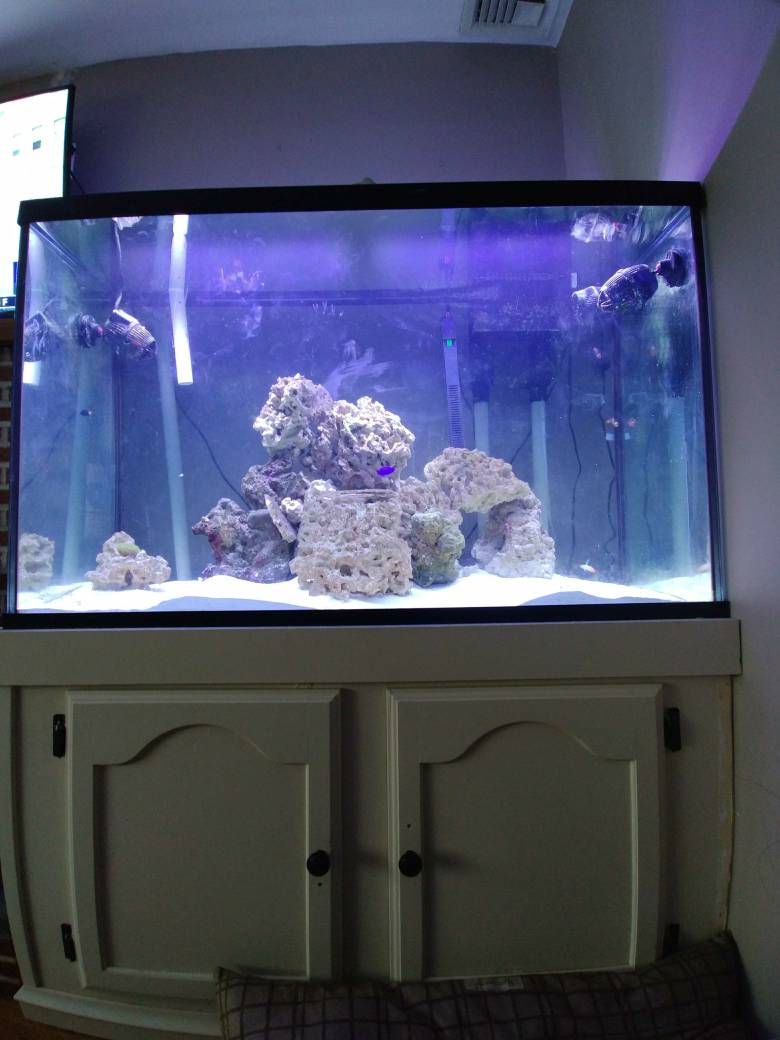
first Salt Tank.

FishHarder

New member
Hey everyone. New to Salt water. Got a 60 gallon for a steal. Started it up with live rock and love sand. I was told to start with 2 small clowns. A local place has me using them to help kick start the tank. I put a 800 power head in. And 40 lbs of live rock and Large bio wheel.

I was told that is all I need. No protein skimmer if I stick to changing water. I have a 4 stage RODI filter. Any recommendations. On things I may have missed or should look into ? I want to eventually make this a reef tank and later make a larger tank. So I want to make sure I do this right
074092110edb2a86f6203645de1f4f1a.jpg


Sent from my ASUS_Z01FD using Tapatalk
 
I really hate to see anyone cycling a tank with live fish and I think you are getting poor advice from your local fish store. I would strongly recommend reading the stickies "Newbies starting a new tank, read here!" at the top of this forum. There is a lot of information to absorb there but it is all important to know to prevent you from starting off on the wrong foot. Subjecting fish to ammonia poisoning is cruel and complete unnecessary. I would recommend taking the clown fish back to your LFS and having them hold the fish until the cycle is complete and then add an ammonia source in the form of pure ammonia without perfumes or surfactants of simply a couple of dead raw shrimp. It also looks like you are likely a little light on the amount of rock you have in the tank; you should have close to 60 rounds of rock.
 
I really hate to see anyone cycling a tank with live fish and I think you are getting poor advice from your local fish store. I would strongly recommend reading the stickies "Newbies starting a new tank, read here!" at the top of this forum. There is a lot of information to absorb there but it is all important to know to prevent you from starting off on the wrong foot. Subjecting fish to ammonia poisoning is cruel and complete unnecessary. I would recommend taking the clown fish back to your LFS and having them hold the fish until the cycle is complete and then add an ammonia source in the form of pure ammonia without perfumes or surfactants of simply a couple of dead raw shrimp. It also looks like you are likely a little light on the amount of rock you have in the tank; you should have close to 60 rounds of rock.

Agreed.

I'd also highly recommend a skimmer, more live rock, and a sump. Ditch the HOB filter.
 
Same as the other 2.
In my opinion:
Take the fish back, trade them for something. If you subject them to ammonia they will be weak and prone to disease. If you really want a reef tank you should start with beginner corals and no fish. The less you have to feed, the less waste to process. Less headaches with algae. Let the tank get a bit more stable then in a few months, add a few fish.
 
Same as everyone else. You can actually do a fishless cycle by adding your own source of ammonia. Since you already have them in there just make sure that you test you water for any chloramine from your RO/DI. Won't hurt adding prime to make the ammonia less toxic. I personally wouldn't add anything else in there until you get 0ppm readings on ammonia.

Also test you tank water daily for ammonia as well. If you didn't use Prime then get some and add the necessary level to your tank water to prevent killing those poor fish.

ABSOLUTELY gonna want a skimmer unless you are going to be a water changing machine, lol.
 
Wow. I was given the run around that a lb per gallon of rock was the "old" way and with all the new products, the way you start a tank was different and easier. This angers me, because if you wanted a continuing customer then quality information would have been what brought me back to only purchase from them. I'm glad a friend sent me to this forum. Really appreciate the advice and help.

Sent from my ASUS_Z01FD using Tapatalk
 
Old way, new way doesn't make sense to me. Yes there are certainly advances in this hobby, but you will be shocked that all of those advances aren't truly necessary. Some of the simplest setups are the once that are the most successful setups.

I help a friend of mine with his LFS at times and when he has customers there, we will not sell them something that we know for a fact will give them headaches. If they still want it, we try to give them info that will help them be successful with what they are purchasing.

As far as live rock, you can add as much or as little as you want depending on your ultimate goal of YOUR setup. Every single aquarium is different and no two are alike; unless you only have water in them and then they still can be different, lol.
 
A suggestion is to go through the build threads to get a feel for what you want to ultimately accomplish. You will get some great ideas from there. You may actually find someone that has a similar sized aquarium that you can kinda mimic to an extent.
 
You can definitely go without a skimmer and a sump. 40 lbs of live rock is plenty to take care of your ammonia breakdown needs. I’d add more just so it looks better. If the live rock you place in there is actually good established live rock you probably won’t get much of a cycle. If it were me in your situation I would buy one of the bottled cycling products that are available and feed lightly for a few weeks while your tank settles in. Just test you’re water often. And if you don’t have a cover on the tank definitely get one.
 
Fish,
As you can see, advice abounds with all extremes.

I operate many growout tanks with everything in your new build with the exception of the rock. I use less rock and rely on sandbed for biofiltration. Pound for pound, substrate has 100 fold more surface area for bacteria to colonize. In display tanks, quality live rock can bring in diversity to seed sandbed with micro fauna and fana. Rock in display tanks allow inhabitants of tank to act more naturally. For me, my aquascaping agrees with how you shaped your tank, good circulation with open spaces for fish to dither.
 
Not to beat a dead horse but as a relative noob myself, here’s what my LFS told me:

“Even if they survive, the ammonia will permanently scar the fishes lungs and they will always have a harder time breathing, kind of like a kid with asthma.”

That was simple and easy for me to understand and relate to. Just enough to help me be patient (hard, hard!) and wait till Ammonia truly was at 0.
 
If you really want all the ins and outs, you might want to look up the 52 week tank setup of the BRS 160 on YouTube. They cover each topic enough to get you started asking the right questions. I found them really helpful. Our first tank is doing well and I'm grateful the videos exist. I still refer back to them sometimes.

Sent from my SM-G950U using Tapatalk
 
Agreed with others. Live rock I would add some more. That will be enough to cycle you up. If the rock had no die off during transportation or was already cured in the LFS, then you may not see much of a cycle. Return the clowns for sure, or find someone in your local forum (can be found in reef club forums) who may want them. I would not want them back in a LFS that gave you that advice, thats for sure. Poor guys are struggling in ammonia water.
 
FishHarder
First piece of advice: take information that is given in forums with a grain of salt. There are a lot of people who post without reading or looking at the given information. I am not saying that this isn't an amazing resource for novice to experts.

Second Old vs. New "rules": The old rules were basically a guide, in the old days before the "net" people got information from books so there was no back and forth communication like these forums and these "rules" were the easiest way to point people in the right direction. Some "rules/guidelines" were "watts/gal, lbs./gal, water changes & percentages". The new "rules" (too me) have more to do with the technology & tinkering. An example is LED lighting, you could read for days about which is better. Personally haven't tried ALL of them but have kept anemones under Compact Fluorescents,T5, MH, & now LED's. IMO rules are meant to be broken, do what works best for you and your situation.

Your tank looks like your LFS got you into the hobby without spending tons of money(pretty nice if you ask me) Do you need 1000$ lights or a 200-500$ skimmer? NO. Can you start a new tank with fish? YES, personally I use a beneficial bacteria in a bottle to seed filter & dry rock. You can also keep a bottle of Seachem PRIME around if ammonia climbs to high. Do you need a sump and skimmer? NO, you could always just upgrade to a large Canister filter. I love large canister filters, they are super easy to take care of, replacement parts are everywhere and of low cost, and they are often overlooked and people sell used ones very cheap.

Last piece of advice we (everyone here on Reefcentral) have a budget. Some big some small. Some people spend on their tank what others would pay for a car. Personally I would rather more of my budget go to fish or a coral than some fancy light that can do lighting strikes or some latest greatest skimmer.

I like your tank, and all new tanks look empty and huge until you start stocking them and then like everyone on Reef Central you will wish you had more room.
 
I'm about to write some really long advice that you probably know already but just in case you didn't :)


The first thing you need to do is cycle the tank. Ammonia, which is toxic to fish and corals, comes from organic waste like food, poop, dead things etc. In order to control this ammonia, you need to have beneficial bacteria in the tank. The live rock and sand you purchased should come with some bacteria, but it is important that they colonize in your tank. This is what cycling is for, it allows the bacteria to perform the full nitrogen cycle, which usually takes about a month.

Like i said earlier, ammonia comes from decaying organic matter, and if you have a test kit, should be undetectable (should show up as 0ppm). Then, bacteria convert this ammonia into a less toxic nitrite. Your nitrite levels should also be undetectable at under 0 ppm. Nitrite is also very toxic to fish but not as harmful as ammonia. Next, the bacteria convert nitrite into nitrate. Nitrate is not as harmful as ammonia and nitrite, and the amount in your water can vary, but in most cases should never go above 30
ppm. In order to prevent the nitrate from building up, you need to perform water changes
.

In the tank setup you have now i recommend doing a water change once a week or at least once every two weeks. I would do from 10% to 20%. When doing a water change, it is very important to siphon your sand as well, which is where most of the detritus builds up. It is also important to make sure that the new water you are adding has the same temperature, salinity, and ph as your tank water to prevent shock to your fish.

In a saltwater tank, there are many other substances you need to test for other than nitrite ammonia and nitrate. One is ph. ph is a measure of how alkaline or acidic something is. You want to keep your ph at around 8.2 or 8.3 in a reef tank. Another is your salinity or how salty your water is. When water evaporates from your tank, it leaves the salt behind making your water saltier and saltier. You need to balance out the evaporation by periodically adding freshwater. You can measure the salinity of water by using a hydrometer or a refractometer. Another substance you need to monitor is the phosphate. The phosphate is the measure of how much phosphorus is in your water. Phosphates can come from uneaten food, dying algae etc. You can remove it by doing water changes.

In a reef tank with corals, there are even more things you need to monitor. Calcium is an element essential to coral growth. Corals build their hard skeleton out of calcium in the water, so it is very important that there is adequate calcium in the water. It should be around 380- 450 ppm depending on the types of corals you have. With basic test kits, many of the other elements important to coral can't be tested for, but you can with an advanced test kit. Magnesium, Zinc, and vitamins just to name a few. The way i dose my elements is i use calcification by seachem to up my calcium, reef foundation abc+ to keep up my magnesium, and i use fuel by seachem to keep up my smaller trace elements.


ALRIGHT NOW FOR WHAT I THINK ABOUT YOUR SETUP!!! :))


When cycling a tank, i find it inhumane to cycle with fish. In cycling, ammonia, nitrite and nitrate go up to dangerous levels that can stress or even kill the fish. I would also add a little more live rock to add enough bacteria to complete the nitrogen cycle. That's about it! Your setup looks pretty good!

Good luck with everything :)

 
Took in everything you all said and had removed fish until it cycled. My tank ended up leaking all over from the bottom. Marineland papered me up $$ Awesome customer service. Ended up upgrading to a 110. And I believe my brain hurts from the amount of learning I have been doing. Yous are a huge help in here.

I have 100lb of rock in there now. And adding another 40 cured Key Largo rock. I have diatom bloom on my rock and much has a deep red algea on it now. I built a sump from a 40 gallon breeder. Installed a skimmer AquaC180. Cheato and some copepods and wave machine. Craigslist sure saved my pocket.

I put live rock in the refugium and was going to add some more. For Copepods to live in. Is this bad idea? Also is it ok I'm getting a green algea on the refugium live rock?
8c9868bbd9888987d06e64299129abff.jpg
5b762e81104ef635926306fcd949fc38.jpg


Sent from my LG-H872 using Tapatalk
 
Wow! What a complete turn around, great job! You obviously have been doing a lot of researching here on RC.

Just a couple things I noticed: the connection from the skimmer collection cup to the container won't work since it goes higher than the top of the cup. In order to go through the tube, the waste would be overflowing the collection cup. I run the same skimmer (its great btw) and just cap the port on the cup, remove and clean the cup when necesaary Another is just a personal preference, but I suggest a black background for the tank, it's an eyesore to see the pipes and wires through the tank.

More rock for the fuge is a great idea, and the green algae isn't a problem, just part of the process. You run the fuge light on an alternate cycle to the display right?
 
Thank you. My brain hurts from all the reading. I actually a plan on painting the back of tank. Just waiting for weather to change to keep Windows open. Glad you pointed out the skimmer hose. Never would have known.

So are you saying to run my fuge light on a timer and not around the clock? What I read was to keep it on. A 30 bar light is good right? Was afraid the brown spots on cheato was it being burnt. Also is it save to just wash of the cured clean rock and add it to this tank. Or do I need to make it live in a trash can for a few months before adding it. ? Someone said it might cause a miny cycle

Sent from my LG-H872 using Tapatalk
 
Hey everyone. New to Salt water. Got a 60 gallon for a steal. Started it up with live rock and love sand. I was told to start with 2 small clowns. A local place has me using them to help kick start the tank. I put a 800 power head in. And 40 lbs of live rock and Large bio wheel.

I was told that is all I need. No protein skimmer if I stick to changing water. I have a 4 stage RODI filter. Any recommendations. On things I may have missed or should look into ? I want to eventually make this a reef tank and later make a larger tank. So I want to make sure I do this right
074092110edb2a86f6203645de1f4f1a.jpg


Sent from my ASUS_Z01FD using Tapatalk

My big question: Did you fill the tank with tapwater, or did you fill it with RODI water from your RODI filter?
 
Back
Top