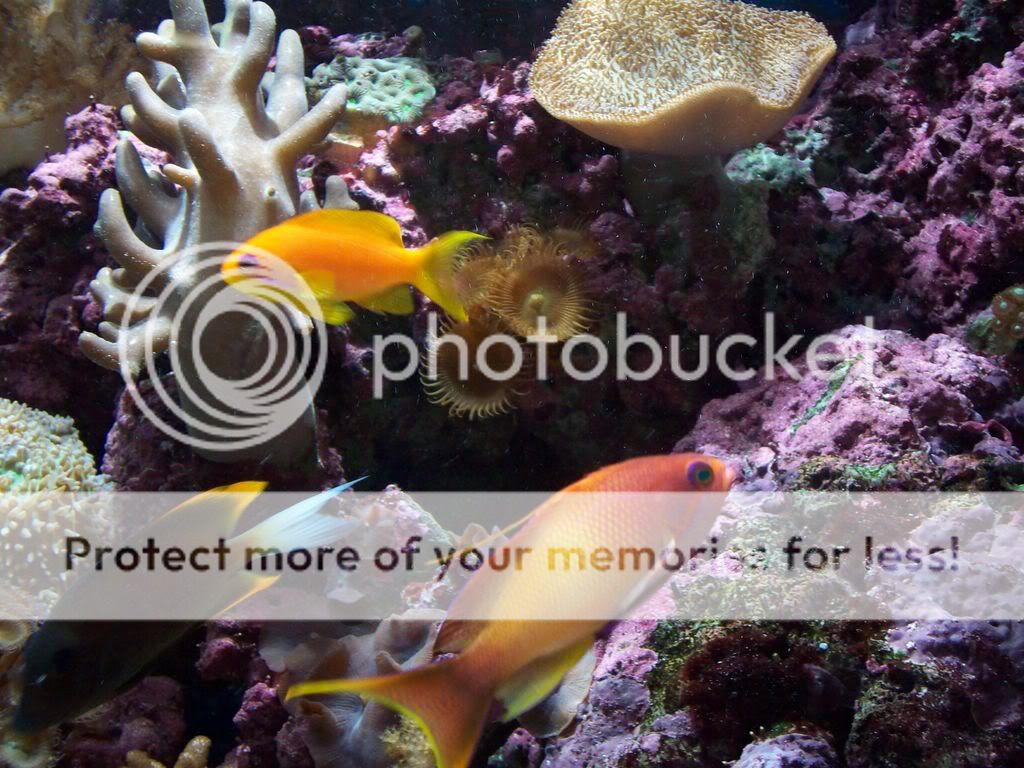
For those who keep anthias . . .

snorvich

Team RC member
Team RC
Which species would you recommend? I can easily feed multiple times per day, but don't want them all to become male and wipe themselves out. I was thinking of 5-8 in a reasonably sized tank? Open to suggestions as I have no experience with them. Thanks in advance! :beer:
 
Bartletts are the easiest, next are lyretails. Dispars, ignitus, and a few others are a bit more work, and tend to have some losses at first.
 
Steve, I got 5 Resplendent Anthias from BZ a few months ago. I QT'd them in copper and prazi and they have all survived! I never even acclimated them from QT to the display, i just dropped them right in! They show no aggression like the bartletts and dont get as big as the lyretails. They show some incredible colors as well. I have never seen a picture of their true representation. They are now by far my favorite anthias. They spend quite a bit of time together too! If i got more anthias, they would definitly be the resplendents!!!
 
I've kept several species, with varying success. I really like Bartletts. I had a big herd when I was keeping a 240 reef and still have a trio left in my smaller reef. Most of the others found a good home. You said you can feed several times a day; I think this is vital, not just a "do it if you can" thing. Some Cyclop-eeze a few times a week seems to really help them.
 
+1 on the Resplendent Anthias, I have different types of antias in my 240, and they stand out in their calmness as they are together all day with zero aggression between them, they were also one of the easiest to begin to eat pellets, i like their color too even though some of my others are more striking in my eyes like the bartletts or evansi.
 
Thanks everyone. Will a group have male/female issues? It seems to be difficult to get a guaranteed male and guaranteed female. I like the look of Bartletts but can one mix species (remember I am new to anthias so these questions are probably pretty uninformed)
 
I like the Bartlett's the best and have not had any issues with aggression.

I just feed two times a day with a rotation of flake, mysis, and cyclopeeze.

Get a minimum of three to five females and let the dominate fish morph into a male over time.

The anthias are my favorites in the tank followed closely by a collection of wrasses.
 
according to the book some types can be aggressive toward the others especially the psedoanthias family and shouldn't be mixed ,
having said that, I have have a mix of the following
Bartlett's,bimaculatus, lyretail, red stripe,Resplendent , tricolor, and one evansi and one Bartlett.
the red-stripes are huge and no one messes with them, the Bartlett's are the only ones that are constantly looking for trouble (4 out of 7 turned males) but mainly between themselves and don't do any actual damage.

the only fish i lost to aggression was a male lyretail i added with 3 females and was bullied to death, but the females were ignored.

I must say that my experience with them is only from the last 7-8 months so for longer experiences lets hope someone else chimes in.
 
I have 5 queen anthias, 9 lyretials, a mating pair of bartletts, and a sunburst. They all are fed 2-3 times a day. What they are fed are ova prawn eggs, cyclopeze, pe mysis, mysis, and brine. 5-8 times a day is way to excessive and they will do fine getting fed 2-3 times a day. The ones i believe are the easiest to keep would have to be the bartletts. They eat nls pellets and actually will spawn in the aquarium. Lyretials are easy no doubt but sometimes will perish one by one. My queens were a little bit tricky to feed but once i found they went nuts for ova prawn eggs were very easy. The sunburst is a little more skittish, only eating when there is no other fish around and hides quite a bit. Pink squares are very easy to feed but do require as you know a larger tank and food that is larger in size. Feeding regular mysis is not sufficient enough to sustain proper body weight there for feeding pe mysis and krill are a must. I had a large square back male but gave him away to a 400gallon tank due to the fact i believed he was too big. I have had all of my anthias 4 years by the way and have not lost a single one.

 
I have 5 queen anthias, 9 lyretials, a mating pair of bartletts, and a sunburst. They all are fed 2-3 times a day. What they are fed are ova prawn eggs, cyclopeze, pe mysis, mysis, and brine. 5-8 times a day is way to excessive and they will do fine getting fed 2-3 times a day. The ones i believe are the easiest to keep would have to be the bartletts. They eat nls pellets and actually will spawn in the aquarium. Lyretials are easy no doubt but sometimes will perish one by one. My queens were a little bit tricky to feed but once i found they went nuts for ova prawn eggs were very easy. The sunburst is a little more skittish, only eating when there is no other fish around and hides quite a bit. Pink squares are very easy to feed but do require as you know a larger tank and food that is larger in size. Feeding regular mysis is not sufficient enough to sustain proper body weight there for feeding pe mysis and krill are a must. I had a large square back male but gave him away to a 400gallon tank due to the fact i believed he was too big. I have had all of my anthias 4 years by the way and have not lost a single one.

You've had your PQ's for 4 years? That's awesome!! I know my friends have them...all they eat is the ova prawn eggs. Unless you feed them that every 3-4 hrs, they lose weight and die. How do you find the time?
 
I have 3 hawaiian bicolors that are very mild, no signs of aggression with themselves or others. IMO they are prettier than barletts too. The problem is finding them for sale.
 
I had a trio of tricolor (P. rubrizonatus) for quite some time. I had ordered two that came in as males. I qt'd them for two weeks with Maracyn II done in the first few days as well as a Methylene blue dip from the acclimation bucket to the QT tank. One, the larger, made it, the other did not. They were definitely aggressive towards each other (don't worry, separate QT tanks) and some towards the females I had, but not other fish. The male would flash and really show some cool coloration. The difficulty I had with them was that the only way I found any females was to browse the not-so-great LFS's and see what the had for "assorted anthias". I enjoyed having the species but the difficulty of finding females has turned me to doing 4-5 lyretails in my 125 instead of hunting down tricolors again. You may have more patience than I.
 
Ive had a couple of anthias tanks. I had tiarra anthias with ventralis, and loved them... i was devastated when i chose not to quarantine two pyramid butterflies and introduced red band disease to the tank, wiping them all out... i think a real factor is how boisterous the tank mates are... imo bartletts and lyretails are the easiest...

000_0328.jpg
 
I've had a pair of lyretails for almost 2 years. I ordered a trio and the male died about a month after I took them out of quarantine. The dominant female changed to male about a month later.
At this time he is probably the most dominant fish in the tank, he chases the female lyretail and my royal gramma but doesn't injure them, just a quick dash in their direction and they duck into the rockwork then come right back out.

100_2402.jpg
 
I have 5 lyretails, 4 dispars, 1 resplendent and a medium juvi squarespot in my 180.
The male lyretail is about 4.5 inches and rules all the anthias.
They all sorta shoal together (except the resplendant) and take turns riding the mp40 currents.

_ECR0182.jpg
 
Interesting. Mine have pretty specific dynamics in my 150g. The three lyretails are really just all over the place. The 5 dispars used to all hang out in a pretty tight ball on the left side of the tank. Recently a female turned male, and ousted the first male, who now resides in the right/middle of the tank. The 3 bartletts and one carberryi that thinks it's a bartlett all hang out on the far right side of the tank.
 
some pics i got this evening (not a good camera and even worse photographer)

tricolor
picture.php


bimac
picture.php


resplendant
picture.php


red stripe
picture.php
 
I see several males of the same species. I'm surprised you don't see aggression.

some pics i got this evening (not a good camera and even worse photographer)

tricolor
picture.php


bimac
picture.php


resplendant
picture.php


red stripe
picture.php
 
Back
Top