tmscube
New member
Nice looking tank Tmscube! I can't wait to see it when it is done. Are you doing all the woodwork yourself?
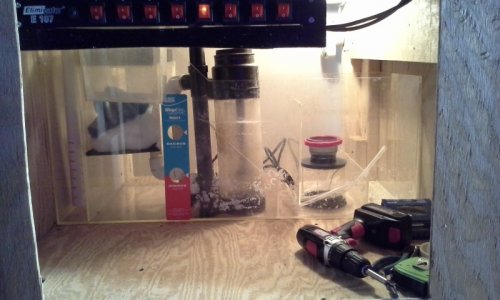
yes .. the whole stand and canopy im building from ground up .. here is some early shots of it ..

Nice looking tank Tmscube! I can't wait to see it when it is done. Are you doing all the woodwork yourself?
yes .. the whole stand and canopy im building from ground up .. here is some early shots of it ..
yes i did retired engineer LOL ..

Glass tank compared to acrylic tank:
cost
a glass tank is normally less than half the cost of an acrylic tank & more commonly made and seen in stores.
weight
acrylic is much lighter but how often any you going to be moving a tank.
strength
acrylic is much stronger than glass. The silicone seam of a glass tank is the weakest point but as long as it is from a reputable maker & level so the seam isn't being stressed a glass tank is plenty strong enough.
scratches
acrylic scratches easier than glass. acrylic scratches can be removed but this involves draining the tank because of the chemicals used. don't want to kill your fish in the process.
fabrication
It is much easier to cut holes for bulkheads in acrylic. Only certain types of glass can be drilled. It is just best to buy a reef ready glass tank in my opinion.
clarity and insulation
acrylic tanks have a slight advantage over glass.

scratches
acrylic scratches easier than glass. acrylic scratches can be removed but this involves draining the tank because of the chemicals used...
acrylic tanks have a slight advantage over glass.

Scratches in acrylic CAN be sanded with water/ LS in the tank! It is not necessary to use 'chemical' buffers to do this!
I have been using acrylic tanks since late 1980s, with some acrylic tanks that are over 20 yrs old, and look like new... There is no one that could convince me to switch back to glass!
Reef tank must be glass. Acrylic scratches way to easy.
I have had glass and acryllic. They both scratch but acryllic scratches much easier. The worst thing that i did was buying that really expensive magnet great white shark? Best way to avoid scratches is to clean by hand and go bare bottom.

Glass, especially 'low iron' can be PERMANENTLY scratched almost as easily!
Agreed. Switched over to cleaning by hand after magnet caused some scratches. Been using a credit card to scrape the bottom 2"-3" and magic eraser for the rest. No scratches since!

Try the acrylic sleeves that go over the magnets... Been using them for about 3 yrs without problems
http://www.championlighting.com/product.php?productid=91110&cat=1144&page=1
#1...try to avoid going near the sand! ... But, the sleeves are a 'mesh' so the sand will usually go in an opening and not scratch the acrylic.How do the sleeves do with trapping sand particles? I was cutting thin strips of magic eraser and using with a magnet cleaner, but trapped a piece of sand and caused a scratch.

#1...try to avoid going near the sand! ... But, the sleeves are a 'mesh' so the sand will usually go in an opening and not scratch the acrylic.
The best part is that the sleeve is much more effective for coralline removal.
A few times a year I throw them in the washer with my filter socks and they come out like new
Everyone that has tried these, have thanked me for telling them... Well worth the $!

Scratches in acrylic CAN be sanded with water/ LS in the tank! It is not necessary to use 'chemical' buffers to do this!
I have been using acrylic tanks since late 1980s, with some acrylic tanks that are over 20 yrs old, and look like new... There is no one that could convince me to switch back to glass!
Try the acrylic sleeves that go over the magnets... Been using them for about 3 yrs without problems
http://www.championlighting.com/product.php?productid=91110&cat=1144&page=1