
- Forum
- More Forums
- Reef Club Forums
- MidWest Region-Reef Club Forums
- Saint Louis Area Saltwater Hobbyists (SLASH)
You are using an out of date browser. It may not display this or other websites correctly.
You should upgrade or use an alternative browser.
You should upgrade or use an alternative browser.
grow out rack
- Thread starter mpgrant77
- Start date


mpgrant77
New member
Maybe make a tab on the 4 corners of the center tile that'll catch the surrounding tiles?
Sorry for the crappy rendering
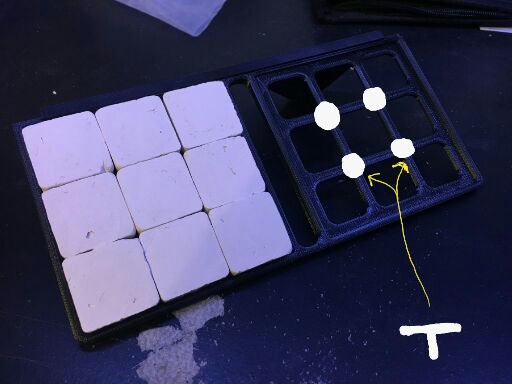
If you do that then the coral could grow onto those tabs as it crossed between plates.

Koddie Doo
Czar of All ThingsAwesome
There are saquare frag tiles with the stem in the corner. Wonder if that would help.
mpgrant77
New member
But I would think if the tabs weren't too large, you you'll be able to "pop" the tiles out fairly easily.
I cannot think of any way to attach the tiles from underneath
There is no real good way to attach the tiles. The biggest problem is that the tiles are all different sizes. They vary to much to make something fit snug.

Scubareefman
New member
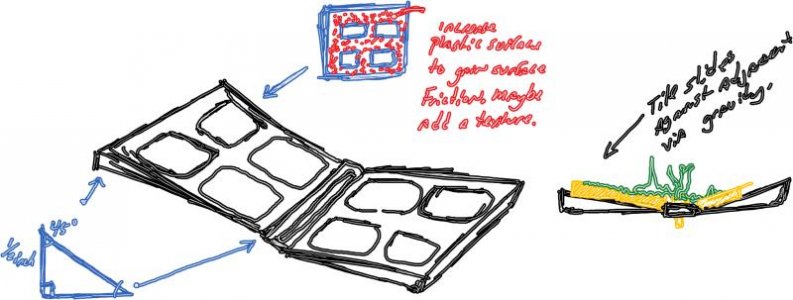
What about a soft silicone bumper around the inside lip, like an over sized gasket to fill in the dead space of the tiles.
Sent from my iPhone using Tapatalk
Sent from my iPhone using Tapatalk
Scubareefman
New member

Scubareefman
New member
My 2 cents[emoji4]
I miss wrote 45 degrees on the angle. It would not be 45.
Sent from my iPhone using Tapatalk
mpgrant77
New member
This is going to be a $100 frag rack before you guys are done with it. LOL Remember there needs to be a balance between ease of use also. You don't want the tiles flying off the rack but when it is grown out you don't want to destroy the coral trying to remove the tiles. I think if I just make the perimeter walls a little higher that might be enough.

Tigé21v
Active member
Where's the over-engineering in that idea?This is going to be a $100 frag rack before you guys are done with it. LOL Remember there needs to be a balance between ease of use also. You don't want the tiles flying off the rack but when it is grown out you don't want to destroy the coral trying to remove the tiles. I think if I just make the perimeter walls a little higher that might be enough.
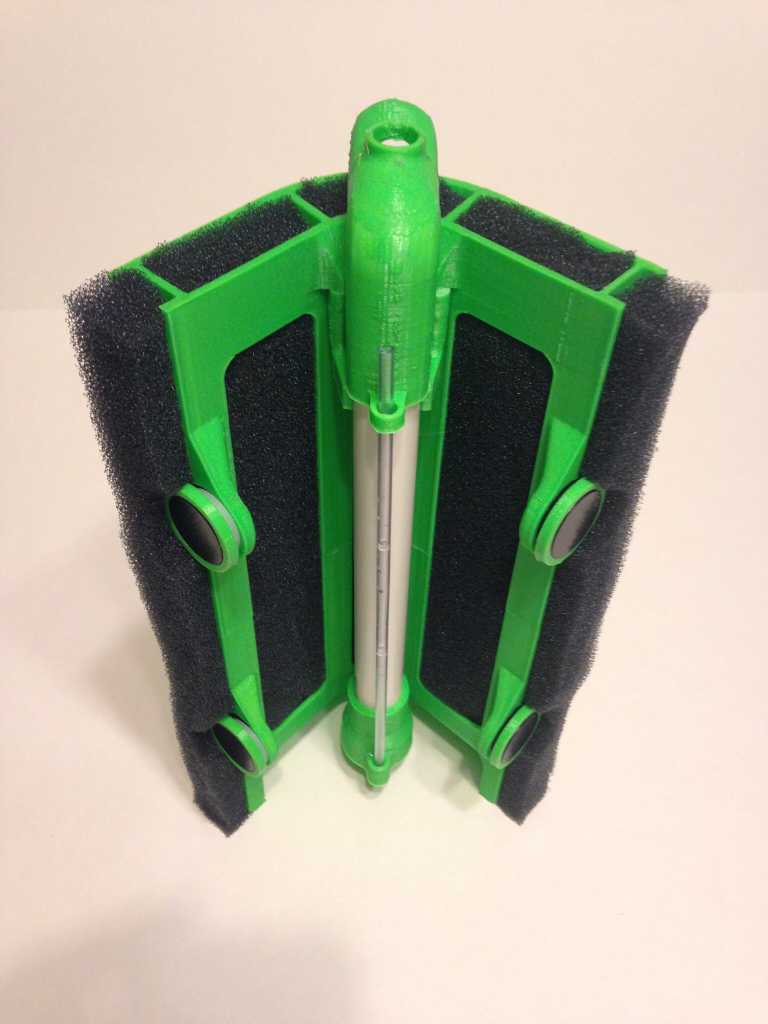
You underestimate the spending power of reef geeks. What's $100 amongst friends.This is going to be a $100 frag rack before you guys are done with it. LOL Remember there needs to be a balance between ease of use also. You don't want the tiles flying off the rack but when it is grown out you don't want to destroy the coral trying to remove the tiles. I think if I just make the perimeter walls a little higher that might be enough.

Schplitter
New member
1. Make the walls taller on the outside.
2. Use your regular grid and circle design for the bottom support instead of the squares. That way it's universal.
3. Add some tabs on the outside walls so rubber bands can be stretched across each row of tiles in at least two or three position for each row. This way the rubber bands can be adjusted if coral grow weird.
2. Use your regular grid and circle design for the bottom support instead of the squares. That way it's universal.
3. Add some tabs on the outside walls so rubber bands can be stretched across each row of tiles in at least two or three position for each row. This way the rubber bands can be adjusted if coral grow weird.
Tigé21v
Active member
If the bottom were solid, with only a frag plug hole in each square, it would definitely cut down on the amount of flow that would be able to contact the underside of the tile. I'd think it would help to keep the tiles from being lifted up and blown around. It would probably be a bristle worm hotel, but I guess nothing is perfect.1. Make the walls taller on the outside.
2. Use your regular grid and circle design for the bottom support instead of the squares. That way it's universal.
3. Add some tabs on the outside walls so rubber bands can be stretched across each row of tiles in at least two or three position for each row. This way the rubber bands can be adjusted if coral grow weird.
Schplitter
New member
If the bottom were solid, with only a frag plug hole in each square, it would definitely cut down on the amount of flow that would be able to contact the underside of the tile. I'd think it would help to keep the tiles from being lifted up and blown around. It would probably be a bristle worm hotel, but I guess nothing is perfect.
I agree but the ABS filament is not cheap. Trying to keep this cost effective is the trick. I also think it would be really tough to make sure it looks decent. Prints are not exactly nice looking when you see the ridges where the layers bonded. There are ways around that but that also takes money and time.
mpgrant77
New member
no one appreciates these racks...just send them to me
You used yours at all yet?

Neurovet
New member
I would imagine any gap between the tiles is going to slow down growth. When I glue an encrusted plug to a grow out tile it takes a long time to bridge the gap. I don't think the flaw design is in the printed rack but the tiles. I wouldn't use 9 individual tiles, rather a larger scored tile that could be easily broken along partial perforations. I know this may depart from a 3D printing business but it is another way to go and I've seen some online hobbyist use similar ideas.
Similar threads


- Replies
- 0
- Views
- 116
- Replies
- 2
- Views
- 106

