
You are using an out of date browser. It may not display this or other websites correctly.
You should upgrade or use an alternative browser.
You should upgrade or use an alternative browser.
Help identifying this anenome please
- Thread starter kohlton
- Start date

Kolhton, you asked about the scientific name, it is Entacmea quadricolor. Wetwebmedia is a good resource, along with Reefcentral for finding information on the husbandry for this anemone.
Cheryl you wrote "wrong post," not sure I understand. Anyway, it's column is what gives it away as a BTA for me, also the way it's attached to the underside of a rock in the first pic.
Cheryl you wrote "wrong post," not sure I understand. Anyway, it's column is what gives it away as a BTA for me, also the way it's attached to the underside of a rock in the first pic.

WDLV
Skunk Hybrid Freak
You have an H. Crispa. It is bleached, but depending on the natural coloration it may not get much darker than it is currently and may never have any color other than brown/tan.
It is definately starved. I would feed it very fine foods like cyclopeeze and oyster eggs or foods that have been blended until it regains health. Introduce food after you have fed your fish and introduce it close to the mouth. If it lets go of the food before eating it, try a small tyrkey baster in the mouth after introducing some to the tentacles(since the mouth is loose already.)
It is definately starved. I would feed it very fine foods like cyclopeeze and oyster eggs or foods that have been blended until it regains health. Introduce food after you have fed your fish and introduce it close to the mouth. If it lets go of the food before eating it, try a small tyrkey baster in the mouth after introducing some to the tentacles(since the mouth is loose already.)


WDLV
Skunk Hybrid Freak
Minh,
First of all there is no need to be insulting. I have probably kept and seen more clowns and anemones not to mention systems than 99% of the people on this forum.
Second of all... yes, I have kept more than one crispa. I have seen many that resemble the one for which this thread was started. Ten to fifteen years ago they were all the rage. Almost all crispas that entered the hobby were white with red-ish or blue-ish dots on their tips.
I would have given you more credit if you had argued over verrucae. Which, the one for which the thread was started has very few visible. I'm about 70% certain that the member who started the thread has an H. crispa. E. quadricolor was my second choice.
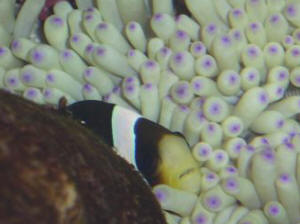
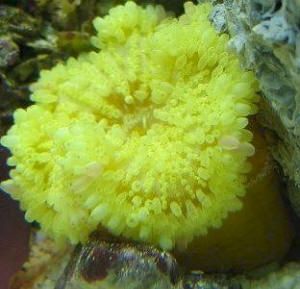
This is one of mine. Look toward the bottom left and you will see the color of the tips. As a matter of fact, yours has colored tips as well.

Same anemone under different bulbs.

Also, look at the front cover (top left) and rear cover of Fautin and Allen's book. While you're at it, also see pgs. 1, 63, 75, 83, and 143.
You can view these while you're at it.



First of all there is no need to be insulting. I have probably kept and seen more clowns and anemones not to mention systems than 99% of the people on this forum.
Second of all... yes, I have kept more than one crispa. I have seen many that resemble the one for which this thread was started. Ten to fifteen years ago they were all the rage. Almost all crispas that entered the hobby were white with red-ish or blue-ish dots on their tips.
I would have given you more credit if you had argued over verrucae. Which, the one for which the thread was started has very few visible. I'm about 70% certain that the member who started the thread has an H. crispa. E. quadricolor was my second choice.
This is one of mine. Look toward the bottom left and you will see the color of the tips. As a matter of fact, yours has colored tips as well.
Same anemone under different bulbs.
Also, look at the front cover (top left) and rear cover of Fautin and Allen's book. While you're at it, also see pgs. 1, 63, 75, 83, and 143.
You can view these while you're at it.
Last edited:

I'm pretty sure that is a BTA. I've seen many bubble tips that had colored tips, so just because the tips are colored does not mean that it is a crispa.
I think that is a BTA for the following reasons:
-It is on the rocks. Generally crispas are sand dwellers. I don't think I've ever seen a BTA on the sand.
- The anemone in question lacks verrucae. BTAs don't have these while Crispas do.
- The column looks like a BTA (kind of light tan where you can see through it)
- It looks like you can see white lines coming radially from the mouth. If you look at the mouth there looks like one is coming out, going towards the left and down a little bit.
Whatever anemone it is, we can all agree that it is bleached and in need of some TLC. Regular feedings with good lights will help it recover.
I think that is a BTA for the following reasons:
-It is on the rocks. Generally crispas are sand dwellers. I don't think I've ever seen a BTA on the sand.
- The anemone in question lacks verrucae. BTAs don't have these while Crispas do.
- The column looks like a BTA (kind of light tan where you can see through it)
- It looks like you can see white lines coming radially from the mouth. If you look at the mouth there looks like one is coming out, going towards the left and down a little bit.
Whatever anemone it is, we can all agree that it is bleached and in need of some TLC. Regular feedings with good lights will help it recover.

Toddrtrex
Premium Member
IMO, it is a BTA and not a Crispa, though not sure if I fall into that 99% group or the 1% one. The lack of verrucae is a big factor for me. The spots on the end of the tentacles aren't only found on Crispas.
A BTA that I had many years ago had them too. This isn't the best picture but shows the spots...

A BTA that I had many years ago had them too. This isn't the best picture but shows the spots...
WDLV
Skunk Hybrid Freak
I'm pretty sure that is a BTA. I've seen many bubble tips that had colored tips, so just because the tips are colored does not mean that it is a crispa.
I think that is a BTA for the following reasons:
-It is on the rocks. Generally crispas are sand dwellers. I don't think I've ever seen a BTA on the sand.
- The anemone in question lacks verrucae. BTAs don't have these while Crispas do.
- The column looks like a BTA (kind of light tan where you can see through it)
- It looks like you can see white lines coming radially from the mouth. If you look at the mouth there looks like one is coming out, going towards the left and down a little bit.
Whatever anemone it is, we can all agree that it is bleached and in need of some TLC. Regular feedings with good lights will help it recover.
Good arguement. I was looking at what I believe to be verrucae on the column toward the foot and was also looking at the little pieces of aragonite attached to the column. Not all crispas have extremely prominant verrucae that you can see. The one I posted was in a BB tank and did not have visible verrucae. Unfortunately I do not have pictures of that as the foot was about 18" into the rockwork.
I've also had BTAs that had colored tips to their tentacles. It's tough to say on the 99% or 1%. I generally view you as a peer but you do wow me on occasion. :lol:IMO, it is a BTA and not a Crispa, though not sure if I fall into that 99% group or the 1% one. The lack of verrucae is a big factor for me. The spots on the end of the tentacles aren't only found on Crispas.
A BTA that I had many years ago had them too. This isn't the best picture but shows the spots...
The reason I'd give BTA 30% is because I'm not entirely comfortable about what I think I see with regard to the verrucae.
WDLV
Skunk Hybrid Freak
There is one more thing that I think you BTA mongers should have mentioned....
The tentacles are rather sparse for an H. crispa. That and the verrucae are the best arguements against me. I suspect that if you guys are right (BTA) that it might survive, whereas if I am right (sebae) it will likely turn into anemone snot.
For the sake of the owner and the anemone I hope you are right.
The tentacles are rather sparse for an H. crispa. That and the verrucae are the best arguements against me. I suspect that if you guys are right (BTA) that it might survive, whereas if I am right (sebae) it will likely turn into anemone snot.
For the sake of the owner and the anemone I hope you are right.

OrionN
Moved on
WDLV,
I did not mean to insult you but I am not sure how else to point out that you are wrong. You ID the anemone as H. crispa due to the color tip but completely ignore the column and the verrucae. That is why I posted the picture of the verrucae and column of H. crispa which the original anemone did not have. Verrucae, and column characteristic can be use to ID anemone, but not color of the tentacles.
When I am wrong, I am not offended when someone point this out to me. This is an information exchange forum, I am only try to, when I can, make sure that the information is correct. I am not sure what else I can say, if after the crystal clear information as above was point out and you still think that the original anemone is more likely a H. crispa than either E. quadricolor or H. magnifica.
I did not mean to insult you but I am not sure how else to point out that you are wrong. You ID the anemone as H. crispa due to the color tip but completely ignore the column and the verrucae. That is why I posted the picture of the verrucae and column of H. crispa which the original anemone did not have. Verrucae, and column characteristic can be use to ID anemone, but not color of the tentacles.
When I am wrong, I am not offended when someone point this out to me. This is an information exchange forum, I am only try to, when I can, make sure that the information is correct. I am not sure what else I can say, if after the crystal clear information as above was point out and you still think that the original anemone is more likely a H. crispa than either E. quadricolor or H. magnifica.
WDLV
Skunk Hybrid Freak
WDLV,
I did not mean to insult you but I am not sure how else to point out that you are wrong. You ID the anemone as H. crispa due to the color tip but completely ignore the column and the verrucae. That is why I posted the picture of the verrucae and column of H. crispa which the original anemone did not have. Verrucae, and column characteristic can be use to ID anemone, but not color of the tentacles.
When I am wrong, I am not offended when someone point this out to me. This is an information exchange forum, I am only try to, when I can, make sure that the information is correct. I am not sure what else I can say, if after the crystal clear information as above was point out and you still think that the original anemone is more likely a H. crispa than either E. quadricolor or H. magnifica.
I may be wrong. I don't mind being wrong. Its someone questioning my experience and telling me what I would or would not do that I found offensive (albeit pretty mild.)
Your picture showed verrucae but this was not the point on which you stated the basis for your ID. What I was debating was your basing your ID on the "color tip" not on information that you are now stating after the fact. I've already stated what I was thinking in terms of verrucae... so, no need to be redundant. If I'm wrong, I'm OK with that.
There was nothing "crystal clear" in your post describing in detail why you thought what you did. Just a brief, under-explained opinion. In retrospect, I don't think that you mean things the way they're coming off. By the way you type I'm guessing that English may be your second language. If that is so, I will know better in the future how to interpret your posts and to give you a bit more latitude in interpreting what you say.
I don't want to beat a dead horse. So, unless I am addressed I'll simply wish koholton the best of luck and be done with it.
Last edited:
Similar threads

- Replies
- 3
- Views
- 1K


- Replies
- 2
- Views
- 836
- Replies
- 2
- Views
- 705