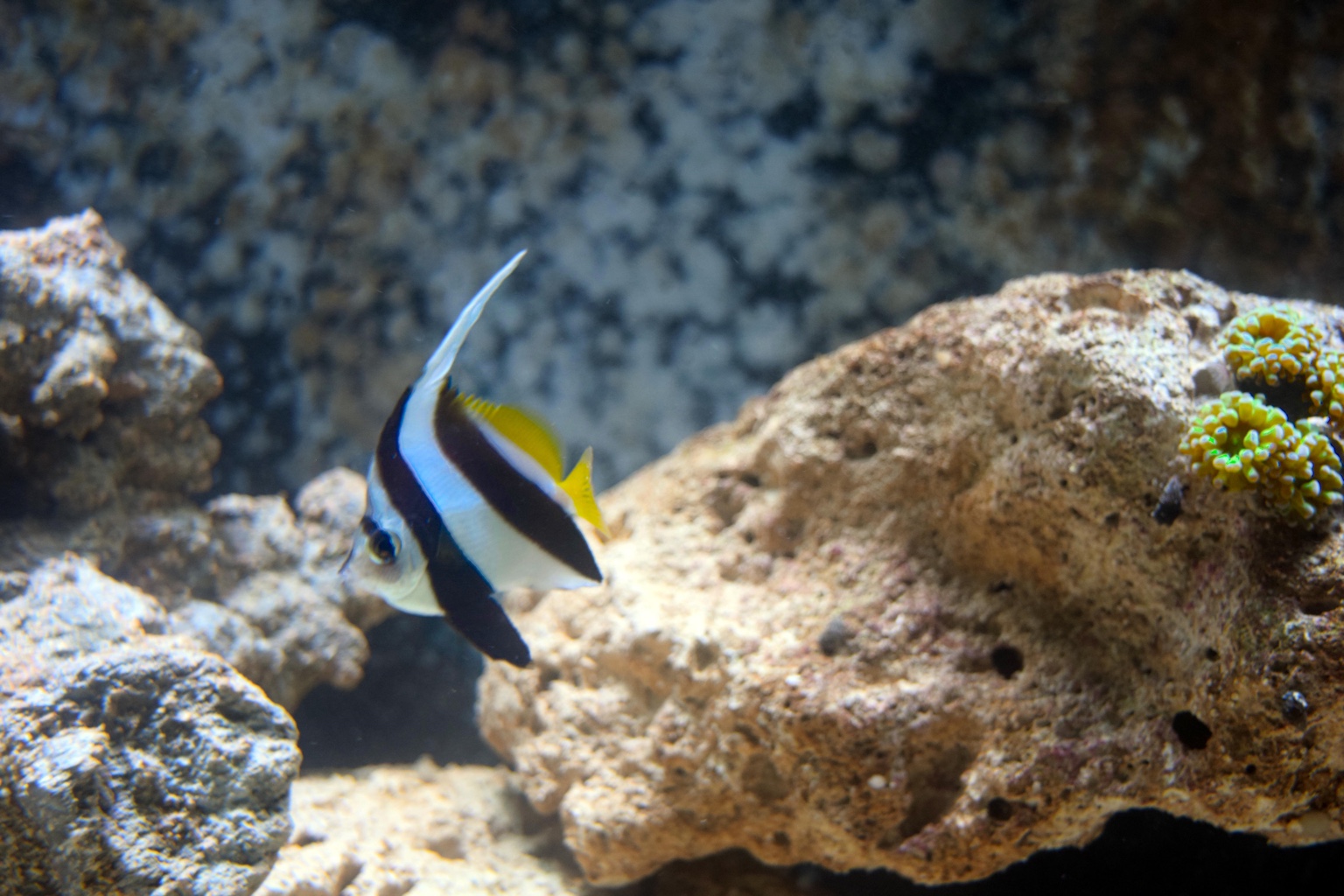
Heniochus Butterfly ID

Jeremy.XIII

New member
I bought a heniochus butterfly from a local but they didn't know if it was the reef safe variety (H. dipheutes) or the non-safe H. acuminatus. Can anyone give me a positive ID on this guy?
9d7e959b02e95bff4fedeb9ef48dd4e2.jpg
3e74acc24f8d2aa445409f9e51bd7020.jpg
 
I thought it may be H. dipheutes because of the shorter mouth and rounded breast area.. Might just be because I want it to be that though. Lol!
 
It's tough to tell. I have always been told that if the distance from the front of the mouth to the front edge of the eyeball is roughly the same as the diameter of the eyeball the fish is the Dipheutes and if the distance is greater than the diameter then it is the Acuminates. However I have also been told that if the anal fin curves back towards the caudal fin that is the Acuminates and if it seems that the back edge goes straight down it is the Dipheutes. Your picture is confusing because the fin structure looks like a Dipheutes but the size of the mouth looks more like Acuminates.
 
It's tough to tell. I have always been told that if the distance from the front of the mouth to the front edge of the eyeball is roughly the same as the diameter of the eyeball the fish is the Dipheutes and if the distance is greater than the diameter then it is the Acuminates. However I have also been told that if the anal fin curves back towards the caudal fin that is the Acuminates and if it seems that the back edge goes straight down it is the Dipheutes. Your picture is confusing because the fin structure looks like a Dipheutes but the size of the mouth looks more like Acuminates.


See that's basically what I've found but the more I looked last night, the more the mouth-to-eye distance looked equivalent to the diameter of the eye. But I may be a little biased. :lol:

I'll try to get a better picture on my lunch break.
 
This may just be from all the pictures I've seen but dipheutes seem to all have either clear side fins or just a bit of yellow on the bottom of the side fins while acuminates all seem to have near solid yellow side fins. So that coupled with all my other observations lead me to believe mine is in fact a dipheutes. Thanks for all y'all's help.
 
Gang, it has to do with the anal fin alignment markings. where the black and white merge equally at the bottom point. And mine became a mated pair since 2" and are now 6" nose to tail 4yrs now, never a nibble either.
 
Back
Top