Herbie on dual overflow

I have an idea - which seems obvious but I am sure it has been tried and likely failed. I have tirelessly read Bean's and Herbies thread over the past few days trying to figure out how I am going to plumb my new 150. I am no expert in fluid dynamics and I have no intention on defining the word siphon!

Durso's as primary flow are out of the question for me.

Simply I am thinking each overflow have a siphon and an open channel. Each siphon can be 1 1/4" PVC through the 3/4" bulkhead and each open channel can be a durso type pipe for that 10% volume difference that makes all of this difficult.

I read Bean's page over and over and he is REALLY clear that without the emergency drain, this system is asking for a flood. Now that is with a three pipe system. This would be a 4 pipe system with the return over the rim of the tank.

If the main siphons could handle 90% of the tank flow and 10% going through the open channel and I had a full plug in one or both of the siphon lines, I know the dursos could take over and sustain the flow. Maybe not fail-safe, but certainly has some redundancy built in.

Assuming this would work, the question then becomes because do I combine the drains with a single valve or because each one has an open channel, I could run 2 valves and fine tune each overflow.

Again, after reading those threads I know that what seems logical in your head does not apply once you add water and gravity ;)

Thanks!
Jeff
 
I read Bean's page over and over and he is REALLY clear that without the emergency drain, this system is asking for a flood. Now that is with a three pipe system. This would be a 4 pipe system with the return over the rim of the tank.

I didn't want to run the return over the top of the tank.
 
Perverse: The system that you are running... Do you feel that its working well with one open drain and two siphons?

Have you been able to keep it balanced?
 
I actually just got my 120 dual overflow up and running with 2 1" drains siphon one 3/4" return and one emergency 3/4" overflow. I closed off both 1" drain and the 3/4" emergency handles the overflow using a mag 9.5 (while diverting some flow to a fuge). So far, 3 days running have achieved keeping them balanced for the most part, however on occasion the the water level will rise to the emergency overflow and trickle down. My main problem I am having now is the water level fluctuates slightly enough when rising to the emergency pipe level it causes my skimmer to overflow. I'm thinking the skimmer might be a little touchy right now due to the amount of epoxy and superglue used in reattaching all my corals. I'm thinking if it doesn't get any better I might just chop down my emergency to be only slightly higher than my to primary drains keeping the fluctuation only slight to fix the problem. Other than that I consider my experience so far to be successful.
 
I actually just got my 120 dual overflow up and running with 2 1" drains siphon one 3/4" return and one emergency 3/4" overflow. I closed off both 1" drain and the 3/4" emergency handles the overflow using a mag 9.5 (while diverting some flow to a fuge). So far, 3 days running have achieved keeping them balanced for the most part, however on occasion the the water level will rise to the emergency overflow and trickle down. My main problem I am having now is the water level fluctuates slightly enough when rising to the emergency pipe level it causes my skimmer to overflow. I'm thinking the skimmer might be a little touchy right now due to the amount of epoxy and superglue used in reattaching all my corals. I'm thinking if it doesn't get any better I might just chop down my emergency to be only slightly higher than my to primary drains keeping the fluctuation only slight to fix the problem. Other than that I consider my experience so far to be successful.

Is your sump baffled? You should be able to configure the skimmer side to stay at a mostly constant level.

Sent from my Kindle Fire using Tapatalk 2
 
Yeah it's baffled. All 3 drains go to the skimmer chamber (skimmer->return->fuge). Problem occurs when the level rises or falls to the emergency drain (2-3") the water level surges slightly ~ .5" in the skimmer chamber causing the skimmer to overflow. It is holding pretty steady now. I think part of the problem on to of superglue and epoxy curing is I soaked the skimmer overnight in water/vinegar and its settling back in.
 
Just noticed the last part of my post didn't make since. I meant, I think part of the problem is due to the glue and epoxy curing and part due to giving the skimmer a vinegar / H2O bath and it is settling in.
 
Just noticed the last part of my post didn't make since. I meant, I think part of the problem is due to the glue and epoxy curing and part due to giving the skimmer a vinegar / H2O bath and it is settling in. I'll provide a update in a day or two.
 
Can anybody post pics of the plumbing setup for any of the above configurations? I'm most interested in the valves and how those are setup. Still working this out in my head for my 120 build.
 
Hey all,
Question on this setup. What level are you running in your overflows? How far of a drop from the tank level?
 
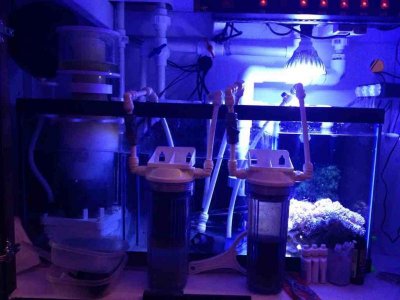
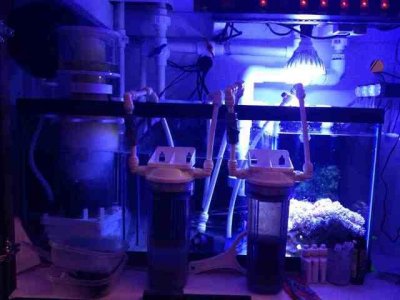
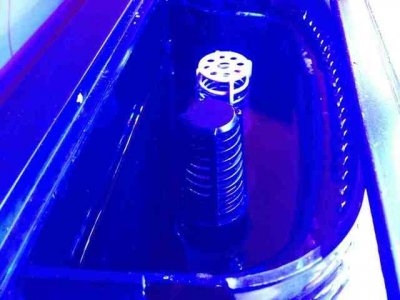
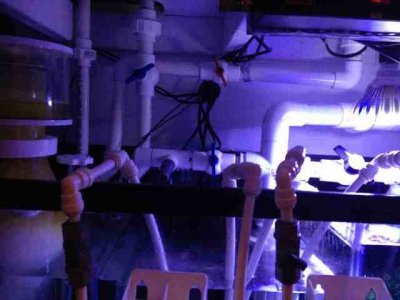
Here is a pic of my plumbing and overflow. The emergency is right at the overflow height and siphons are around 4" below the overflow.


ImageUploadedByTapatalk1349323557.464730.jpgImageUploadedByTapatalk1349323577.983948.jpgImageUploadedByTapatalk1349323602.285860.jpg
 
Got a question guys. So I'm in the process of plumbing my 180 with two corner overflows, and wanted to know if this setup would work:

Following convention here, o=3/4" O=1" :P
[O o] [o O]
.1..2...3..4

1. Open channel emergency
2. full siphon tee'd with 3
3. full siphon tee'd with 2
4. return

My return will be between 750-1500gph. This is a basement sump, so head height is 9' or more. A 3/4" full siphon with 9' head can handle 2000gph according to http://www.beananimal.com/articles/hydraulics-for-the-aquarist.aspx so 2 3/4"s tee'd together will be more than enough. Having two siphons should prevent stagnant water in either column. My thinking is that even if one siphon gets clogged, the other is more then capable of handling the flow, and there's always the 1" emergency.

Sounds good?

--Adeeb
 
Got a question guys. So I'm in the process of plumbing my 180 with two corner overflows, and wanted to know if this setup would work:

Following convention here, o=3/4" O=1" :P
[O o] [o O]
.1..2...3..4

1. Open channel emergency
2. full siphon tee'd with 3
3. full siphon tee'd with 2
4. return

Sounds good?

This has been proven not to work by others in this thread as equilibrium will not be shared across both overflow chambers.

I have a conceptual design to resolve the problem and I should have definitive results within a few weeks. I will update this thread after I verify proof of concept.
 
So... after almost 3 days of filling the tank.... I was able to try out the plumbing - kinda herbie, but not. I must tell you, the initial results were disastrous, but once I started to fiddle a bit, I got it working very very well.

This tank is a 4ft 150 gallon (30" high) with dual overflows. Each overflow has a 1" and 3/4" bulkhead. My bulkheads are thread/thread because I knew there was a good chance I was going to need to tinker.

I configured both overflows identically. The 1" bulkhead has a 20" tall - 1 1/4" PVC Stand pipe with a strainer. This pipe is reduced down to a 1" male threaded adapter. 20" does not include the strainer. The 3/4" bulkhead has a 1" pipe that is just below the slots (maybe 1/4") in the overflow. There is also a strainer on this pipe and the other end has a 1" to 3/4" male threaded adapter.

Underneath I tied both 1" bulkheads together. Again both with male threaded adapters. The left side is a direct vertical drop into the sump which is handy. I purchased a 1.5" sanitary tee, (2) 1 1/4" reducers, (1) 1.5" gate valve and (1) 1 1/4" union.

I have about 6" of 1 1/4" pipe with a male adapter threaded into the bulkhead. Then into the reducer into the top of the sanitary tee. From the right side overflow, I am running 1 1/4" flex PVC with again a male threaded adapter into the bulkhead, then into the 1 1/4" union - then into side of the tee with the reducer. Underneath the sanitary tee was the gate valve and a very short piece of 1 1/2" pvc, measured to be 3/4" below the surface of the water in the sump. The flex pvc does not run horizontal - it has a pretty nice pitch to it.

The two 3/4" buklheads are not tied together. They run individually back to the sump. Again the left side is a straight shot down 1" PVC with a male threaded adapter. The right side is is flex PVC to a small piece of pipe with a 45 to accept the flex. I used stainless pipe clamps to keep the small piece with the 45 attached to the left side. (that's kinda hard to explain) Again both of these pipes are about 3/4" below the surface of the water.

Important point here is my return pump is a Water Blaster 10000. It's a pretty hefty pump. Including head pressure, it's pumping about 1800 GPH for the tank.

The initial startup was a disaster. There is no other way to explain it. It sounded like I was in a water treatment facility. I've never been to a water treatment facility, but if I were to imagine what one would sound like, my tank may have been noisier. The overflows were running at completely different levels. The left one was just above the standpipe sucking air while the right one was hitting the emergency drain. I was really upset. I turned off the pump, watched TV and went to sleep aggravated.

This morning while working (I work from home, the tank is in my office) I decided to click the pump back on. Again, complete disaster. I laughed - took a deep breath and just kept it going since I didn't want the water in the overflows to go stagnant. After a short amount of time, I noticed the tank began to quiet down! Not good by any means but better. Again it was favoring the right overflow, but the left side came up considerably. I took the gate valve, and in one fairly fast movement I opened the gate valve and shut it right back down. The system at that point BURPED the air out of the line. The overflows were now within 1/4" of each other. After a few tiny tiny little adjustments of the gate valve and some time to let it balance out, I got both overflows perfectly even. I intentionally have the second pipe accepting just a trickle. Everything stays perfectly balanced now. I can start and stop the pump w/o any issues. This initial setup had the return pump throttled way back so I decided to crank her to full flow. Again it was a complete disaster and after the quick little movement of the the gate valve, I had the system back in close balance in short order. I made the fine adjustments over a period of time and again it was perfect.

Sorry for being so long winded here, but I think the morale of the story here is, air in the line can cause some crazy issues. Also the big movement (this is repeatable on my setup) of the gate valve was the key. As much as I try to keep the 'emergency pipes' dry I can't. I find achieving that perfect balance with two overflows nearly impossible.

If anyone has any questions or wants to see pictures of my setup, let me know. Tee'ing together does work if you let the system work the air out and settle down.

/Jeff
 
I have one herbie running in each of my two overflow boxes. The issue that I dont get is it will run for days then just start draining like its not throttle back enough then go back to running normal a day later.
 
I have one herbie running in each of my two overflow boxes. The issue that I dont get is it will run for days then just start draining like its not throttle back enough then go back to running normal a day later.

Is the barometric pressure abnormally high/low on those days?
 
Bumpin' this up.

I'll be getting a 180g with dual overflows and thinking about going with the Herbie overflow. I'm still wondering if finding an equilibrium for the siphon drains is still a difficult task or if somebody has found an answer.
 
Personally, I went with a traditional herbie in one overflow and ran a single return through the other overflow. The second pipe in the return overflow is capped. This works on my 135g with a 500gph return. If you want to run a high flow sump then you may need to employ both return lines in the second overflow.

When I do water changes, I siphon from the bottom of the return overflow to keep the water from getting nasty since it is stagnant. I have also dropped a small powerhead in the return overflow (mj400) to keep the water moving and it worked well.

The design is absolutely silent. The skimmer pump is the loudest thing in my system.
 
Back
Top