Hooded Fairy Wrasse and Regal Angels Issue

Psionicdragon

New member
Hi everyone.

So I am at a lost in regards to these fishes. I bought several from Liveaquaria recently and have lost 3 so far. 1 was DOA.

The wrasses were fine when I acclimated to the tank. They were swimming, very active, and eating like pigs.

There isn't any sign of trama, flukes, ich, etc. But the two started rapidly breathing one day and the next they will die. This happen twice.

My parameters are stable as in 0 Ammonia, 0 Nitrite/Nitrate, etc. Salinity is at 1.025.

Any idea why they would suddenly croak??
 
Last edited by a moderator:
co2 keeps PH down, which keeps the toxicity of the ammonia down. once the bag opens, the co2 escapes, ph starts rising and toxicity increases thus ammonia poising the fishes.
 
co2 keeps PH down, which keeps the toxicity of the ammonia down. once the bag opens, the co2 escapes, ph starts rising and toxicity increases thus ammonia poising the fishes.

Exactly. Lengthy acclimation (drip of whatever) is very bad for fish.
 
Exactly. Lengthy acclimation (drip of whatever) is very bad for fish.

+1

Best way to acclimate fish (especially those shipped overnight) is to match salinity of QT to that of the transport bag. Fish can't handle large upward swings in salinity over a short period of time.
 
I would assume ammonia would kill the wrasses within the first few days, but for example, another just passed away this morning. It was active and eating.

However, I did a water change and noticed that my tank is still cloudy after 2 days. Not sure if this could contribute to it.
 
If the shipping water was at 1.017 as Snorvich said, and you acclimated to 1.026 in a short period of time (within 24 hrs) that could be your problem.
 
I think the fishes came from the East Coast/Mid West or something. Their other facility.
??? Wasn't aware of a 2nd facility for LA (other than DD)
Exactly. Lengthy acclimation (drip of whatever) is very bad for fish.
+1... 15-20 min max
If the shipping water was at 1.017 as Snorvich said, and you acclimated to 1.026 in a short period of time (within 24 hrs) that could be your problem.
I've never had a problem acclimating new fish to a higher salinity...
 
Acclimating salinity any more than .02 in a 24 hr period can be detrimental.
With certain 'delicate' fish there is that possibility ... But with over 40 yrs and thousands of fish (helped friends run LFSs) I have no problems with 15 min temperature acclimation, and 15 min drip... My QT is a completely separate system that can be expanded from 100g to 150/270/300g easily, and although I sometimes adjust the salinity depending on the type of fish (leopard wrasses, certain angels) I have not found it to matter for most fish.

Last week I got a shipment direct from Australia and the fish were not in great shape after a long flight and long stay at airport (tusk and hooded wrasse were open mouth and lifeless) ...they went into QT system with a big salinity difference and all are now eating and doing great.
 
With certain 'delicate' fish there is that possibility ... But with over 40 yrs and thousands of fish (helped friends run LFSs) I have no problems with 15 min temperature acclimation, and 15 min drip... My QT is a completely separate system that can be expanded from 100g to 150/270/300g easily, and although I sometimes adjust the salinity depending on the type of fish (leopard wrasses, certain angels) I have not found it to matter for most fish.

Last week I got a shipment direct from Australia and the fish were not in great shape after a long flight and long stay at airport (tusk and hooded wrasse were open mouth and lifeless) ...they went into QT system with a big salinity difference and all are now eating and doing great.

It may work for you, but it is not advisable for others.
 
I've wondered why ammonia neutralizers aren't added to the packaging when fish are transported, and I assume it is because these chemicals also reduce the amount of dissolved oxygen available.

If circumstances result in being unable to match the SG between the transport water and tank, it seems the consensus is that an acclimation period is recommended. Is there a reason why an ammonia neutralizer, such as amquel, can't be added, along with an airstone, to the transport bag upon opening so that drip acclimation can be performed? Why doesn't this technique eliminate the issue of ammonia exposure during drip acclimation while the salinity is gradually changed to match the destination tank?
 
Albano, I share your same experience. Quick acclimation even with big differences in salinity haven't been an issue for me. I don't even acclimate crabs... never lost one. Everything in Sk8r's post is the opposite of my experience.


Andy0148, I don't see why that wouldn't work. Amquel claims to destroy all forms of ammonia, nitrite and nitrate. It very well might be the safest way to acclimate. I personally haven't experienced an issue with quick acclimation process.
 
I've wondered why ammonia neutralizers aren't added to the packaging when fish are transported, and I assume it is because these chemicals also reduce the amount of dissolved oxygen available.

If circumstances result in being unable to match the SG between the transport water and tank, it seems the consensus is that an acclimation period is recommended. Is there a reason why an ammonia neutralizer, such as amquel, can't be added, along with an airstone, to the transport bag upon opening so that drip acclimation can be performed? Why doesn't this technique eliminate the issue of ammonia exposure during drip acclimation while the salinity is gradually changed to match the destination tank?

The ammonia is constantly being produced by the shipped item. Even if you add ammo - lock or prime, you can only add so much before it becomes toxic to the livestock.
 
??? Wasn't aware of a 2nd facility for LA (other than DD)

+1... 15-20 min max

I've never had a problem acclimating new fish to a higher salinity...


Wisconsin is the other office.

To be honest, I don't think I test the salinity from the wisconsin location.

My procedure is basically this:

-Remove fish from the bags into a 5 gal bucket
-Dump out Excess water leaving probably 1 gallon or so.
-Add tank water every 5 min
-Sometimes use prime

WIth this, I haven't had many deaths except when the fishes that I get in are not doing well as is. FOr example, I got in a bunch of sunrise anthias. After further inspection, they look horrible. Ripped fins, flesh wounds, bacteria infections, and potential uronema. All but 1 died.

From the same batch wholesaler/LFS, I got two regal angels and had no issues. They are eating also. However, with my experience in regards to the regals, I also get this issue very often:

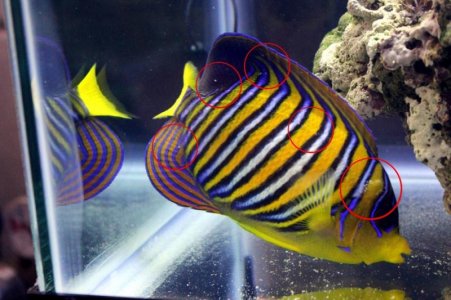
(Not my pic. ANother reefer posted it and its better than what i can ever take from my fish. Would give credit, but can't remember who it was)
attachment.php


I am not even sure what it is and I have tried many types of medications in the past and never was able to get rid of it. It looks like anchor worms that you would see in fresh water. In the past, the regals that ended up with this usually died; however, I can't say for sure that it is what killed it or lack of eating or a combo.

Anyone able to identify that parasite?
 

Attachments

  • oie_3019492U4OOUUpI.jpg
    oie_3019492U4OOUUpI.jpg
    71.9 KB · Views: 6
Back
Top