I'm very excited, and would like some advice: Inheriting a 90g.

laeelin

New member
The situation
My father has has a 90g saltwater aquarium for about 10 years, and he has offered the tank to me - he is even going to help me move it!

I've always wanted a large reef tank, and this will save a LOT of money!

We are moving the tank to my house in the next couple weeks.

The Problem
When he first setup the tank he bought an RO unit for his well water.

After a partial water change (about 8 years ago) and many things in his tank died. He didn't realize that the RO unit's membrane had busted and he had just done a 30% water change with filtered well water.

I know he did multiple water changes, and the LFS tested the water and said that everything looked fine.

Then he added a brittle starfish and it died by the time it hit the bottom of the tank.

More water changes and things started looking better.

This was about 8 years ago. He does a 30% water change once a year, and has the water tested every once in a while. The LFS still says everything looks fine - but I don't know what they are testing for.


Fast forward to today

They have not added anything except a couple fish and a soft coral in the last few years.

They have 3 blue fish (cant remember what kind) and 2 clown fish.

They have some soft corals, but I don't know what kind.


Planning The Move

The week before we make the move:
1. Buy several Rubbermaid containers, fill them with RO water and saltwater mix.
2. Add a heater to each so that I can heat the water to a reasonable temperature.

The move:
1. Drain some water from the tank into several Rubbermaid containers.
2. Carefully move all the live rock and coral into the containers.
3. Move the fish into plastic bags, and place them in the Rubbermaid containers.
4. Drain the tank, and toss the live sand (I hate to, but from what I've read it's the best choice)

5. Move everything to my house.
6. Set the tank back up.
7. Add new sand to the tank.
8. Fill the tank with fresh saltwater.
9. Move the live rock back to the tank. (without the water)
10. Move the fish back to the tank. (without the water)


Questions

Hopefully with a move like this, and with all the time and water changes that have passed the tank can be used for a reef tank. If not, I will make it a saltwater fish tank - and live without my coral.

1. How does my plan sound? Is there anything I should change?

2. Once the tank is stable again, what should I add to "test the waters"? ( something hearty and reasonably priced )


20151027_171825.jpg

20151027_171850.jpg

20151027_171855.jpg

20151027_171907.jpg

20151027_171914.jpg

20151027_171924.jpg


Edit: Added question 2 and several pics (yes i'll be cleaning the sump - and I need to see what is going on with the wooden bar next to the light.).

Thank You!
David
 
Last edited:
sounds fine, tossing the sand is the safer way, but id take the time and go trough the sand i found several nassarius snails etc. i wouldve lost if i havent.

I kept about 1/3 of my old tank water and the rest new Water, just make sure it has the same salinity as the old water and dont forget the temperature.

First add the Rocks, place them where you want them to be, then the sand, otherwise the rocks might slide and harm the glass.
 
Read though the stickies, especially the ones on water chemistry. Sounds like this is all new to you. Always ask if you're not sure and never EVER rush!!
 
I moved my 65G display and 55G sump a couple of months ago. You plan is very similar. I started in the morning, and was finished at about 10pm (only a half hour drive).

Make sure you have plenty of fresh salt water on hand. I saved as much of my water as I could, and had 30 gallons (ish) at my new house, I think I used it all...

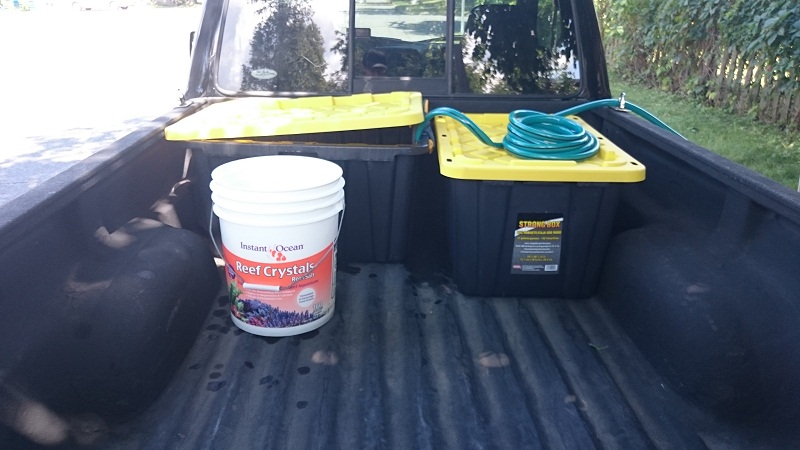
I had two buckets for livestock, one for fish, shrimp and corals, one for everything else (snails, macro algae, crabs, etc). They sat in the bucket with a bubbler and a lid until I had filled one of my large bins with clear water (as seen in the pic below). I used a pump to pump the water from the tanks into the truck. I kept the fish in the dark as much as possible through this process.

DSC_1276.JPG


As the water level in the tank dropped, I removed the layers of rocks and put them into a truck bin. Once the water got cloudy (when there was about 2-4 inches above the sand) I stopped pumping and disposed of the water. I put the old sand in its own bin for future use (I have since cleaned it up and put it into another tank).

I also took advantage of the down time (while waiting for water to pump) to clean and prepare the pumps, powerheads, etc...

I also hosed down both tanks before moving them to remove any gunk build up, algae and detritus...

On the receiving end, since it went into the night, I had to run some power out to the truck and heat the water that had the live rock and the fish/inverts. At this point, just for kicks, I added the bubbler back in with the fish.

There was a couple hour delay after putting the rocks in due to the new sand. I rinsed it (what felt like) a hundred times, however, when I put the live rock back in, and started moving it around, the water got cloudy. Since this is likely hard on the fish, I waited as long as I could before putting them into the tank.

I think that covers the bulk of my adventure. Most importantly, everything survived. Although my anemones split (one split twice, so I went from two to five). This is all thanks to planning every step, from getting enough bins and buckets, to having enough vehicles to move everything (I used a pickup and an SUV to fit it all). I also tend to do things very slowly, I am sure others could have done the same in half the time with the same success, lol...

When is the big day?

PM me if you have any questions!
 
id take the time and go trough the sand i found several nassarius snails etc. i wouldve lost if i havent.

This is a good point, I knew exactly what I had when I moved my tank, so I was able to find the sand creatures easily, however you will not. Get some nitrile gloves and comb your fingers through the sand to find the life in there.

Also, read the stickies on the poisonous hazards. I have also had some prickly encounters with worms, so get some gloves for handing rocks and corals...
 
Questions

Hopefully with a move like this, and with all the time and water changes that have passed the tank can be used for a reef tank. If not, I will make it a saltwater fish tank - and live without my coral.

1. How does my plan sound? Is there anything I should change?

2. Once the tank is stable again, what should I add to "test the waters"? ( something hearty and reasonably priced )


20151027_171825.jpg

20151027_171850.jpg

20151027_171855.jpg

20151027_171907.jpg

20151027_171914.jpg

20151027_171924.jpg


Edit: Added question 2 and several pics (yes i'll be cleaning the sump - and I need to see what is going on with the wooden bar next to the light.).

Thank You!
David

Congrats on the tank! I'd first like to say, trust but verify whatever your LFS is telling you. I was once told by my LFS that a $900 chiller would solve my problems, while my apt is set to 70º and my water temp is fine. Other than that, your plan looks pretty good but a few things come to mind...

From the looks of your pictures, that sump needs some TLC. If I were you, I'd invest in a nice sump that can house everything without the need of an additional plastic tub since you've already saved on everything else - tank, stand, rock, etc.

I'd definitely add the rock before sand, as Rhygar mentioned. I'd also keep in mind that with new sand, you'll most likely have a small 'cycle' to keep an eye out for.

Instead of 'testing the waters', I'd literally test. the. water. to make sure your tank is, in fact, stable... get a test kit to make sure all of your levels are in check before adding new fish. Nitrite, Nitrate, and Ammonia are all things to look out for. If you're looking for corals, red sea test kits for Calcium, Alkalinity and Magnesium are good to have on hand.

Lastly, I'd keep up with water changes in your new tank. Once a year might work for some of us, but a lot of folks are doing water changes once a week or at least every two weeks/once a month...

Happy reefing! :fish1:
 
Congrats on the tank!
If you can get a better pic of the blue fish and coral we can tell you what they are, I kinda see a hippo tang, but it ought to be bigger if it's 8 years old; maybe a colt coral and some orange mushrooms. If the tank was in bad shape the coral wouldn't look so open. Your dad was doing a lot of things right to keep the tank happy this long, but it's really not that big of a deal to take it to the next level since you've already got a sump going. Just a little tlc and some research like the other posters said.

Welcome to the hobby!
 
The fish are not 8 years old, so you could be right. I'll have more pics of the fish in the move.

It's roughly scheduled for next Wednesday.

I'm going to look into RO units now, it might be better to buy my own now - before spending 45 cents a gallon :)

My funds are limited though, I'm just trying to figure out the best place to spend them.
 
I just got off the phone with my dad. I'm going to visit him tonight and get more pictures and information.

Thanks everyone!
 
The fish are not 8 years old, so you could be right. I'll have more pics of the fish in the move.

It's roughly scheduled for next Wednesday.

I'm going to look into RO units now, it might be better to buy my own now - before spending 45 cents a gallon :)

My funds are limited though, I'm just trying to figure out the best place to spend them.


You've been using the term "RO units" but you really mean (and want) an RODI unit. RO water will only get you so far.

Also...Think about how you want to do maintenance going forward, do you have a place to keep a couple of Brute trash cans to make/store water?

Most folks generally do water changes 1-2 times a month so I'm guessing that 30% once a year (was that a typo?) is not really best practice, especially if you are going to do corals etc..

Congrats on the tank!...as always READ...READ..READ the stickies here and don't be afraid to ask questions.
 
You may not need to replace & buy a new RODI unit. All filters on you Dad's unit can probably be replaced easily, and a DI cartridge added for a lower cost.
 
You may not need to replace & buy a new RODI unit. All filters on you Dad's unit can probably be replaced easily, and a DI cartridge added for a lower cost.

Thats a great point, i'll ask while i'm there.

You've been using the term "RO units" but you really mean (and want) an RODI unit. RO water will only get you so far.

Thank you, He did have an RODI unit. I'm hoping it's still there.
 
The cylinders are easy to change. BRS can help you on the phone if you have questions on procedure.

The SETTING UP sticky above will help you avoid mistakes and expense. Beautiful tank.
 
I would like to add that you might want to consider something to test for salinity of your water. The best solution would be a refractometer (always combined with a standard solution for calibration).

Good luck with the move!

Oh, and when using fresh sand, wash it first! It will help to prevent cloudiness. I added my sand after I filled the tank but that was because I had no container to mix enough salt water in. Now I would add sand first, then slowly fill the tank with salt water.

At the beginning you might want to consider a Seachem ammonium batch just to be on the safe side and have some prime on hand for emergencies! Certainly gave me the peace of mind.
 
You may want to do more than a 30% water change per year. 10% each week or 20% every two weeks would be better.
 
Update:

I just came back from visiting my dad, and he did still have the RODI unit.

He also had a skimmer for a little while, but has not used it in years.

Here is a list of what I'm getting:

  • RODI is model RO6100-DI from Water General Mfg. Co. It looks like replacing all stages and the membrane will run ~$100
  • The lights are AL-HO48 AQUASUN LED HO
  • Tank Lid
  • 3 x "Blue" fish. The color is off in the thumbnails. I believe they are Reef Chromis.
  • 2 x Clown Fish. I dont know the exact species. They have darker shading.
  • ~125g of Oceanic Sea Salt Mix
  • NO3 Nitrate Test
  • Phosphate / Silicate Remover
  • Marine Buffer
  • Phosphate Sponge
  • Flatworm Solution

Image Links:

Blue Fish
Clown Fish
Lid
Lights
Skimmer
RODI 1 2
Other Items
 
Back
Top