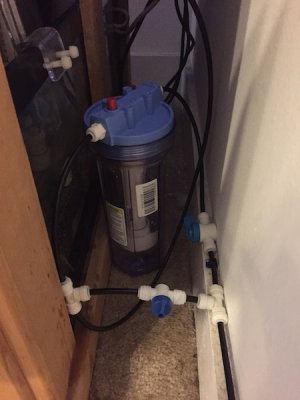
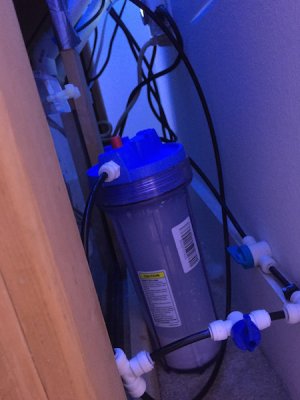
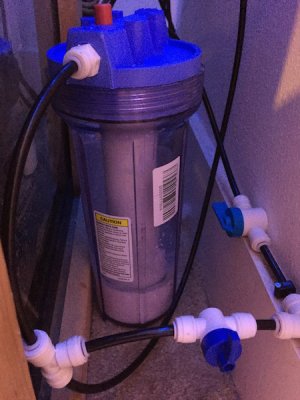
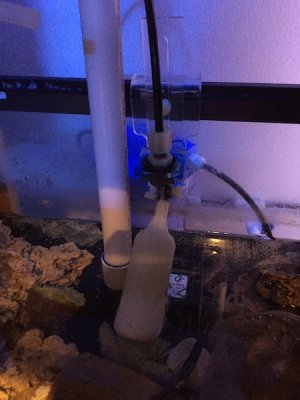
Import from ORCA: $40 DIY Kalkwasser Reactor for RO-fed ATO

toomanytanks352

New member

Attachments

  • IMG_1714.JPG
    IMG_1714.JPG
    66.9 KB · Views: 4
  • IMG_1715.JPG
    IMG_1715.JPG
    72 KB · Views: 4
  • IMG_1718.JPG
    IMG_1718.JPG
    78.3 KB · Views: 4
  • IMG_1719.JPG
    IMG_1719.JPG
    96.4 KB · Views: 4
  • IMG_1717.JPG
    IMG_1717.JPG
    87.1 KB · Views: 4
have you measured the conductivity of the effluent? does the kalk clog? how long have you had it set up?
 
rwb500 - I have measured the pH of the effluent and it is included in the thread that I linked above. The clogging issue is also addressed in the link I provided and the system has been going about two weeks now.
 
" Before you go bashing me for running limewater through the narrow 1/4" tubing and then to a float valve (which would easily clog the system), know that the limewater - although saturated with a PH of 12 - is mostly clear and does not contain the big chunks of white lime that usually cause clogs. "

not bashing but want you to know i made one of these years ago that worked well but would always clog and needed to be maintained regularly. deposits would accumulate at the float valve and seal shut. finally took it off line for good when i came home from a weekend away to find micro bubbles everywhere. hate to think what would have happened if i was away for one more day or if it was winter (i live in canada) and my evaporation rate was greater.
 
Reefology1 - Thanks for your reply! When did your deposits begin to accumulate? I'm still keeping my fingers crossed that everything will continue to work as well as it does now, but I know that if the crust does start to accumulate and block the outlet for the float valve, I can still keep the system inline, I'll just have to replace the float valve with a float switch and solenoid.
 
cant tell you exactly as it was a while back. however, i will say all issues were where the effluent is exposed to air, deposit will accumulate there. the problem for me was the float valve was a pain to pull out every month to flush with vinegar, and so as murphy says...

i don't run kalk anymore (though it by far is the best cal/alk supplement) and just have my ro/di plumbed directly into my sump on a float valve...flawless.

if i build another,and likely will, it will be a stirrer with ro/di fed via float switch and a wide open gravity fed 3/8" return to sump. as simple to build and almost as inexpensive. Check out avast's stirrer.
 
pH is not as useful as conductivity, 2 weeks is not long enough to make sure it will never clog, and don't post here if you're not even going to answer questions here.
 
Plumbing your RO/DI directly into your system has two flaws. The first is the risk of flood and while small, its not one I'm ever going to take. The second is much more problematic and that is short cycling the RODI. All RO membranes will allow contaminates to work through them when they first start flowing. Because you only get a small amount of water entering your system before the float valve (tries) to cut off the supply, you are adding water with the highest concentration of TDS the RODI system produces instead of the water which has had all contaminates removed while the RODI is running. This also means that you will burn through the DI resin much faster than if you had collected the water over a longer period of time in a separate container.
 
Plumbing your RO/DI directly into your system has two flaws. The first is the risk of flood and while small, its not one I'm ever going to take.

easily remedied with control valve to reduce pressure prior to float valve.

The second is much more problematic and that is short cycling the RODI. All RO membranes will allow contaminates to work through them when they first start flowing. Because you only get a small amount of water entering your system before the float valve (tries) to cut off the supply, you are adding water with the highest concentration of TDS the RODI system produces instead of the water which has had all contaminates removed while the RODI is running. This also means that you will burn through the DI resin much faster than if you had collected the water over a longer period of time in a separate container.

the convenience and stability far outweighs the minimal cost of such a small amount of di resin. in fact, the cost and inconvenience to maintain an ato system, reservoir, pump... is 10 fold and make it a no brainer imo :)
 
easily remedied with control valve to reduce pressure prior to float valve.

What kind of control valve? The chance of the flood comes because there is an unlimited amount of water that can be added to your tank. If the float valve doesn't 100% seal, water will continue to flow into the system. And by running kalk out the float valve you are introducing a source of contamination to the sealing surfaces of that float valve, thereby increasing the likelihood that it will fail to close properly unless religiously maintained. If life gets in the way and you forget to clean it, you risk more than you save.

the convenience and stability far outweighs the minimal cost of such a small amount of di resin. in fact, the cost and inconvenience to maintain an ato system, reservoir, pump... is 10 fold and make it a no brainer imo :)

Lets look at that for a second. The cheapest replacement resin I can find runs about $13 for new resin. Now lets say you are short cycling your RODI system such that it allows 4ppm per gallon to go to the resin vs the 1ppm per gallon you get running it for longer periods. This would deplete the resin 4 times faster than normal. That means instead of once every 6 months for replacement, you need to do it once every 6 WEEKS. That works out to 6 additional purchases a year at $13 a pop for a total of $78 a year. I'm not sure which ATO you are considering but at $40 for an Aquahub kit and $13 for an aqualifter pump, the 6 extra resin replacements just paid for the ATO setup in under a year.

Let me add that I like your overall concept for a kalk reactor using a water filter housing. I've seen it before and it is a clever DIY solution. My only issue is connecting it directly to the RO/DI outlet. From my perspective, that just has too many problems going for it.
 
RocketEngineer, to begin, you're addressing the wrong person. though i have my ro/di plumbed directly to a float valve in my sump, im not adding kalk...i recommend you reread the thread. as for "my" setup, i have a 1/4'' Plastic Quick-Connect Straight Valve dialed down to slightly more than my evaporation rate creating a VERY low pressure situation. if that worries you then not sure how you sleep at night when you consider every other plumbing gateway in your home!

and for the di resin, assuming your calculation is correct (which it is not but to end this debate i will grant in your favour), the lack of maintenance is worth the $78 annually. i've had one set up for more than 10 years (my current reef has only been 2 years) which hasn't been touched and not a hiccup. think i'll stick with it thanks :)
 
pH is not as useful as conductivity, 2 weeks is not long enough to make sure it will never clog, and don't post here if you're not even going to answer questions here.

Someone woke up on the wrong side of the bed, or is a grouch in general. There's always one on every forum...

I apologize that I have not checked this forum in a few days. I'm a busy man working on two master's degrees, so this is not the mainstay of my life, buddy. Try commenting in a positive way, rather than the nay-saying.There was nothing encouraging about your reply to my post.
 
Plumbing your RO/DI directly into your system has two flaws. The first is the risk of flood and while small, its not one I'm ever going to take. The second is much more problematic and that is short cycling the RODI. All RO membranes will allow contaminates to work through them when they first start flowing. Because you only get a small amount of water entering your system before the float valve (tries) to cut off the supply, you are adding water with the highest concentration of TDS the RODI system produces instead of the water which has had all contaminates removed while the RODI is running. This also means that you will burn through the DI resin much faster than if you had collected the water over a longer period of time in a separate container.

Thanks for your reply, RocketEngineer. My RO stays on all day and is constantly flushing via a bypass I installed when my auto-shutoff valve engages. It is a very small amount of bypass, but it just ensures that the system can remain on and constantly flush waste to keep the membranes (two of them) clean. Cheers!
 
Back
Top