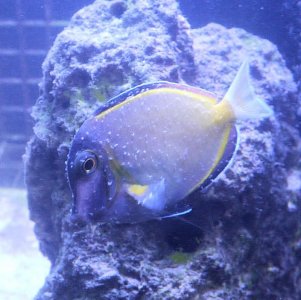
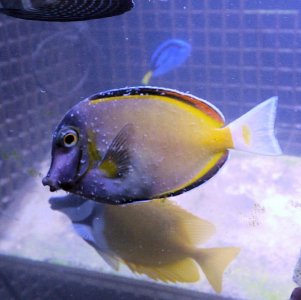
Is this Cryptocaryon (marine ich)?

Is this Cryptocaryon (marine ich)?

  • Cryptocaryon (marine ich)

    Votes: 5 50.0%
  • Amyloodinium (marine velvet)

    Votes: 0 0.0%
  • Brooklynella (clownfish disease)

    Votes: 0 0.0%
  • something else

    Votes: 5 50.0%

  • Total voters
    10
  • Poll closed .

adikira

New member
I thought this was ich but now I'm not sure anymore. I had started multi tank transfer method of treatment and would have expected it to fall off as it completes the cycle but I don't see that.

I had 3 fish died recently but they didn't show these white spots.

I had also tried a 3 minute fresh water bath and then a few days later a 5 minute one, again it didn't seem to make too much of a difference (either no difference or small difference).

My understanding is that FW baths are more useful against marine velvet and not as much as against marine ich since marine ich gets deeper into the skin. However these spots seem pretty external to me.

Your input is appreciated.
 

Attachments

  • P1180396_.jpg
    P1180396_.jpg
    65.4 KB · Views: 16
  • P1180394_.jpg
    P1180394_.jpg
    100.2 KB · Views: 17
I hope you don't really treat based on the results of a poll. These critters look way to big to be any of the protozoan parasites. I'm surprised the FW bath didn't help. Is the fish eating? how about behavior, scratching, etc.? I'd try a formalin bath; if most of the parasites don't die; I'd treat with Prazi-Pro. I'm not great with pics, but if health is OK, I's assume a fluke-type worm.
 
Tank transfer does not use live rock or substrate in the transfer tanks

Thanks. I believe I understand the procedure. I didn't use any substrate in the QT and I due to lack of additional tanks I used my sump. I covered the bottom of my sump with a plastic sheet (pumping the water from under the sheet to over the sheet) so there was no water transfer between the two. I used a UV for water coming to the sump. From my research, FW ich tomites are killed by 336,000 uWs/cm2 UV which, depending on the quality of the UV, is achieved by around 225 gal./hr for my 36 W UV. I assumed that cyrptocaryon would be similar in that respect to FW ich and that free swimming stage would probably the only ones that may be coming over the waterflow down to the sump (the tomites that drop off the fish tend to go down and I only had 2 fish which might generate such tomites and they seem fine) and my guess is that the free swimming stage is easier to kill with at UV than the tomites. So I concluded that it's reasonably safe to use the sump and discard the plastic sheet with the water when I do the transfer.

The plan was to move them from sump back to the QT but I couldn't catch 2 of the fish form DT in the first place, I didn't see a reduction in the white spots on the poweder brown based on the ich cycle and how the method works (maybe it's not cryptocaryon??) and it was still a bit of a hassle with the transfers, water change, keep an eye on the parameters, my 20 gal. QT was very small for my fish from my 187 gal DT. And finally my living room where the DT, sump and I aldo had the QT there for this time became messy and under pressure... I stopped the transfer and decided to go for hyposalinity.

I had a live rock (actually a dead coral) on the QT because my small blue tang hides in between the branches and I could not get him out of there, I had to move the whole dead coral and even outside the water I could not get him out and have him the FW bath with the coral. I realize that there may have been cysts on the coral but my plan was to compensate for that with one additional transfer. When I did the 2nd transfer I worked harder to get him out and I was successful. I did not transfer the coral, but I kept in in clorox solution and then let it dry out.
 
I hope you don't really treat based on the results of a poll. These critters look way to big to be any of the protozoan parasites. I'm surprised the FW bath didn't help. Is the fish eating? how about behavior, scratching, etc.? I'd try a formalin bath; if most of the parasites don't die; I'd treat with Prazi-Pro. I'm not great with pics, but if health is OK, I's assume a fluke-type worm.

Thanks. It seems all fish are eating fine (except a few fish died, apparently from a disease but didn't show these white spots, and a diamond goby jumped out of my sump at night). Several if not most of fish display the scratchinig behavior. The fox face had a biger, ugly spot on its side. I thought it's the same disease now that I'm not sure if it's ich or not I'm not sure if that was the same as it looked different. However it seems it's gone at some point during the FW dips and the transfers.

I'll look into a formalin bath. How long should that be? For FW baths I read in a book I got 2-3 minutes (which is the the FW bath when I did the first transfer) but from other source I read 5-6 minutes (I did 5 min. for the second transfer).
 
For a formalin bath, use 1mL 37% formalin per 1 gallon of water. Keep the fish in a well aerated bath for 45-60min. I've done this several times in the past by placing the fish in 1 gallon of water in a 5 gallon bucket with an airstone running.
 
I'd try a formalin bath; if most of the parasites don't die; I'd treat with Prazi-Pro. I'm not great with pics, but if health is OK, I's assume a fluke-type worm.

I agree with MrTuskfish as the pictures appear to be some type of worm. I share the surprise of the ineffectiveness of the freshwater dip. Insufficient duration in the bath may be the culprit, but something stronger maybe necessary. Depending on availability, a formalin dip or Seachem Paraguard dip would be my recommendation for your next treatment.
 
Thanks for anyone's suggestion and advice. Unfortunately, the disease, whatever it is no longer poses a problem to my powder brown... it died from the dip I did. I used paraguard. the instructions on the bottle said 1 hour and can be longer if it doesn't show sings of distress. as I didn't see such signs I kept the tang in there for 3-4 hours and I doubled the dose but it was still fine. Then I decided to do a Kent Rx dip. I just poured in the same water the quantity for my volume of water and kept the tang for 15 minutes (the instructions say 15 minutes or less). At some point it laid on its side. I thought that is normal for dips (since that's not an issue for FW dips) but at the end of the 15 minutes, while breathing it showed very low reactions when I caught it with my hand. It was still breathing when I transferred it to my sump but found it dead in the same place the next day...:(. My guess is that it died from Kent's Rx.
 
Looks like a bad case of lymphocystis to me,can't be sure from the photos though.. If so, it's a virus with no known cure but often cures itself when nutrition is improved and stress from shipping is reduced. I've seen floks scrape it off with their fingernails on some heavily infested fish and it didn't comeback.
 
Looks like a bad case of lymphocystis to me,can't be sure from the photos though.. If so, it's a virus with no known cure but often cures itself when nutrition is improved and stress from shipping is reduced. I've seen floks scrape it off with their fingernails on some heavily infested fish and it didn't comeback.

I added 2 additional pictures taken during the dip. I could see "strings" hanging on its body. They didn't come off just bur rubbing my hand against its body but I didn't try to scrape them off with my fingernail. I didn't see any other fish displaying that but I did see what seems more like ich and something else completely different (I couldn't get a good picture though).
 
Back
Top