Journal of a CUT S. gigantea

D-Nak

Active member
I received an email from my LFS notifying my that they received a purple S. gigantea. Upon arriving at the store, one of the owners immediately said "You don't want it, it's dyed." (best LFS ever, I trust these guys with everything since they are so honest with me).

I prodded the gig a bit --lifting up the disc to view the verrucae -- and it was very active, tentacles vibrating though not all were extended. The base was very blue, the bluest I've seen for a gig. However, active careful inspection, I also noticed that it was cut. There is a scar on the foot, that travels all the way up the disc, towards the mouth.

The owner said that since he thought it was dyed, and that he complained to the wholesaler, I could have it for an extremely reduced price. I pointed out the scar, and he mentioned that they got it from a reputable dealer of anemones (this concerns me, but we can table that for another discussion). He bagged it up and I took it home. Given its condition and the price I paid, I thought it would be a good chance to document the experience.

CAVEAT: I don't condone the act of cutting a gig, nor do I think anyone should purchase a cut gig since I think it should be stopped given that the odds of survival are very slim.

Photos to come.
 
D-Nak,
whats important to consider is that this is being done i would hope in holding pens in the ocean where there is a better chance for these animals to survive.

That being said, obviously cutting has caused soo much stress to these nems that their survival rate once in the US is dismall.
 
DAY 1

In the bag (noticed the very blue foot and blue verrucae):


Siphonoglyhs exposed, blue interior. Has anyone seen this blue color on the inside of a gig before? I don't think it's dyed since I have seen quite a few gigs with a blue foot, but this is clearly VERY blue:


In the QT tank (10 gallon with heater and powerhead). I also added Iodine (4 drops Kent Iodide):


The only lighting I have on it is a small, single LED lamp.

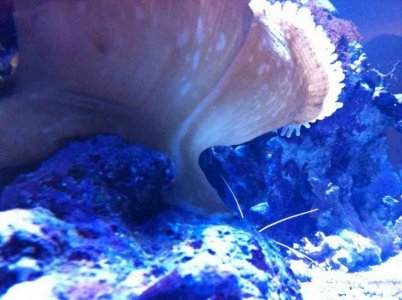
Front view. Notice the siphonglyphs are still exposed. Slight tentacle extension. Clearly spots that are bleached:


It's actually closer to magenta than purple, but I think if it pulls through, it'll turn into the dark purple we are used to seeing.

Top down view. Notice the shape. The cut is at the 12 o'clock position:


View of the scar:


At night I administered Cipro (250MG).
 
DAY 2:

Partially deflated at lights on, typical size for a gig. Some small patches of the nem are fully deflated. It's not as active as it was on day 1. Foot is securely on the rock, sloughing of muscus-like substance on the base. I switched to a 250 watt 14K halide as the light source. I have it suspended about 14" above the tank. The tank is in front of a window, so when the halide is on, i have the window open. This provides enough ventilation not to overheat the tank. It maxes out at 84 degrees.

About an hour after the halide is on (mouth still open):


Top down shot:

 
DAY 3: As similar to day 2. The mouth remained opened. I forgot to mention that I did 50% water changes in the late afternoon, using water from my DT (120 gallons that houses my other gig). Not much to report other than I used forceps to removed the sloughing that continued to form at the base. I find this interesting because my healthy gig doesn't do this.

DAY 4:

Mouth finally closed!


Top down shot:


Since the cut isn't fully healed, I didn't think it was able to close its mouth. I'm glad I was wrong.
 
I've been noticing that the smaller gigs coming in this way lately. it seems to me that collectors are cutting them.
 
I agree that the anemone is not dyed. I am concerned ( I know you are too)that someone has decided that cutting gigs is good idea.
 
I forgot to mention that up until this point, the gig never pooped. Only small pieces of waste, but they didn't appear to be poop -- nothing brown or stringy, or harder pellets -- only small, off-white chunks that appeared to be hardened mucus.

DAY 5 (Sunday 4/28): As was feeding my main tank of my mix of Rod's food and my homemade mix of sushi grade fish, Nutrimar OVA, cyclo-peeze and Selcon, I decided to see if the gig would latch onto a small piece of food. It immediately showed a feed response, expanding its mouth and using its tentacles to pull the food in.

That afternoon, I came home to this:


Another view:


I have never seen a gig do this. I know it's common for magnifica, but not gigs. I'm extremely concerned at this point, and kicking myself for trying to feed it.

A few hours later:


I noticed a huge piece of poop (hard, like rat poop) in the tank, which I quickly removed.

Notice the mouth is open once again.


I hypothesize that the nem only has enough energy to do one thing at a time -- healing, eating, or pooping. I won't feed it anymore until I see signs of improvement since I still see patches of deflated tentacles.

The Cipro and water change regiment remains the same.

I'll post periodically or as soon as I see a radical change in appearance or behavior. I'm sitting tight and remain optimistic since I haven't seen 100% deflation yet. However, I know that's it's a LONG road ahead. I want to see it expand more, color up, and close its mouth 100% of the time. I also need the deflated patches to go away, and for the shape to become closer to a circle.

Wish me luck!
 
Last edited:
Wow very interesting.. my purple certainly doesn't have that colored inside of its mouth, that is rather cool looking..

The balling up is very typical of Mags, but have never seen a Gig do this.. Hope this one pulls through but from what we've seen, their survival rates aren't as high. Your'e doing the right stuff, keep it up and thank you for documenting this, the community greatly appreciates it.
 
D-Nak,
whats important to consider is that this is being done i would hope in holding pens in the ocean where there is a better chance for these animals to survive.

That being said, obviously cutting has caused soo much stress to these nems that their survival rate once in the US is dismall.

I'm curious to know how it's being done. IIRC, Shu-Tin mentioned that she saw cut gigs in raceways when she visited an exporter. Typically these are fed fresh sea water. I'm guessing that this is how they are still holding the gigs. Not perfect, but better than in tanks or vats without a fresh supply of sea water.

Something else I noticed: the person or people cutting the gigs clearly understand anemone physiology, and that they are bilateral. The cut on mine is at the halfway point between the siphonoglyphs. It's almost as if someone opened the mouth, looked for the siphonoglyphs, and cut in between. This is where J. Malcolm Shick's book comes in handy, though it makes my head hurt trying to understand it! The gig is not perfectly symmetrical anymore because the it needs to wrap around itself to heal, unless they are forcing them closed after cutting them (by stitching or gluing?). Assuming I'm understanding Shick's book correctly, since the gig has been cut, one of the reasons why the mouth is open and the siphonoglyphs are exposed is because the gig is trying to maintain osmotic pressure and is having a hard time doing so (an analogy would be that it only has one lung when it should have two).

I've been noticing that the smaller gigs coming in this way lately. it seems to me that collectors are cutting them.

I agree. I discussed this with the LFS and we agreed that this is probably due to the fact that they're taking larger ones from the collection site, and cutting them in half. So, since they're not growing while healing, I'm guessing that this gig is literally half the size of what it should be.

Looks like your doing a great job as the gig is looking better.

In some ways it's looking better and in others it's not. The outer edge of the tentacles are never fully inflated. I've seen this in many sick gigs in the past. The other tentacles are more brightly colored (because they're compacted) and they form an outer rim of the disk.

I agree that the anemone is not dyed. I am concerned ( I know you are too)that someone has decided that cutting gigs is good idea.

I guess I can't start a thread about a cut gig without discussing the cutting part. I've spoken to a few people about this -- one who was importing and selling them in Los Angeles, a couple of LFS, and people who had them (I think all of the ones I knew about ended up dying). Based on these conversations, I'm guessing that it's one exporter who's doing it. This is a good sign. I just hope more exporters don't catch on to this. I've told everyone I've talked to to let the exporter know that we would gladly pay twice the amount for a gig that's not cut. Unfortunately, it sounds like we're up against a language barrier and unless someone can actually visit the export site, it may not stop anytime soon.

Wow very interesting.. my purple certainly doesn't have that colored inside of its mouth, that is rather cool looking..

The balling up is very typical of Mags, but have never seen a Gig do this.. Hope this one pulls through but from what we've seen, their survival rates aren't as high. Your'e doing the right stuff, keep it up and thank you for documenting this, the community greatly appreciates it.

I actually told my LFS that I wasn't sure if I was going to document it. I don't want others thinking it's something that we're accepting. I'm torn because a part of me knows that it's easier for people to stop doing it if they know that it has a 100% failure rate, yet another part of me wants to learn all I can so that I can try to save them. I decided that it makes the most sense to share the information and let people do with it as they please.
 
Something else I noticed: the person or people cutting the gigs clearly understand anemone physiology, and that they are bilateral. The cut on mine is at the halfway point between the siphonoglyphs. It's almost as if someone opened the mouth, looked for the siphonoglyphs, and cut in between.

Do you mean they are cutting them through the siphonoglyphs so each haf gig will have a pair of half siphonoglyphs, or between them so each half gig will only have a single siphonoglyph??
 
I still dont consider this to be a viable option until the wound has completely healed. I have seen magnificas that have the same cut lines but they and bubbletips are know to handle the natural splitting better
ImageUploadedByTapatalk1367270282.302104.jpg

What is going on is that they arecutting them like you said but for them to overcome the trauma they must be in pens in the ocean or in a system fed clean nsw.

Bleaching is from stress of bein cut and either lack of sufficient lightig if the cuts are being done indoors.

Just think if if this is how many gigantea that die from splitting by hand there must be a reason why haddoni gigantea and mertens dont do it natural.
 
Sadly, whoever has access to these areas is just doing what they please. Unfortunately, they probably don't sit on RC and spends hours reading, studying, and appreciating Giganteas...
 
Do you mean they are cutting them through the siphonoglyphs so each haf gig will have a pair of half siphonoglyphs, or between them so each half gig will only have a single siphonoglyph??

I hope I'm understanding the physical characteristics of the siphonoglyphs correctly. My understanding is that gigs have a pair (while other anemones may have only one), but each looks like a set of two buck teeth. Using that analogy, I only see one set of two buck teeth. So, to answer your question, I think each half gig only has a single siphonoglyph. If this is true, then I don't know how they will grow another one. Maybe this is why they don't survive for a long time, even if it appears that the cut has healed.

I still dont consider this to be a viable option until the wound has completely healed. I have seen magnificas that have the same cut lines but they and bubbletips are know to handle the natural splitting better
View attachment 229629

What is going on is that they are cutting them like you said but for them to overcome the trauma they must be in pens in the ocean or in a system fed clean nsw.

Bleaching is from stress of bein cut and either lack of sufficient lightig if the cuts are being done indoors.


Just think if if this is how many gigantea that die from splitting by hand there must be a reason why haddoni gigantea and mertens dont do it natural.

I definitely don't consider this a viable option. I still feel that gigs CANNOT be propagated via cutting and have any long term chance of success. Since BTAs split frequently, and mags with less frequency, I can understand why those particular anemone species are forcibly split.
 
Poor thing. :( I'm rooting for you to nurse it back to complete health.

I agree that the anemone is not dyed. I am concerned ( I know you are too)that someone has decided that cutting gigs is good idea.

Probably figure they can double their profits by trying to create two anemones. With that in mind, I wonder if this trend reflects overcollection in the area these particular gigs come from.
 
Seeing all of these cut anemone threads, I was worried my purple was cut... Around the 1PM position of the pedal it always curled up in a weird way, weren't many tentacles, but I don't see a slice wound like so many of these have..

It's unfortunate, but with the type of demand these animals are getting, someone is going to supply and it's just what happens.. It also makes it worse that with animals as specific to certain parts of the world, there becomes a quazi monopoly on the exportation, then comes the greed.
 
This is a great thread. I think the more we talk about this situation the more likely word will spread that it is an unacceptable practice and buyers will look for and avoid cut gigs. One other thing I noticed was that the cuts are not so fresh but appear to be in the beginning stages of healing. More importantly, this implies that there is a system in place to artificially propagate these animals. The only way to stop this would be to hit em' where it hurts...their wallets. We don't buy they and they won't get paid!

I wonder if your gig was dyed? In the past (short) three years I've been researching gigs I've never seen one with blue internals. I wonder if your LFS saw something that tipped them off?

What is your theory behind adding Iodine? I think it is a good idea and thought about doing the same but didn't want to interfere with the established Cipro regimen or risk being inconsistent with the water conditions in my DT prior to transitioning my gig.
 
Back
Top