
LDD-700H LED drivers

karimwassef

Active member
Ok. I decided to explore using the LDD drivers and got 10 x LDD-700H drivers to step 39V to 36V at 700mA.

I just got them and decided to do a routine continuity check on the pins before doing anything with them. I found that the Vin+ and Vout+ are shorted on all of them.

I don't know the power topology but I expected this to be a non-isolated buck topology with a switch and inductor between input and output, so this doesn't add up.

Has anyone checked this?
 
I connected it to my power supply and it seems to work (delivers 700mA), but there's no 3V drop between input and output? Input is 38.8V, output is 38.3V and 700mA flowing through 10 LEDs. The LED Vf range is between 3.2 and 3.9V each.
 
Ok. I decided to explore using the LDD drivers and got 10 x LDD-700H drivers to step 39V to 36V at 700mA.

I just got them and decided to do a routine continuity check on the pins before doing anything with them. I found that the Vin+ and Vout+ are shorted on all of them.

I don't know the power topology but I expected this to be a non-isolated buck topology with a switch and inductor between input and output, so this doesn't add up.

Has anyone checked this?
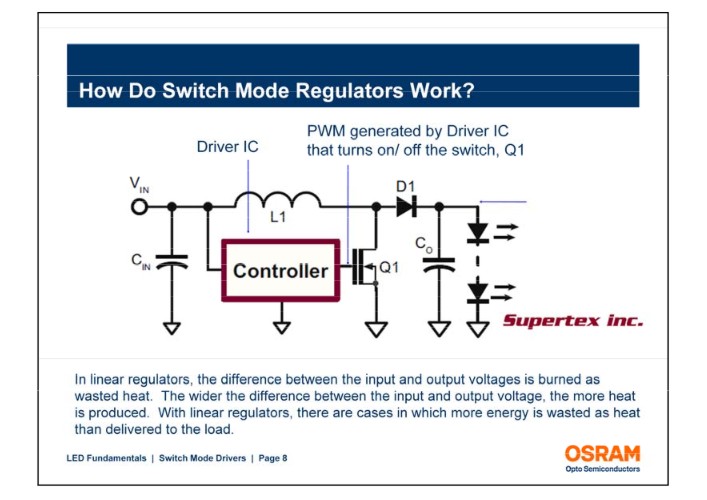
If the topology was like this what would that tell you??

switch.jpg
 
I connected it to my power supply and it seems to work (delivers 700mA), but there's no 3V drop between input and output? Input is 38.8V, output is 38.3V and 700mA flowing through 10 LEDs. The LED Vf range is between 3.2 and 3.9V each.

Unknown, not as speced by Meanwell, though an oscilloscope trace would probably be more accurate..
 
I connected it to my power supply and it seems to work (delivers 700mA), but there's no 3V drop between input and output? Input is 38.8V, output is 38.3V and 700mA flowing through 10 LEDs. The LED Vf range is between 3.2 and 3.9V each.
Sounds like the average fV of the 10 LEDs you are using at 700mA is 3.83V so you are actually driving the LDD out of spec running 10 on 38.8V input. I wouldn't want to use it like that long term, but it may be fine! Try it with 9 and see what voltage you get!

Tim
 
I reduced the input voltage to 32V in and got 32V out. Each of the LEDs measured 3.2V (they got dimmer).

I raised the input voltage to 39V in and got 39V out. Each of the LEDs measured 3.9V (very bright).

I didn't measure the current, but the 3V drop between input and output doesn't look to be working.
 
Last edited:
It's not that there is designed to be a 3V drop that can stop working. It's more along the lines of the way it works results in a 3V drop. If what you are suggesting is correct, it means they are not limiting the current correctly. I suspect it is more down to the accuracy of the measurements and tolerances. It may be that it was only managing 675mA before (whether its assessment was wrong or the accuracy of the ammeter in use) so when you ramped up the voltage a bit more, it gave it enough more to increase as it has not reached its rated output. That's why i suggested less LEDs in the string as you would hopefully then have seen a voltage drop :)

Tim
 
It's not that there is designed to be a 3V drop that can stop working. It's more along the lines of the way it works results in a 3V drop. If what you are suggesting is correct, it means they are not limiting the current correctly. I suspect it is more down to the accuracy of the measurements and tolerances. It may be that it was only managing 675mA before (whether its assessment was wrong or the accuracy of the ammeter in use) so when you ramped up the voltage a bit more, it gave it enough more to increase as it has not reached its rated output. That's why i suggested less LEDs in the string as you would hopefully then have seen a voltage drop :)

Tim
Put a shunt resistor in line and measure the voltage across that and translate to mA's. IF it exceeds 700mA (+/- a "little" ) they certainly would be defective..
secondly do you have what current "should" be drawn at 3.9V for the diodes??
"Bright" is a terrible metric.. ;)

HT162QNFRxaXXagOFbXY.jpg


nothing matters as long as the driver is NOT exceeding 700mA what plus/minus 10% (???)....

Voltage output trace of an LDD-700. I really don't think a meter can actually determine the "correct" output voltage..Maybe peak, but not average..

image24146.jpg


Maybe at it's rated current a 3V differential is just a stability factor..
in other words it doesn't "drop" 3V but requires a 3V differential between input and output to be stable..........
Only thing I can think of, but it sure changes the tune.. ;)

Testing with 5 x XM-L2 T6 1A and power supply set at 24 volts, 2A max


No PWM, IN: 24v, 764mA; OUT: 15.70V RMS, 993mA;
Power IN: 18.336W
Power OUT: 15.590
Heh, efficiency (is this right or actually it is efficacy the right term?): 85.02%
LDD-1000H-PWM-100-NOWPM.png

http://www.ultimatereef.net/forums/showthread.php?691102-Mean-Well-LDD-H-vs-XPPOWER-LDU56/page2
 
Last edited:
Ok. Tried 9 LEDs with 38V in. It dropped by 4V to 34V to the string and 3.7V per LED. Current was 700mA.

Not sure why 10 LEDs at 40V wouldn't work. It should drop by 3V to 37V and deliver 3.7V per LED. It may be that I'm bumping up against the maximum output of the power supply... It could also be that the drop is more than 3.7V because of resistive losses.
 
Last edited:
Also, don't forget that the fV quoted for the LED is only a quoted value, not an absolute. They do vary (the datasheets may provide details on how much they vary).

Tim
 
Shifting gears to a higher input voltage power supply. I'll start with a 48V trimmed down to 42V. The LDDs should be able to convert that to 38V per 10 LED string or 3.8V per LED. This should also give me headroom in case the drops are higher than expected.

I guess the learning here is the unpublished performance of the LDD if the output voltage across the LED string pushes into the conversion window. I had assumed that the string drop would be 36V so running 39V in should work. Unfortunately, the string was running at 38V collapsing the needed conversion window. At that point, it looks like the LDD stops working and just turns on 100% throughput (with just an internal diode drop of 0.6V or so).

That's not published anywhere.
 
Shifting gears to a higher input voltage power supply. I'll start with a 48V trimmed down to 42V. The LDDs should be able to convert that to 38V per 10 LED string or 3.8V per LED. This should also give me headroom in case the drops are higher than expected.

I guess the learning here is the unpublished performance of the LDD if the output voltage across the LED string pushes into the conversion window. I had assumed that the string drop would be 36V so running 39V in should work. Unfortunately, the string was running at 38V collapsing the needed conversion window. At that point, it looks like the LDD stops working and just turns on 100% throughput (with just an internal diode drop of 0.6V or so).

That's not published anywhere.
10 diode and your applied voltage never reached the "constant current" control area...
IF one builds to specs one never reaches this point..;)

OR w/out the 3 volt imbalance the control circuit never "kicks in".. ;)
 
My specs were a 3.6Vf per LED. That would have worked.

Unfortunately, they came in at 3.8V forcing me out of my planned 36Vin power supply's trim up max of 40V.
 
Oreo and Tim - since you seem familiar with this driver and I can't get an internal schematic:

I don't plan on dimming but since these drivers have that ability, I want to experiment. I am thinking of using a cheap LED PWM dimmer (not a controller or arduino) and a 5V supply to make a simple experimental dimmer. Without knowing the impedance of the dim pin, I don't know if I can inject enough current to pull down the pin voltage to make this work.

Any feedback?
 
Oreo and Tim - since you seem familiar with this driver and I can't get an internal schematic:

I don't plan on dimming but since these drivers have that ability, I want to experiment. I am thinking of using a cheap LED PWM dimmer (not a controller or arduino) and a 5V supply to make a simple experimental dimmer. Without knowing the impedance of the dim pin, I don't know if I can inject enough current to pull down the pin voltage to make this work.

Any feedback?

http://electronics.stackexchange.com/questions/34346/control-speed-of-nidec-fan

http://i.stack.imgur.com/zIMFx.gif

http://electronics.stackexchange.co...m-signal-based-on-555-for-meanwell-ldd-driver
A 1k resistor, a 100k pot, two schottky diodes, a 555, and a handful of capacitors. Simple circuit, all you need is a +5v
tinker toys..
Note that the voltage supply for the 555 timer does not have to be the same as the supply for the LDD-1000H. You can use different supplies as long as the ground references between the two supplies are connected. Also notice that the LDD-1000H requires a PWM signal between 2.5V and 6V. Therefore, the 555 timer must be supplied with a voltage in that range. Not all 555 timers can operate as low as 2.5V, so make sure you pay attention to the operating range of all parts you use
They sell a lot of the "type" on flea bay.. look for low voltage PWM dimmer.. They are only a few bucks..
 
Last edited:
Back
Top