
You are using an out of date browser. It may not display this or other websites correctly.
You should upgrade or use an alternative browser.
You should upgrade or use an alternative browser.
LED fixture
- Thread starter ragingreefer
- Start date

masharp1126
New member
Where are you guys getting the prices from? Do you have to contact them for pricing?

xCry0x
Active member
No that is not correct. LED fixtures use dimmable drivers which reduce voltage/current to the LED strings as you apply the dimming control. This reduces the electricity consumed by the fixture proportionally. Incidentially this is the same way a dimmer works in your household light. When you dim, you use less energy.
according to physics: http://en.wikipedia.org/wiki/First_law_of_thermodynamics
When you reduce the current to the LED you are using resistors. Those resistors take the 3w and reduce them to the lower wattage to run the light less bright and convert the un-needed wattage to heat.
The method of dimming lights that does not use the power is having a more complicated dimmer that pulses the light, longer on periods than off periods = brighter and longer offs = dimmer. Note you are not reducing the voltage/current, you are turning the LED on and off.. when it is off it uses 0 power, therefor uses less energy than a 3w led that is on but having a resistor feeding the 3w LED only 1w of power.
"Typically current is controlled using a resistor in series with the LED, or a current regulator circuit. Supplying more current to an LED increases its intensity, and reducing the current decreases its intensity. One way of dimming an LED is to use a variable resistor (potentiometer) to dynamically adjust the current getting to the LED and therefore increasing or decreasing its intensity. This works very well when just one LED bulb is involved." - http://www.reuk.co.uk/LED-Dimmer-Circuit.htm
Last edited:
Yes the law of thermodynamics is very applicable here. If you dim using a huge resistor that resistor will dissipate the extra energy as heat. This is a waste. Instead dimmable LED drivers reduce their electical consumption from the AC outlet, therefore supplying less energy to the LEDs. The 1st law of thermodynamics holds well here. I built my own LED fixture that is dimmable because it uses dimmable drivers. I can assure you there are no resistors in line with LEDs. Nor is there any flashing on/off. The driver reduces current/voltage that it supplies to strings which I have measured myself with a multimeter. It would only cost you a $100 or so to try this yourself if you don't believe me. 
You can also read this thread where there are a lot of more knowledgeable people than me to explain how a dimmable LED driver achieves what it does:
http://www.reefcentral.com/forums/showthread.php?t=1759758
You can also read this thread where there are a lot of more knowledgeable people than me to explain how a dimmable LED driver achieves what it does:
http://www.reefcentral.com/forums/showthread.php?t=1759758
Last edited:
xCry0x
Active member
The potentiometer that most DIY kits use IS the resistor. I would imagine if you are using an expensive controler than maybe that uses the strobe method, which btw you would not visibly see strobing lights. Again, not positive on how the expensive drivers work but the traditional way to dim a light is via resistors (pots in this case).

yerboy
Member
The potentiometer that most DIY kits use IS the resistor. I would imagine if you are using an expensive controler than maybe that uses the strobe method, which btw you would not visibly see strobing lights. Again, not positive on how the expensive drivers work but the traditional way to dim a light is via resistors (pots in this case).
The dimmer does not change the input or output current of the fixture yet instead changes the reference voltage to the power supply. This change in reference signal tells the power supply how much current to push to the string of LEDs, less output = less input.
Its NOT the resistor.:furious: That's what I've been trying to explain here all along. :headwally: DIY fixtures and the commercial ones both use LED drivers that use a device called voltage regulator. The potentiometer is what controls the voltage regulator in the LED driver. And they are relatively expensive. Cost is 1/2 of the fixture in bulk pricing. Happy reefing! :spin3:The potentiometer that most DIY kits use IS the resistor. I would imagine if you are using an expensive controler than maybe that uses the strobe method, which btw you would not visibly see strobing lights. Again, not positive on how the expensive drivers work but the traditional way to dim a light is via resistors (pots in this case).
GreenHammer
New member
Bump!
The potentiometer that most DIY kits use IS the resistor. I would imagine if you are using an expensive controler than maybe that uses the strobe method, which btw you would not visibly see strobing lights. Again, not positive on how the expensive drivers work but the traditional way to dim a light is via resistors (pots in this case).
Most commercially available dimmable LED fixtures would NOT use resistance as a dimming method!
PWM is the most common way. You may see a "pot" on a dimmer but it mostly for signal control, not for actual supplying power to LED.
Electronic "pot" is not suitable for power led or dropping the power because they are mostly made to withstand very little power. One or two strings of 750ma LEDs can burn the pot. When you use the high power "pot", they cost probably more than a PWM because the amount of metal used in high power "pot" is not cheap.
I just ordered three 60w bridgelux units with dimmers for my 90g build. Ill post an update in a few weeks.
can you post a link to this fixture?
Were you able to order the controller?
I was sent a quote today for a 48 cree xpg and xpe unit with solar stimulator for around 390 shipped. It is over kill for my tank though.
Its NOT the resistor.:furious: That's what I've been trying to explain here all along. :headwally: DIY fixtures and the commercial ones both use LED drivers that use a device called voltage regulator. The potentiometer is what controls the voltage regulator in the LED driver. And they are relatively expensive. Cost is 1/2 of the fixture in bulk pricing. Happy reefing! :spin3:
Im confused! A pot cost about $4 and a voltage regulator cost about $15. And one has nothing to do with the other.
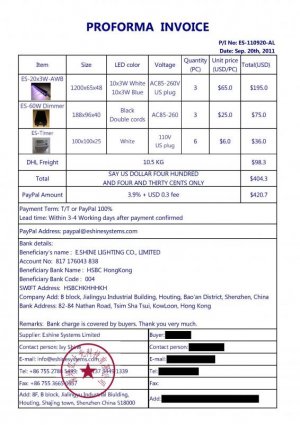
For the record, here is my invoice in case the prices change.
I'm very curious, did you discuss using the CREEs LEDs at all? It looks like the fixture using CREEs is twice the price of the Bridgelux ones for the same exact fixture.
Any one have a link to information about the Bridgelux LEDs? I'm wondering why there's such a huge price gap.

4deepwater8
New member
I have been talking to Ivy and Robin over there and from what I gather the CREE is a brand name that cost more, like BMW, but the BridgeLux is newer and not as well know so cheaper. I am looking into the 200x3W LED Aquarium Light, and they are very helpful. I have asked a lot of questions and they get back to me on everything.

Spaced Cowboy
South Bay Reefer
I'm very curious, did you discuss using the CREEs LEDs at all? It looks like the fixture using CREEs is twice the price of the Bridgelux ones for the same exact fixture.
Any one have a link to information about the Bridgelux LEDs? I'm wondering why there's such a huge price gap.
This is a comment I made in the DIY forum:
Note that the bridgelux LEDs are only rated for 0.7A forward current. The Cree XP-E (for example) are rated for 1.0A forward current. I know we typically (and certainly I intend to) run the LEDs at 0.7A anyway, but this means we're well under the maximum stated power for a Cree, whereas you're either at the absolute maximum recommended current for a BridgeLux, or somewhere in no-mans land (if your drivers fluctuate and over-drive the LED).
Of course, if you're running at 0.5A or below, you're probably well within the stated acceptable power range; additionally, the LEDs may quite happily function at >0.7A, but that's all the manufacturer specs them to, and there's normally a reason for that.
Links to BridgeLux datasheet and Cree datasheet.
Simon

mls228
Member
Regarding the Cree LEDs, I've built a DIY fixture out of them for my cichlid tank. I only have 12 cool white and 12 royal blue over a 75 gallon tank and they are incredibly bright. I run them at close to 50% of their rated current.
I'm new to reefing but I feel this is more of a coverage game that outright intensity. I've read thread after thread of people paying a premium for Cree then running them at a fraction of rating. Time will tell and I will be reporting back.
I'm new to reefing but I feel this is more of a coverage game that outright intensity. I've read thread after thread of people paying a premium for Cree then running them at a fraction of rating. Time will tell and I will be reporting back.

BonsaiNut
Premium Member
I have been talking to Ivy and Robin over there and from what I gather the CREE is a brand name that cost more, like BMW, but the BridgeLux is newer and not as well know so cheaper.
They are not the same LED emitters - they differ in more than just brand name. That is why the Bridgelux emitters they use cost half as much.
Interestingly... both CREE and Bridgelux are American companies

E-A-G-L-E-S
New member
I was about to order a unit or two, but was told that only two of their units use Cree's, all the others use Bridgelux. I was told these do not have the penetraing power of Cree's.
One of the two units that do use the Cree's is the 60w washer but it is 48" long, so too long for my tank. The other is the new programmable 4G - 48 x 3w unit.
My tank is a mixed reef(lps,sps,clams) 46 bow, so 36"l x 15"w x 21"h.
Do I NEED the Cree's?
144w seems like too much compared to a 4x39w t5 setup.
One of the two units that do use the Cree's is the 60w washer but it is 48" long, so too long for my tank. The other is the new programmable 4G - 48 x 3w unit.
My tank is a mixed reef(lps,sps,clams) 46 bow, so 36"l x 15"w x 21"h.
Do I NEED the Cree's?
144w seems like too much compared to a 4x39w t5 setup.
Similar threads

- Replies
- 2
- Views
- 154


- Replies
- 8
- Views
- 348

- Replies
- 0
- Views
- 1K