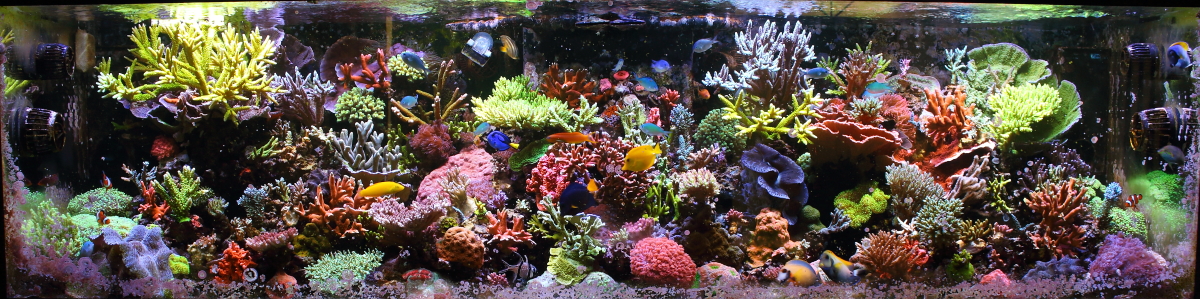
It seems to me that LED's are not producing the same quality as MH or T5's when it comes to colors on their own. Only when a combination is incorporated does the corals respond. Not saying that they dont grow or have any color, just not the same quality or depth.
Although others certainly share your opinion, some people seem to think they are getting wonderful color and growth with LEDs. To my knowledge, no scientific (e.g. hypothesis driven and controlled) experiments have been done to truly measure color or growth of corals under the various artificial light sources. Looking at pictures online of tanks with the different lighting types is next to useless because of the huge number of uncontrolled variables in addition to light type (e.g. light color, intensity, water params, corals species, feeding regimens, disease/pest presence, picture taking method, computer screen differences, personal taste differences, etc). Thus, we really don't know whether one type of artificial lighting is "better" in any objective sense than the others. In fact, I've never seen any convincing evidence that the sun grows better corals than artificial lights. Again, to my knowledge no one has done a controlled experiment and we cannot simply look at natural reefs and say the corals grow better because of the sun. There are simply too many uncontrolled variables out there to make any conclusions.
I wanted to know if the UV radiation difference or isotopes or black light radiation or IR radiation or whatever is the difference. Being that the T5's, VHO's and MH's are all gas(like the sun) and produce different types of radiation(like the sun) than LED's then there is something missing that the corals respond to, much like insects not being attracted to LED's.
Just FYI, isotopes are atoms with the same number of protons but different numbers of neutrons (e.g. Carbon 12, Carbon 13, and Carbon 14; all have 6 protons and are thus called Carbon, but Carbon 12 has 6 neutrons and Carbon 13 has 7 neutrons, etc.). Lights do not give off isotopes/atoms of any kind; if they did, then they would likely be highly damaging to living things (e.g. radioactive via alpha decay). The lights we use give off only photons, which all have the same resting mass (0 daltons).
Now I'll get off my soapbox and answer your actual question, which is a good one. As I said above, no controlled experiments have been done to test what type of artificial lighting is best for growing/viewing corals, so we don't know whether more or less UV (blacklight = long-wave UV, bordering on the visible spectrum) or IR radiation is good for coral growth or color.
I would wager that UV does virtually nothing for coral growth and might actually hurt them. I base this assumption on the absorption spectra of chlorophyll a and b, neither of which absorbs photons efficiently in the UV spectrum, and that ionizing radiation is bad for all organisms with nucleic acid (e.g. all life except prions, if you even count them as alive). Assuming that the dinoflagellates that photosynthesize for corals do not have some novel chlorophyll that has yet to be discovered, they do not get energy from UV and thus UV probably doesn't help corals.
However, it is possible that some amount of UV brings out the fluorescence of corals because one major hypothesis about coral coloration is that fluorescent pigments are produced as a kind of sunscreen to protect them from excess/damaging light. If this is the case, then UV might trigger corals to produce more "sunscreen" and become more colorful. But no controlled experiments = no conclusion.
I would also wager that IR isn't useful for corals. I base this assumption again on the absorption spectra of chlorophyll a and b, as above, but also on the penetrance of IR in water. My understanding, and I am not a physicist or expert on optics, is that water is almost opaque to most IR wavelengths, meaning that even if you blasted your tank with IR, almost none of it would ever reach the corals (although it would heat up your tank nicely).
As a final side note, although fluorescents, metal halides, and the sun all technically use "gas" to produce light, they use vastly different gasses in vastly different ways and produce vastly different spectra. They are so far from being comparable to each other that I would argue that fluorescents and MHs put out spectra that are MUCH more similar to a modern LED fixture than to the sun, despite the fact that LEDs are the only solid state light emitter among the four sources.