LED Vs. Gas Lighting

The 800 gallon half led, half mh test I mentioned previously just search for, vivid-metal-halide-led,
In regards to side by side in the same tank I think they did a great job.
 
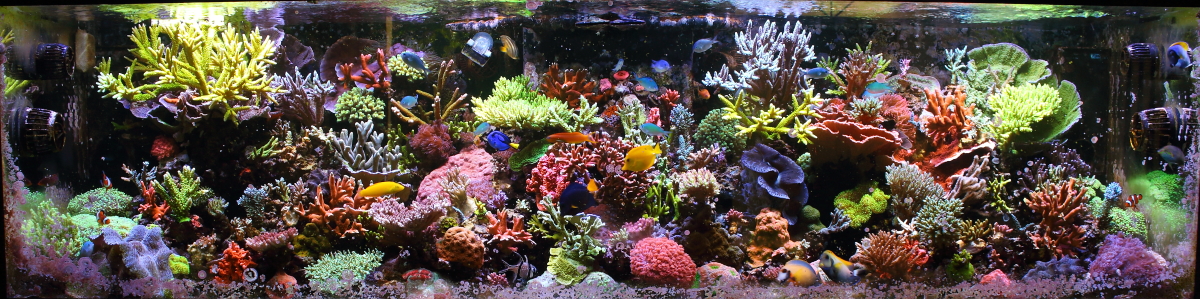
Full Tank shot 5/2013 Before Crash With 12 LED Panels Tank grown under led for about 16 months.

FTSFTS.JPG


Full Tank Shot 1/2014 removing 2 led panels and turning down the leds approx. 50% and adding 4 used 250 watt Radiums. Radiums installed about a month.

ftsjan2014.JPG


The crash was not related to lighting but rather to some HVAC issues and stressed starving corals I had over the summer. The image processing is slightly different but I think there is no doubt that the growth and color has accelerated with the addition of the MH. Thanks JDA if your reading!

Id stick with a combo of the two!

Are you saying the difference in those 2 pictures is 1 month under the radiums? That much growth seems a little hard to believe in a month. Nice looking tank btw.
 
The difference is between the two pics is one month under MHs + 7 months under the original all LED lighting. Check the posted FTS dates.
 
Photons are photons and electromagnetic radiation is electromagnetic radiation, doesn't matter the source. Additionally white leds are using the same phosphors as are used in fluorescent bulbs, don't see much difference there. Spectrum on the other hand will be argued for a long time to come.

There's quite a bit of difference, because the white leds are starting with just a blue led underneath. meaning the spectrum begins only at 450nm and goes down from there. Conversely, noble gas bulbs rely on electron excitation and emission to provide the photons starting well below 450nm and in a more robust way.

What Im getting at is that MH and T5 bulbs provide a more robust representation of the visible spectrum than do LEDs at their current development stage.

what we need is a stable high energy 350nm LED or something with a phosphor coating that can give a spectral plot like a radium or similar. Then I think we'll see a real industry shift.
 
I would be very suspicious of stating that t5 tubes have a broad spectra as they don't - it is typically very peaky, but when presented the spectral plots have been heavily smoothed, smearing out displayed spectral plot.

Remember uv is really heavily attenuated in seawater, so it's hard to believe it's vital for corals
 
anyone ever looked into how WHITE LIGHT is created, or what WHITE LIGHT is ?

WHITE Light coming from a black body [sun] contains all spectrums ... they get seperatd in what we call a rainbow ...

shine an LED on a prism and see what wavelenghts come out.

we still do not have what is needed to make white light with LEDs, so we make blue LEDs, with yellow cover, resulting in whitish ... or the RGB set up for LEDS, which when blended, would show whitish ... we have only limited material used for emitting light in LED ...

in T5 ... we have mercury and po4 and ... which give off a nicer and fuller spectrum ... regular T5 is made of (Ca5(PO4)3(Cl, F):Sb3+, Mn2+). as the gas, and doping each would alter the color...

Also look into CRI, CCT.

use a prism to seperate Wavelenghts on LED and T5, to see the coverage of spectrum.

 
im sorry, but after looking at those two full tank shots i would be happy with either!
the color (to me) of the coral clearly looks more vibrant in the mhalide shot.
that being said, the first (led )pic is awsome too.
 
anyone ever looked into how WHITE LIGHT is created, or what WHITE LIGHT is ?

WHITE Light coming from a black body [sun] contains all spectrums ... they get seperatd in what we call a rainbow ...

shine an LED on a prism and see what wavelenghts come out.

we still do not have what is needed to make white light with LEDs, so we make blue LEDs, with yellow cover, resulting in whitish ... or the RGB set up for LEDS, which when blended, would show whitish ... we have only limited material used for emitting light in LED ...

in T5 ... we have mercury and po4 and ... which give off a nicer and fuller spectrum ... regular T5 is made of (Ca5(PO4)3(Cl, F):Sb3+, Mn2+). as the gas, and doping each would alter the color...

Also look into CRI, CCT.

use a prism to seperate Wavelenghts on LED and T5, to see the coverage of spectrum.

what does a prism of led look like?
all blue?
thanks!
 
Back
Top