LED's with respect to color of Sps corals

Big E

Premium Member
This thread has spawned off from here--
http://reefcentral.com/forums/showthread.php?t=2055941&page=12

It seems the only tanks being cited are from Europe or some other country & I'm not sure what type of units(or brand name) they are using. I'm more concerned about what's out there(in the US) that I can buy today that has at least 6-months to year of success.

From what I have seen..........not much.


Let me preface this post by saying that there's no doubt that LEDs will take over. The newest units from various companies are not out yet & the few that are it's been only for a few months. The spectral plots of quite a few look good & may start to actually color all Sps corals to their fullest with par at 100%.

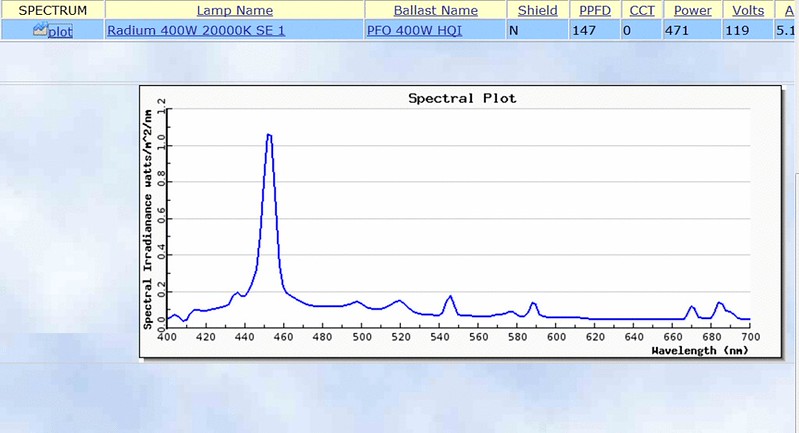
Here is the spectral plot of a Radium 400w bulb on an HQI ballast. It's been the gold standard for Sps for over a decade. You can run very high par get excellant growth & get fantastic colors.
radium by Big E 52, on Flickr

I'd be willing to bet that any tank that has great colors mimics this plot regardless of bulbs & ballasts used. There's many ways to supplement a halide bulb & T5's alone have many bulbs, if paired correctly can match that spectral plot.

There's also many halide bulbs that can come close to this plot on their own.


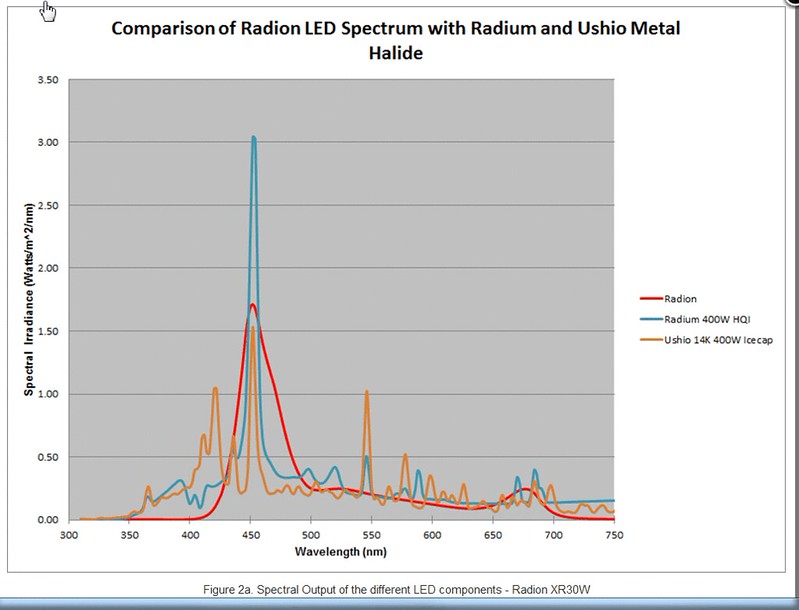
Here's a Radion LED at 100% compared to the Radium bulb........looking at that how can you possibly get the same great colors in your sps with this unit.
You would need some supplementation from, say T5's. Which is fine, but doesn't that defeat the whole purpose? Don't you want to save electricity & not have to replace bulbs?
radion vs radium by Big E 52, on Flickr

Here's the sol blue vs radium.............same issues.

solbluevsradium.gif
[/IMG]


Quote from Sanjay Joshi---
"As seen from the data, there are significant spectral differences between the LED spectrum and those of the most popular MH lamps. The LEDs tend to have more output in the blue regions 400-500 nm range, while lacking in the warmer regions of the spectrum. This could explain why the aquariums tend to have a "flat" look when lit by LEDs. Lack of the red spectrum results in corals and fish with red color to look lack lustre. Lack of a broader spectrum and missing quantities of output at wavelengths to promote a more full spectrum is often a concern cited with LEDs, and it is obvious when comparing the spectrums to metal halides."

http://www.advancedaquarist.com/2012/3/aafeature

I've seen these issues many times in pictures & in person about red & pink on Acroporas just not cutting it with LED only setups. The punch in colors across the board just isn't there unless you use something else to supplement them.

There are some units that do a much better job of hitting the spectrum desired from that Radium bulb, but right now they are few and far between.

The kessel A350 is one that has been out a few months here's their spectral graph at 100%

a350.gif
[/IMG]

Right now it needs more time over people's tanks to evaluate.

Your comments are welcome......I have more to come concerning commercial units that you can buy right now.
 
Last edited:
Thanks for that link & I'm aware of that article.

Are you aware that article is a full two years before Sanjay did any spectral tests on LED units?

It's great for evalutaing coverage & par.......and it's welcome, but isn't related what so ever in reference to coloring Sps.
 
I added 9 reds, 9 violets, and 9 green to my 5 ai sol blue fixtures and have had excellent sps coloring since adding the diy bars to my set up. I feel that the regular white/blue combo isn't enough.

I just wish my photography skills were up to "par" hehe. I have seen great coloration since adding these spectrums, but I was already getting very good results.

_DSC0019.jpg


www.photobucket.com/210g
 
note that the leds also don't have anything in the 350-400 nm range ! I have some bridgelux led's that are supposed to be 400nm but that still leaves a big gap below that 400 range....looks like the radium is putting out pretty good at that range
 
This thread has spawned off from here--
http://reefcentral.com/forums/showthread.php?t=2055941&page=12

Let me preface this post by saying that there's no doubt that LEDs will take over.

Disagree.

Plenty of other will back me on that also.

I have had much better growth using metal halides versus using the best LEDs that are out there.

Plus - my metal halide ballasts have now lasted 8+ years. Bargain.

Same with T5. Had better experience using ATI versus LEDs. Better growth, better color.
 
Don't you want to save electricity & not have to replace bulbs?

LEDs can and do go out early - much earlier than the "50,000 hour" myth that is being told.

Several units from various companies have problems and go out early.
 
Big E:
I've been looking at the spectral graphs of the popular T5 bulbs, which produce colors in SPS that are as good as those produce by the Radium MH, yet they would not match up very well to the Radium graph (I am not talented enough to produce an overlay like you have shown with the LED). Can you explain this?

What is it that the t5's and the Radium have in common that you believe to be missing from the commercial LED fixtures that you looked at? And once that is determined, don't you believe that this missing spectrum is easily supplied by existing LED's. In other words, why can't an LED fixture be created that produces exactly what the MH and T5 bulbs produce that makes the SPS "pop"?
 
In other words, why can't an LED fixture be created that produces exactly what the MH and T5 bulbs produce that makes the SPS "pop"?

We don't have sources yet for quality emitters that cover the entire spectrum. The second problem is the efficiency of current LEDs. If you used LEDs to fill in every peak in the spectrum of MH you would be running close to the same wattage of LEDs. You would still add less heat directly to the aquarium, and you would gain some efficiency from the lack of a reflector but many of the energy savings would be mitigated. Part of the idea behind LEDs is that we can save energy by eliminating spectrums that aren't useful for coral growth. I think at this point we are trying to find the balance necessary between maintaining efficiency and losing some to compete aesthetically.

As LED technology improves we will be able fill the spectrum out more while still using less energy. At some point we may be able to duplicate that spectrum with 100W of LED. We are not there yet though. I'm not even saying all those peaks are necessary as we really don't know yet. This hobby has never had the ability to choose lighting that incorporated such tight spectrums. Once we know what is useful for growth AND color we will be able to fully utilize the technology. IMO


As an aside can we please keep the personal commentary about what we like best out of this thread. I dont believe this is an LED vs MH thread or a cost to benefit thread or a best lighting thread and such comments start off topic rants that result in the threads being closed. See the link in the first post. If I misjudged the OP's intent with this thread then please feel free to correct me.
 
Last edited:
Disagree.

Plenty of other will back me on that also.

I have had much better growth using metal halides versus using the best LEDs that are out there.

Plus - my metal halide ballasts have now lasted 8+ years. Bargain.

Same with T5. Had better experience using ATI versus LEDs. Better growth, better color.

grigsy,

Your'e speaking to the choir.............I'm right with ya. The technology will get there though. The new batch of models have similar spectral graphs to the Radium & more diodes that fit reef tanks are being made.

I doubt I'll make any jump till they prove themselves & I can see a spectral graph from Sanjay or another reliable source.
 
added 9 reds, 9 violets, and 9 green to my 5 ai sol blue fixtures and have had excellent sps coloring since adding the diy bars to my set up. I feel that the regular white/blue combo isn't enough.

Great idea!!!.............pictures aren't needed, no worries. I'm more concerned with spectral plots & specs.

There is going to be a ton of used sols when the Vega comes out..........supplementing with the right emmitters & a few strips is something I was thinking about. The thing that irks me about those Sols is too many Cree cool whites.

Not sure about red & green diodes though.............they do more of coloring the water column than actually flourescing the corals.
 
Last edited:
jerpa said--

As an aside can we please keep the personal commentary about what we like best out of this thread. I dont believe this is an LED vs MH thread or a cost to benefit thread or a best lighting thread and such comments start off topic rants that result in the threads being closed. See the link in the first post. If I misjudged the OP's intent with this thread then please feel free to correct me.

Exactly, thank you jerpa........this isn't about MH-t5 versus LED. It's more about the specturm & technical aspects of LED with respect to coloring Sps corals.

Thanks for the other input also.
 
note that the leds also don't have anything in the 350-400 nm range ! I have some bridgelux led's that are supposed to be 400nm but that still leaves a big gap below that 400 range....looks like the radium is putting out pretty good at that range

Yes, there's that little shoulder on the left that's in that 415-420 range that needs to be covered. I pointed that out in the local thread I linked in that other thread. I'm not sure you want to go much lower though as it starts to get into the UV range & possible coral damage.
 
acesq wrote--

Big E:
I've been looking at the spectral graphs of the popular T5 bulbs, which produce colors in SPS that are as good as those produce by the Radium MH, yet they would not match up very well to the Radium graph (I am not talented enough to produce an overlay like you have shown with the LED). Can you explain this?

First on the MH..........you can look at a spectral graph of a bulb & see what it's missing & then add t5's or another supplement to fill the gaps. You can't really write a combined plotted graph but you can make an educated guess & then use your eyes.......corals don't lie.

There's so many options of bulbs to do this with & they don't burn corals. A bulb is full spectrum.........each diode has a very narrow spectrum. So you have to combine a cluster of them to mimic a bulb. Try to think of a LED cluster or a unit as a single big bulb & imagine what they're dealing with, then add to the fact most diodes aren't designed to grow corals................it's like trying to fit a hexagon peg in a round hole.

On T5's----
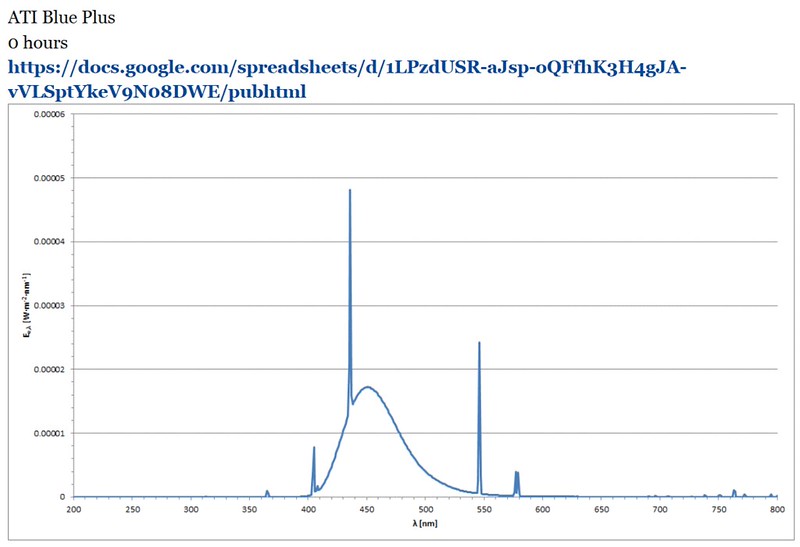
The Ati blue+ bulb covers a lot of that spike from 410-470 range that the radium shows.

ati blue by Big E 52, on Flickr

Now combine it with the ATI Coral +. This bulb has the red/gree spikes, but they aren't so overbearing to wash out coral colors & fills what the Blue+ lacks.

ati coral by Big E 52, on Flickr

You get a bright white ambient look with a slight blue tinge in the water column & the corals pop. You can see some pics in my thread here..........
http://reefcentral.com/forums/showthread.php?t=2197142

Some people do it differently using the ATI purple plus, AB special & an antinic or whatever grouping.
I only had 4 bulbs to work with & hated the too blue/purple ambient look & an AB special washed out colors. You can see their spectral plots here----

http://www.saltycritter.com/lighting/t5-bulbs-ati.htm
 
Last edited:
I'm as cynical as the next man, but my lighting trail in the last few years is ...

400W Radium + T5 supplementation then ...
8 tube Sunpower - got it for a steal, wanted the look of Radiums but more grunt and then
Radions.

I can set the Radions up to look very much like the Radium 400 which I also use as the benchmark. The green and expecially the red diode does the job of filling out the spectra compared to the Sol or Sol blue.

I also recall we went thro' all these spectral debates 5 years ago when T5 was considered new, apparently lacked critical peaks in the spectra for successfully growing SPS and lacked the puch only MH has.......
 
We'd be much better off if more of these LED units would give you the capabilities to swap out diodes & offer different clusters instead of making you buy a unit that you dim.......makes no sense to me.

Everytime you dim those things you lower the par, but just to that diode or a diode group...........totally ridiculous.

The DIY guys can probably make a better unit than any manufacturer right now. I'm not well versed on what's available when you make your own, but I thnk they offer emitters that plug in instead of having to solder them?
 
I'm as cynical as the next man, but my lighting trail in the last few years is ...

400W Radium + T5 supplementation then ...
8 tube Sunpower - got it for a steal, wanted the look of Radiums but more grunt and then
Radions.

I can set the Radions up to look very much like the Radium 400 which I also use as the benchmark. The green and expecially the red diode does the job of filling out the spectra compared to the Sol or Sol blue.

I also recall we went thro' all these spectral debates 5 years ago when T5 was considered new, apparently lacked critical peaks in the spectra for successfully growing SPS and lacked the puch only MH has.......

Can you tell me more about your set up? Dimension of tank & number of units.

I downloaded Radions software, but couldn't play with it without a unit attached. Obviously you can't match the 420 range or as big as a spike as the Radium at 450 but you can mimic it by using percentages, so it makes sense.

Can you post a pic of your plot? I'd like to see it & also learn more about what you can do with the software.

The problem I have with the red/ green is it coloring the water column not really doing anything for the coral...........that's fine I guess unless your selling corals.
 
Please do not assume that all LEDs in the array must be the same 3 watt bulbs, or all 1300mA, etc. Adding low power LED's to fill out the color spectrum will not use very much wattage over time and the low power LEDs are cheaper than the high power ones. Also, a big advantage of LED lights is the ability to run portions of the array at lower power. On a DIY LED array (and some purchased ones) Each set of LEDs can be ran on less power or more to tweak the color or spectrum, and will actually use much less wattage than the rated amount.

The posted charts only cover the full-power spectrum of a very specific purchased LED light. A hobbyist can easily use more or fewer of various LEDs to change it, including using even more in 450-460nm to provide more luminosity than the MH bulbs. I pulled up mouser, and found plenty of ultraviolet LEDs in the 365-410nm range. The problem is cost, LEDs in this range are 4x or more than 450nm LEDs. No wonder the big manufacturers do not add this part of the spectrum.

I expect that DIY hobbyists will find combinations of LEDs, power settings, patterns of the array design, and lenses (or not) to achieve the results of equal or better growth and color than is achieved through MH. And I think it is likely to not match the color spectrum chart of the Radium 400w HQI. DIY'ers will experiment with LED's in real-world trials where they are not attempting to match any existing spectrum charts to find what truly works.
 
I couldn't agree more about the DIY'ers.

------------------

In a perfect LED world you'd want to to able to have a correct spectrum for corals with the unit at 100% par. So all you have to do is raise or lower the unit or dim(all the LEDs at the same percentage).

Right now with these commercial units you can only dim certain colors or groups to mask the inappropriate clusters.

To make an example of how this is bad.........

Joe Blow buys say two units to cover his tank. He looks at the companies coverage plot or the rep tells him it will cover a 24 x 24 area at 100%.

Joe blow sets them up & has to dim certain diodes to get the ambient color or not burn his corals & all of a sudden he doesn't have the coverage he was supposed to have because now his unit isn't running at 100% He's dealing with shadows, or corals that won't color up correctly. Then he adjusts more to get the colors right & his tank looks too dark or blue. Or he finds out he has to buy another unit to get a uniform look.

I don't envy guys buying these commercial units with big deep tanks.
 
Some people do it differently using the ATI purple plus, AB special & an antinic or whatever grouping.
I only had 4 bulbs to work with & hated the too blue/purple ambient look & an AB special washed out colors. You can see their spectral plots here----

http://www.saltycritter.com/lighting/t5-bulbs-ati.htm

Great thread!

I recall a few years back when the T5s were in question. One of the sweet tanks from Germany was running 1:1 aqua blue:blue plus. Most thought the tank was gorgeous. Many halide users viewed the tank as cold looking and lacking depth. Then came the Fiji purple and the like. Now it's pretty much a standard in the T5 world. I think it's the same with LEDs. Cool white and royal blue are not enough.

What I don't understand is why the Fiji purple is so popular when most of the spectrum is wasted (huge spike in the red range). I think there is a disconnect between what the corals need to show their best colors and what our eyes need to see them.
 
Back
Top