
You are using an out of date browser. It may not display this or other websites correctly.
You should upgrade or use an alternative browser.
You should upgrade or use an alternative browser.
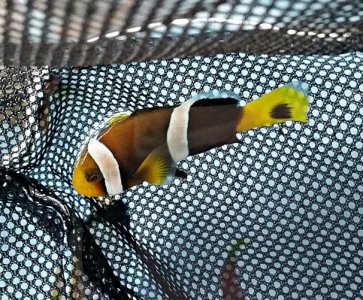
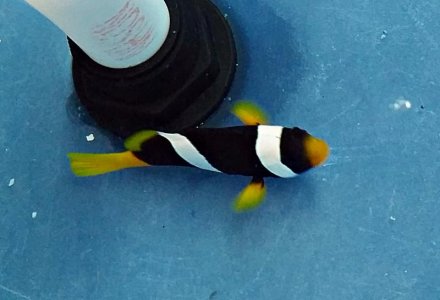
Let's play another round of: ID this clownfish
- Thread starter Postal
- Start date



Amoo
Member
Description
The Sebae Clownfish are elongated, slender bodied clownfish from the Saddleback Complex, in contrast to the deeper bodied shape of those in the Clarkii Complex. This species is the largest in its complex, reaching reaching 5.5” (14 cm) in length. They can have a lifespan of up to at least 12 years, and possible longer.
Sebae Amenonefish typically have a black to dark brown body with two broad white bars, and a yellow-orange coloring on the face, bottom fins, and tail fin. They typically never have white outlining the tail fin or have any white at the base of the tail fin. There is also a melanistic form that is all black except for the white bars, the yellow tail, and a gray nose. The base of their tail fin and the entire tail fin is always yellow-orange, except with “designer” colorings in captive bred specimens. In various natural color phases, the following can occur:
The dark brown coloring extends from the top of the fish to at least 2/3rd to 3/4ths downward and they have a yellow-orange belly and nose. Only the dorsal fins are dark brown with the second dorsal fin having white at the top edge. The other fins are yellow-orange.
The black color phase comes from Bali and only has an orange in the tail fin, and a light gray nose.
The mostly dark brown color phase is the same as the black except the pelvic fins, nose and tail fin are yellow-orange.
This fish is sometimes mistaken for the Clarkii Clownfish Amphiprion clarkii as they have a similar color pattern, though the Clark's anemonefish has a deeper body. The Sebae can be distinguished by its second white band tipping towards the back of the fish along the top and extending onto the dorsal fin, and also by its yellow anal fin.
The Sebae Clownfish can also be confused with the Saddleback Clownfish. To tell the difference between the two, the Sebae always will have a bright yellow-orange tail fin in all its color phases, and unlike the Saddleback, the tail fin is never outlined in white.
These fish have been bred in captivity producing the following strains and hybrids, coming from Bali Aquarich:
Picasso True Sebae Clownfish
These color morphs are dark brown to black with gray to yellow noses and tail fins. Sometimes the tail fins may have a black spot of various sizes. There are variations on the amount of yellow in the other fins. They have the two stripes, which are irregular and typically have white spots as well.
White Tip Clownfish
This fish is a fertile hybrid between the Sebae Clownfish A. sebae and the Saddleback Clownfish A. polymnus. Although no pictures have been seen yet, it would be hard to distinguish these without counting spines and rays on all the fins.
Source: http://animal-world.com/encyclo/marine/clowns/sebae.php
Would tentatively ID it as a Picasso True Sebae Clown based on that description, but probably some generational cross breed. That tail spot is definitely not a common trait, but he's missing the altered bars so ???
Amoo
Member
Really depends on how you look at it, as they are both one in the same. All the designer clowns we have are really "aberrations" from the original species markings. Some type of DNA misnomer if you will.
Looking at the pictures and assuming that both tank mates are from the same clutch, I would say these are probably some tank raised Sebaes. Whether the one you're looking at was pulled out of a line bred from the Picassos and sold as a regular Sebae because it didn't develop altered bars or is the genetic anomaly itself is hard to say.
The article specifically states that Black color phase BALI have a light gray nose which the one on the bottom does not appear to. I honestly don't follow all color morphs Bali has in their lines so I don't know if there is an acceptable black/brown morph in their lines with the yellow nose. Or even a black morph with yellow fins.
All that said, if you're interested in the fish it is definitely a unique look. Personally if I were looking for a Sebae I would probably snag it. In order to properly verify where it actually came from, you're going to have to get the vendor to give up his source and so on and so forth until you can trace it back to the actual breeder. I would suspect you might find Bali somewhere in the lineage, but color morphs can just happen in any line so it really is hard to make a call one way or the other when a fish doesn't adhere to all of the "standards" for that classification of morph.
Looking at the pictures and assuming that both tank mates are from the same clutch, I would say these are probably some tank raised Sebaes. Whether the one you're looking at was pulled out of a line bred from the Picassos and sold as a regular Sebae because it didn't develop altered bars or is the genetic anomaly itself is hard to say.
The article specifically states that Black color phase BALI have a light gray nose which the one on the bottom does not appear to. I honestly don't follow all color morphs Bali has in their lines so I don't know if there is an acceptable black/brown morph in their lines with the yellow nose. Or even a black morph with yellow fins.
All that said, if you're interested in the fish it is definitely a unique look. Personally if I were looking for a Sebae I would probably snag it. In order to properly verify where it actually came from, you're going to have to get the vendor to give up his source and so on and so forth until you can trace it back to the actual breeder. I would suspect you might find Bali somewhere in the lineage, but color morphs can just happen in any line so it really is hard to make a call one way or the other when a fish doesn't adhere to all of the "standards" for that classification of morph.
Amoo
Member
I can't find any evidence which would support that, but it is entirely possible. The tail spot is a common feature in the Bali Aquarich lines seen here http://************.com/2012/04/05/picasso-sebae-clownfish/
Doesn't mean they aren't wild caught, I just can't find evidence to support the claim. Keep us posted though as I'm intrigued.
Doesn't mean they aren't wild caught, I just can't find evidence to support the claim. Keep us posted though as I'm intrigued.

ThRoewer
New member
If they were wild caught in the waters around Bali it couldn't be A. sebae since its distribution doesn't reach Bali. At Bali you would only find A polymnus.
That said, Bali is just one of the Indonesian shipping ports and the fish you get from there could come from all over Indonesia (a store here has a pair of wild PNG onyx percula that came in with a Bali shipment).
The first one could be either A. polymnus or A. sebae. The black spot on the tailfin is nothing unusual for sebae. I had several sebae with those tail spots before, and they were not hybrids. Often it's a remnant of the juvenile coloring that may go away later. It can also be a menanistic coloring.
The second one looks like a clear A. sebae.
That said, Bali is just one of the Indonesian shipping ports and the fish you get from there could come from all over Indonesia (a store here has a pair of wild PNG onyx percula that came in with a Bali shipment).
The first one could be either A. polymnus or A. sebae. The black spot on the tailfin is nothing unusual for sebae. I had several sebae with those tail spots before, and they were not hybrids. Often it's a remnant of the juvenile coloring that may go away later. It can also be a menanistic coloring.
The second one looks like a clear A. sebae.

ThRoewer
New member
I think the first one is a Sebae. I have had one or two that were brown colored when they were younger then turned the deep black and eventually looked like the one in the second picture.
Might be - it would help to know how big he is. Juveniles have often a more or less different coloring.

Yuri Barros
Member
The black dot at the fish Tail is due that Bali is the OVERLAP zone..............between Amphiprion sebae fron Indian Ocean X Amphiprion polymnus from Makassar Strait............WALLACEA..........
The population of Amphiprion polymnus reach Bali island (Lombok Strait).........due Indonesian throughflow (ITF)................

So............this is he morph of Amphiprion polymnus founded in the area of Sulawesi.........Lembeh Strait........Makassar Strait..................until they reach Bali.........
Picture from Lembeh Strait.........

Pictures from Bali.......


Well...........these WALLACEA morph of Amphiprion polymnus...........is one of the Parental species.............
Another parental species is the TRUE Amphiprion sebae..............from Indian Ocean........
Let´s see some pictures of Amphiprion sebae........
Musandan........Oman Sultanate........

Musndan......

Thailand.........Andaman Sea.......

Krabi........Thailand.........

Thailand..........

Kho Racha.......Thailand..........

These are some exemples of the Amphiprion sebae from Indian Ocean...........from Oman´s Gulf and persian Gulf to Andaman Sea untill they reach Bali.............where these two species have an encounter...........an OVERLAP AREA........
The population of Amphiprion polymnus reach Bali island (Lombok Strait).........due Indonesian throughflow (ITF)................
So............this is he morph of Amphiprion polymnus founded in the area of Sulawesi.........Lembeh Strait........Makassar Strait..................until they reach Bali.........
Picture from Lembeh Strait.........
Pictures from Bali.......
Well...........these WALLACEA morph of Amphiprion polymnus...........is one of the Parental species.............
Another parental species is the TRUE Amphiprion sebae..............from Indian Ocean........
Let´s see some pictures of Amphiprion sebae........
Musandan........Oman Sultanate........
Musndan......
Thailand.........Andaman Sea.......
Krabi........Thailand.........
Thailand..........
Kho Racha.......Thailand..........
These are some exemples of the Amphiprion sebae from Indian Ocean...........from Oman´s Gulf and persian Gulf to Andaman Sea untill they reach Bali.............where these two species have an encounter...........an OVERLAP AREA........
Last edited:
Yuri Barros
Member
Let´s see some HYBRIDS..................
From BALI.........

One can see together Amphiprion sebae and Amphiprion polymnus.............in Bali.....

See them all together in the OVERLAP zone........in Bali........

Bali........

Bali.......

Bali.......

So.............fishes with blak dots at tail that came from Bali..............is due this OVERLAP area.............between Amphiprion sebae from Indian Ocean............and Amphiprion polymnus from Wallacea...........
From BALI.........
One can see together Amphiprion sebae and Amphiprion polymnus.............in Bali.....
See them all together in the OVERLAP zone........in Bali........
Bali........
Bali.......
Bali.......
So.............fishes with blak dots at tail that came from Bali..............is due this OVERLAP area.............between Amphiprion sebae from Indian Ocean............and Amphiprion polymnus from Wallacea...........


