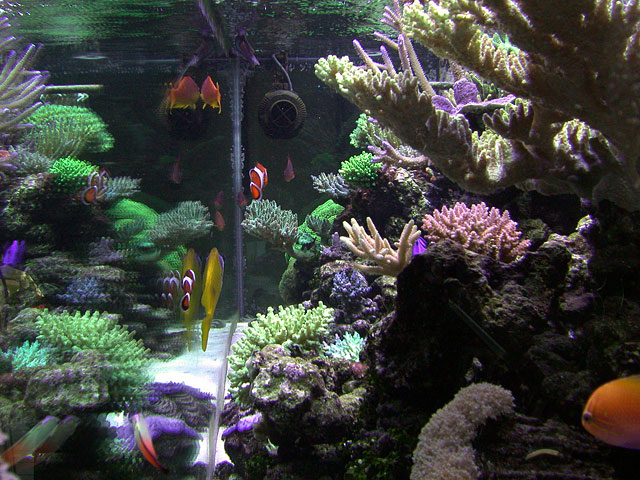
Let's talk about water quality in an SPS tank.

invincible569 said:
Now, if we live in a beautiful atmosphere, smog free, 70 degrees weather, then we become more healthy. Same goes for any animal in its environment. If not we become ugly people! ;) JK

That's why the Oregon Tort is the best looking coral...haha LOL :D

Also, there have been cases where carbon, that have been deem PO4 free, have leeched PO4 back into the tank.
 
I also want to remind everyone that having nitrate and phosphate levels at or near near zero only means that they are being used up at about the same rate they are being added. So even if your nitrates or phosphates currently measure "0", working to reduce them further through water changes, improved export, and better maintenance habits can still pay dividends.

Mike
 
...not to mention that the sensitivity of test kits for nitrate and phosphate is well above the threshold needed for algae growth.

I think dissolved organics is a big one - and goes hand in hand with the clear water thing. DOs are a huge group and accurate testing for them is not really very accessible to the hobbyist (that I know of). I'd bet that many "unexplained" negative phenomena may just be a result of DO toxicity. With the wide array of chemicals labelled "DOs" and the lack of suitable testing, one would expect them to be somewhat "mysterious" players...
 
For those of you keeping a tight lid on your water chemistry, what test kits are you using? I'm especially interested in the kits you guys are using for Nitrates, PO4, and Magnesium.
 
And what would be `mystery X factors' that we can define?

D.O.M. /Organics would appear to be one.

I'd suggest Bacteria as well. :rolleyes: As I would propose that different tanks have different bacterial levels, and in closed aquaria environment ... bacteria often are a dominant player. No idea how to discuss, compare this one; yet that doesn't mean it's not a player + likely relates to or stores compounds [nitrogen, phosphorus] that relate directly to water quality. Given their generally short lifespan, said nutrients are being cycled in and out of the water system.

Tests for Phosphate almost make it a mystery, but maybe not.

What other ones are out there?

It's good to have an idea of what other variables are playing, even if we can't test or directly control them. I'm sure ORP monitors tell an interesting always changing story of many variables [seems like pH does to a degree].
 
AlgaeMan said:
Shouldn't ph be on the list?

I'll edit the fist post to include pH, forgot about that one :)

I feel pH should be between 8.0-8.3 with the smallest swing you can manage. Mine goes from about 8.15 to 8.30 on a normal 24 hr period.

You can have low pH in the 7.9 and 7.8 but ultimately I think you are best trying to keep it above 8.0.
 
JB NY said:
I'll edit the fist post to include pH, forgot about that one :)

I feel pH should be between 8.0-8.3 with the smallest swing you can manage. Mine goes from about 8.15 to 8.30 on a normal 24 hr period.

You can have low pH in the 7.9 and 7.8 but ultimately I think you are best trying to keep it above 8.0.
This might be a dumb question but, how do you stabalize your PH? During the photoperiod the PH always goes up as we all know.
 
aquariumclown said:
This might be a dumb question but, how do you stabalize your PH? During the photoperiod the PH always goes up as we all know.

High Alk will help stabilize pH. So will a refugium on a reverse daylight lighting schedual. Some people have swings of 7.8 - 8.2 or 8.3 that's a little much IMO. I think pH swings of .2 are good to work towards.
 
I think one of the best way to keep your water quality high is to have a high turn over of water, i do a 20% water change weekly and i also feed heavily, since i started doing this in Jan. the fish and coral have grown tremendously, more than i really wanted, i had to get rid of some fish that got too big for my tank as they were fraging the sps and not letting me do it.
 
Testing Kits

Testing Kits

For those of you keeping a tight lid on your water chemistry, what test kits are you using? I'm especially interested in the kits you guys are using for Nitrates, PO4, and Magnesium.

I really like the Salifert kits. I use them to test for Calcium, Alkalinity and Magnesium. I don't test for nitrates or phosphates since I don't have a problem with nuisance algae in my tank. I test pH with a Pinpoint pH controller, salinity with a Pinpoint salinity monitor and I check the temperature everytime I glance at the tank with the digital thermometer mounted on the wall behind the tank.

To be honest, I haven't tested with the Salifert kits for months. I watch for nuisance algae, and the growth and color of the corals to make sure water conditions are okay. I feel close observation of your corals on a daily basis is a good way of gauging your water conditions.

Recently, I noticed one of my green table corals in the back is bleaching a little in the tips since I changed from a flat to a parabolic reflector for my metal halide lamps. The bleaching seems to have stabilized and no other corals have been affected, so I'm not going to worry for now.
 
I would agree with the parameters listed. These seem to be what is mentioned in most reefkeeping texts. Nothing earth shattering, but what interested me was some of the comments.

While I have decided not to continue using Rowaphos, I am not sure we can lower phosphates to the necessary levels through RO/DI, water changes, detritus removal, macroalgae, not overfeeding etc.. Especially if we want to keep fish.

Tom, what do you consider necessary levels? We all/ or most get zero readings so are you referring to vivid colors? And why do you feel this is unattainable with the process you mention above?
Could it be we all tend to want a loaded tank with a large enough variety of fish & corals(the usual TOTM)? How bout a lighter load of fish & corals that better matches the size of tank & export system they are in? Or maybe the way we go about these tasks isn't maximizing them to their fullest benefits. Or the speed of which animals are added to a system sure would make a lot of parameters flucuate.


Joe,
Why is Cyano in the corners here or there okay?

I didn't want to take this post off topic but it looks to be already exhausted..............so when you move on to water movement & maintenance practices, bioload, for other threads, ect. this should get interesting. It would be great if you could continue these. Looks like you got a nice series going here. I think it will promote a lot more "outside the box" thinking.
 
Hi,

I understand what the params should be and why. How about the "hows". Exactly HOW do you keep these water parameters within your target range?

I've read a lot about "food things" floating in the water to feed coral. If you do that, how can water be crystal clear?
 
If you're wondering about feeding, I bet JB NY has one part of this series eventually coming up about that. This appears a series of discussions on different `sps tank' topics [a good idea].

If you want to talk about feeding now, there's some good threads on it, very different thoughts to search up. For starters, there's this discussion going on:
what's the best thing to feed sps's


Also I'd suggest checking out Eric Borneman's Coral Food series, this is part 1 of 7 [goes thru various kinds of foods, etc]
Food of the Reefs - Borneman

---

As for how to achieve these, esp. with the point raised above about how we do like to jam our tanks with bioload ... that depends I guess.

Attempting to balance importe with export would be the short answer. I'll leave it for wiser heads to answer the long one.
 
Big E,

yes, keeping sps with vivid colors is a primary goal for me, and, I believe, many others on this forum. This seems to require levels of phosphates and nitrates (<0.013 ppm phosphates and <0.2 ppm nitrates are targets that I have seen) That are near or below the detection threshold of commonly available hobbyist test kits. There are more expensive kits that can detect lower levels.

A lower bioload can certainly make it easier to maintain these parameters, and some have gone this route. Many of us, however, do not have really large or multiple tanks, and wish to keep colorful fish and other creatures along with our colorful sps. That is why we are pursuing additional means of lowering these levels.

One method that appears to work well is the ZEOvit system developed in Germany. Rather than get into it here, I will refer you to these threads:

http://www.reefcentral.com/forums/showthread.php?s=&threadid=262217&perpage=25&pagenumber=1

http://www.reefcentral.com/forums/showthread.php?s=&threadid=384195

The first thread on the Advanced Topic forum is long and involved, but worth working your way through.

agiacosa,

on the reefs, there are all kinds of plankton floating around in the water, but the levels of various nutrients dissolved in the water are extremely low.

Tom:fish2:
 
And what would be `mystery X factors' that we can define?

D.O.M. /Organics would appear to be one.


I guess this falls into the all those untestable nutrients that we can have in our systems when all our parameters test as "perfect". Here is what I use as my gage to keeping nutrients levels as low as possible.

How long can you go without cleaning the front of your glass before you can notice it being dirty? I used to only be able to go 3-4 days and then it really needed to be cleaned. Since last August (10 months ago) I got more aggressive on my water quality, and in the past 8 months or so I can easily go 7 days without cleaning my glass and you can hardly even notice any buildup on the glass when I do clean it, which is now once a week.

As far as stuff being in the water column, I've got things floating around as well, but it shouldn't impede you're viewing of the tank (I use no filer socks or sponges to remove anything either).

Here is a picture (from today) looking down my tank, six feet long. I also have not cleaned the glass for 4 days in this picture, you can hardly, if at all, see any build up yet on the glass. And it's clear from one end to the other.

DSCN4480.jpg


For those of you keeping a tight lid on your water chemistry, what test kits are you using? I'm especially interested in the kits you guys are using for Nitrates, PO4, and Magnesium.

I've had good luck with both Salifert and SeaChem test kits as well.

Why is Cyano in the corners here or there okay

Because almost every tank I have seen in person or on the boards seems to have at least a little. When I write a little, I mean a patch or two here and there. I have some too. But it should only be a little, meaning you have to look for it, not have it visible all over.

I would agree with the parameters listed. These seem to be what is mentioned in most reefkeeping texts.

But I don't think everyone keeps those levels. Keeping SPS and colorful healthy ones, is still a difficult thing to do. From the posts I see in this forum, I would say many people do not keep these levels in their tank. Most people have detectable nitrates, huge temperature swings, hair algae or other PO4 problems (from looking at pictures posted).

I understand what the params should be and why. How about the "hows". Exactly HOW do you keep these water parameters within your target range?

While I have decided not to continue using Rowaphos, I am not sure we can lower phosphates to the necessary levels through RO/DI, water changes, detritus removal, macroalgae, not overfeeding etc.. Especially if we want to keep fish.

Personally I think you can get the levels that are given above. As far as how to do it. The easiest and cheapest way is frequent water changes and carbon. That and aggressive skimming should be able to get most all your levels down as long as you do not stock too heavily with fish. Using a refugium helps a lot. I think many times people are too impatient to wait for the tank to take care of itself.

So what other things are you guys doing to keep your levels down? I'll post everything I do to keep my tank running healthy a little later this morning.

 
JB, wish I could keep my glass that clean. I've got to clean every other day.

I wonder how big a factor water volume plays here? Are the large tanks really easier?

I've been way too busy lately. I haven't had time to clean the skimmer, feed very much, trim the fuge, do water changes (2 mos?), change DI resin, etc. etc... Things are actually looking pretty good. The only thing I've tested in the last 3 weeks is calcium and it hasn't budged off 420 so I assume everything else is OK.:rolleyes: Since the ony additives are a CA reactor, I assume things are relatively balanced.

It just goes to show, sometimes less is more. I did notice that polyp extension wasn't as good as it had been. I quickly discovered the problem: my powerheads and seio were pretty much grown over with coralline and that thick, brown encrusting algae stuff. After a good cleaning, things perked up a lot.

I have 6 fish in my 125 (Prple Tng, CB, Maroon Clown, 3 chromis) I guess the light bioload pays off.
 
Personally I think you can get the levels that are given above. As far as how to do it. The easiest and cheapest way is frequent water changes and carbon. That and aggressive skimming should be able to get most all your levels down as long as you do not stock too heavily with fish. Using a refugium helps a lot. I think many times people are too impatient to wait for the tank to take care of itself.

Joe, I couldn't agree more...........BUT, the quote above is kinda general. People see a tank like yours & they do all that & it doesn't work. Why? Maybe the % change is not enough or their defination of frequent water changes are different than yours. What more specifically is overskimming? Or under or overstocking? See what I'm gettin at?

I think the successful guys need to be asked more specific questions so each reefer can nail down a regime that works basing it off a proven formula. More numbers & things better defined would help alot. Normally this doesn't happen on these threads.

I'm experienced, but consider myself a noob with acros............3 years & have learned more what not to do than what's best.

I'm about halfway to a nice setup...colors & healthly corals.....& it's pretty simple, alot like what you mention, but I'm trying to nail specifics for better control.

Tom,
Same here...colors, overall health........I've been reading that Zeovit thread, but for me I don't consider it an option. Too costly but interesting. It sure seems the users follow a SPECIFIC & exact regime & I think that's the best part about it. Those guys have a plan or exact blueprint for success.......that's more than half the battle.
 
schanz said:
JB, wish I could keep my glass that clean. I've got to clean every other day.


That's what I mean. Most people need to clean their glass every day or two. It's an easy way to see, literally, how good you water quality is. 5-7 days is where you want to be for high water quality. It's much easier than testing your water all the time.

It's not easy to get there. But once you do, good things will happen in your tank.
 
Joe, that's a great quickie reference. It ties into a whole lot of things going on, is fairly easy to keep track of ... great insight IMO.

A great addition to test-able parameters. Hints at stability, definitely requires low dissolved nutrients, and generally a sign of good conditions.

Does anyone monitor ORP? Does that seem useful to watch, predict anything [from practical experience]?

---
As for skimming/overskimming, stocking ... so much is `dependent on situation'. I really learn whenever Joe, or Mojo, or 64Ivy, or some of those I look to for inspiration describe their system ... yet size-wise, equipment-wise ... there's only so much I can `follow their regime' IMO.
Even with exactly the same equipment I'd suspect results vary. I understand the desire for a `game-plan' or even a couple - yet given the amount of unknowns, variance between exact setups/livestock/LR/etc.etc.etc .... IMO it's more important to look at all the parameters and figure how to effect those myself.

That's my take ... but unless you want to switch skimmers, run ozone, and do everything just exactly like someone else's setup ... IMO a better bit to learn the parameters, see how Joe here [and everyone else] achieves them ... and figure what works. Trying to follow an exact plan/rules will leave things like DSB's ... working for some, not for others.

Otherwise it's too easy to think that Ozone generator, or Phosphate media/chamber, or ____ new product will `make things right'. Not to say they won't help, but yet might not solve `my problem' causing imperfection in my tank [and distracts me with gadgets I think I need, instead of other ways to solve the problem]. I could be totally wrong though.
 
Back
Top