Liquid cooled LEDs light fixture

  • Thread starter Thread starter MK
  • Start date Start date

MK

New member
Hi,

Recently finished my crazy project and just want say everything is working awesome and passed my tests ;)

Why liquid cooling? Why not heatsinks?
Well... I like new challenges ;)
Reduced weight comparing to heatsinks, I think is many more positive arguments like better heat controlling, etc...

If anybody is interested i can share some pics and can say more info about my project.

Best regards,
mark
 
It would be fun to see. IMO liquid cooling makes TONS of sense if you can feed that heat into your aquarium, ie for folks in the colder climates and those with basement tanks, and you can utilize a low wattage pump like a 3 watt aqualifter. Then your light gets scary close to being 100% efficient.
 
Certainly interested in hearing more... I think it would great if that heat could be transferred back into the tank during the winter months.
 
Guys, please give me some time cause all pics I have are in my iPhone... Those are not best but decent to see what's going on.

Ok... You can transfer heat back to your tank, you can eliminate heat from your room installing radiator in the window (next to a/c unit) with regular heatsinks you are not able to do this :)
I can use one radiator, two or 5 if necessary to keep my fixture cold and extend LEDs life to maximum... so fare one dual 140mm radiator is enough to keep decent temp when LEDs run at 80% I gonna install three temp probes in my setup and will tell every digits soon. I'm waiting for my apex controller module from service it should come back Monday or Tuesday then I can finish everything.
Right now setup is connected temporary just to see what's going on.

Widmer in the room where is my tank I have problem with overheat all year around, house is very good isolated and I don't need extra heat from my light fixture.
To eliminate about 70-80% heat from my fixture I decided to do liquid and install radiator in the window.
I'll measure air temp next to radiator soon to show what I mean...

Regards,
mark
 
this would be similiar to pc watercooling just on a larger scale.. actually wouldnt be too hard i wouldnt think... the only think you would have to worry about is corrosion if using metal.. wouldnt know how else you would do it.. but have seen plenty of diy pc processor water cooling blocks most were copper thou.. also the heatsink itself would be super heavy is it's thick... but yea cant wait to see what ya come up with..
 
Guys I'm sorry for my bad english but I'm european and english is my second language.

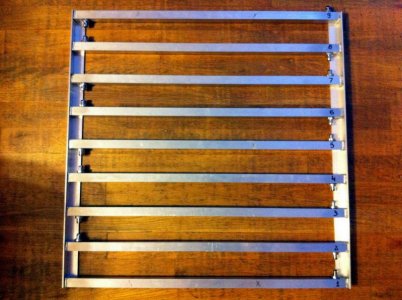
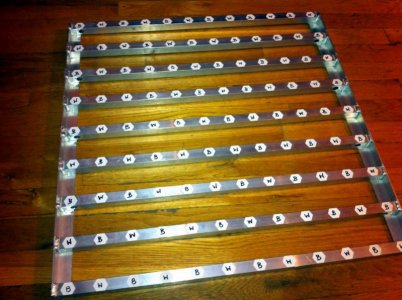
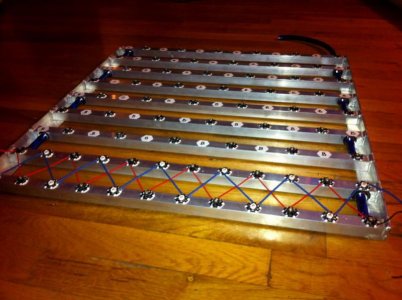
ok here are few pics of the main thing "heat exchanger" just to show how it looks like...
Whole construction is aluminum and we don't have to talk about corrosion...
For test i'm using water but finally i gonna use coolant which gonna lower temperature about 10-15 degree extra.
heat exchanger dimension are 24"x24"x1"
my idea was to install 108 3W LEDs (9 rows, each row 12 LEDs) but finally I installed only 8 rows- 96 LEDs (48 white and 48 blue).
I have marineland cube tank 30"x30"x24"H (93gal) in my opinion 96 3W LEDs (288 W) is enaugh even for SPS corals, and i was right :) I can't run my setup on full power cause is to bright thanks god I'm setting up my tank is nothing yet inside except 3 little fish, live rock and few hermits and i can play as long as i need.
I'll post more pics tomorrow.

Regards,
mark
 

Attachments

  • frame.jpg
    frame.jpg
    81.8 KB · Views: 17
  • frame1.jpg
    frame1.jpg
    78.4 KB · Views: 14
  • frame2.jpg
    frame2.jpg
    64.9 KB · Views: 18
I think the aluminum you used there is sufficient to cool your LED's, you could have just used U-channel, but if it's difficult to get your temps down then I guess this is THE method to use.
 
I think the aluminum you used there is sufficient to cool your LED's, you could have just used U-channel, but if it's difficult to get your temps down then I guess this is THE method to use.

U-channel? ;) I think I understand what you mean but i don't think so it gonna work. Temperature is really high and you can't make any mistakes cause you can burn a lot of $$$ ;)

Regards,
mark
 
I would be cautious about using coolant in any fixture above the tank - what if there is ever a leak? Ethylene glycol is very toxic. I know you are going to be careful to seal it up well, but stuff happens . . .
 
Interesting project.

IMHO, the advantage of liquid cooling isn't that it has potential to be "better" than air cooling, in the sense that it can cool to a lower temperature or anything like that, but more along the lines that widmer was commenting on: liquid cooling allows you much more control over where the heat goes when you remove it from your LED array.
 
I would be cautious about using coolant in any fixture above the tank - what if there is ever a leak? Ethylene glycol is very toxic. I know you are going to be careful to seal it up well, but stuff happens . . .

You are absolutely right!
I was thinking about it and all hose barbs I used ti this project has a tread and also these are glued with very good epoxy.
For pressure test I connected my RO boosting pump and adjusted it to maximum, my heat exchange frame passed 125 psi test w/o any leaks.
I was thinking to take it to my work place and test it with hydrostatic pump as I'm doing plumbing and is no any problem for me but after it passed 125 psi test I don't think so I have to do this cause max fixture pressure can hit maybe about 5-10 psi.
The alternative is to use some "safe" coolant, I research Internet and found some which are safe even to drink ;) hehe yea I know is funny but I have to check it...
 
Interesting project.

IMHO, the advantage of liquid cooling isn't that it has potential to be "better" than air cooling, in the sense that it can cool to a lower temperature or anything like that, but more along the lines that widmer was commenting on: liquid cooling allows you much more control over where the heat goes when you remove it from your LED array.

Yes I understand but...
Even if you gonna use 10 fans to cooling heatsinks all hot air gonna stay in your room. This is the major problem for me and I want to eliminate as much hot air as I can. The other thing is the weight, friend of mine almost finish his 120 pcs LEDs fixture using heatsinks the total weight is about 60 lbs !
My fixture filled up with water is about 20 lbs, the heat exchanger itself (aluminum pieces) weight is 4.4 lb, the whole liquid is 1/2 gal. Some 2"x2" aluminum frame which holding everything another 6 lb and 8 drivers are installed in my fixture... Don't even know how heavy they are.

Regards,
mark
 
"coolant" will not lower the temperature of the system and will in fact raise it. "Coolant" has less heat capacity than water and is used to prevent systems from freezing or change their boiling points.

You should be using distilled water with an anti-microbial agent in it, as things WILL tend to grow in the closed loop and coat the surfaces, reducing the efficiency.
 
To prevent from "stuff" growing in your system. You can use the additive called "water wetter", its use in automotive radiators.(this is for a close loop setup, not to your fish tank).. I use it for my PC water cooling setup and haven't see any stuff growing in the lines or the cooling block.
 
For the battery chillers we use in aerospace, we just add H2O2 to distilled water.

You just have to add a little every few months.

Stu
 
Back
Top