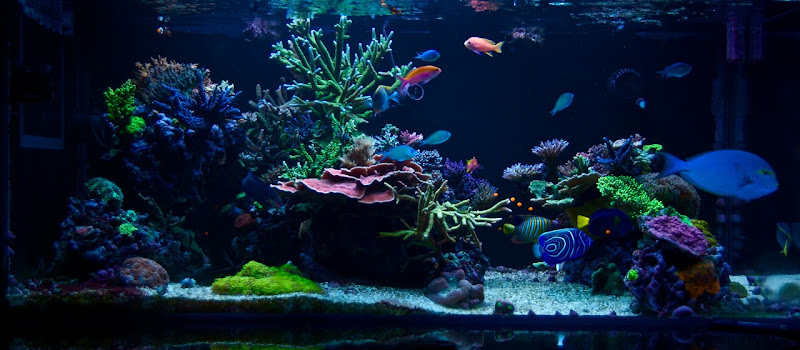
living with aefw

<a href=showthread.php?s=&postid=15438438#post15438438 target=_blank>Originally posted</a> by SDguy
I have not tried an MJ1200, so I can't say anything for comparison. Perhaps the method of basting/blasting was not the issue?

Perhaps, as suggested, the issue is bite marks. I am betting the flesh peels off more easily when there are bit marks.

I blast the corals often enough to avoid major bite marks.

I do not turn off my powerheads. The fish like to chase the litter buggers and I like to see them get chewed put and spit out by my tunze pumps!
 
Another observation that I remember... even after blowing the tissue off that area, polyps were visible in a day or two, suggesting only the surrounding tissue was lost...the polyps were intact.
 
I am having them surface right now. They seem to be only on one of my millies, They are tearing to shreds though. I try basting them, but they seem to be back in about 2 days. Has anyone ever took out all your acros for some time to let the life cycle die out in the tank??

They dont seem to touch any other coral except for my one millie. but its the millie that is encrusted to a HUGE rock and I cant take it out to frequently dip it.
 
I just recently discovered them in my A. valida colony. Turkey baster every couple of days and yes, my fish have learned to eat them!
 
<a href=showthread.php?s=&postid=15443834#post15443834 target=_blank>Originally posted</a> by orcafood
when you guys turkey baste do you see small ones fly off to or just large ones?

It depends. If I have not basted in awhile I may see a number of large ones. If I am doing it more regularly then I may only see small ones, if I can see them at all.
 
I decided to turkey baste today.
I noticed the following

- Turkey basting too hard on corals with heavily bitten areas will cause those areas to lose skin. It doesn't appear to be very bad though, as the corals in my tank, 4 hours later, appear to be developing a new skin. Polyps are still there too.
- Only a few of my fish liked the flat worms. Notably the 3 wrasses. All in the genus halichoeres.
- I tryed to make sure that I got all the ones I could see as they came off (manual removal or consuption by fish) but I am sure a few escaped me into the rocks. These should be removed later by continued basting.
- Oddly enough, the smallest I found was 1/8in. My eyes are fairly sharp and I would have seen something smaller fly off the corals. Questionably interesting. Also I found that turning off the powerheads gives the aefw less of a chance of escaping into the rocks on a lucky turbulent water pattern.

All in all I saved about 12 aefw in a bucket. I plan on running a few tests on them.
 
has anyone see the list of de wormers and tried each of them ?

just google "wiki Anthelmintic"

Levi was listed there...maybe others could be a prospect
 
I just discovered AEFW in my tank while I was basting, so I blasted all my Acros and found AEFWs on 4 of them in different quantities.

I was hoping that a regular basting routine would break the breeding cycle between hatch/maturation/egg-laying but maybe that's just wishful thinking.

Someone posted in another thread that Prazi Pro kills AEFWs. . .anyone try this?

I love this hobby. . .

:D
 
The Prazi Pro experiment failed. Some people have been able to eradicate them completely with basting, but it takes lots of diligence over a long period, and doesn't work for everyone. I just think of the weekly basting as party of my weekly water change chore now. Rocks should be blasted weekly anyway to avoid buildup of detritus, so IMO blasting for AEFW kills two birds in one stone, and forces me to do something I should do anyway, but otherwise might not.

As for colors, I've had them in my system for almost a year and a half. Only time it has affected my colors is when I totally let it go for two months without basting.

FTS:

FTS%209.24.09.jpg


And here are some shots taken a couple weeks ago of some corals that my AEFW love, I think their coloration is ok :)

IMG_2885%20-%202009-09-12%20at%2015-10-53.jpg


IMG_2842%20-%202009-09-12%20at%2014-58-51.jpg


IMG_2887%20-%202009-09-12%20at%2015-11-36.jpg
 
Back
Top