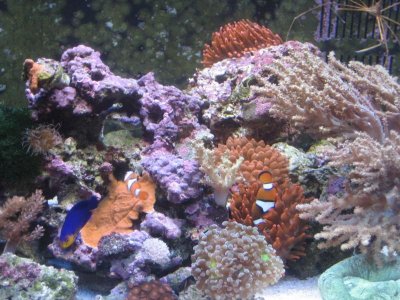
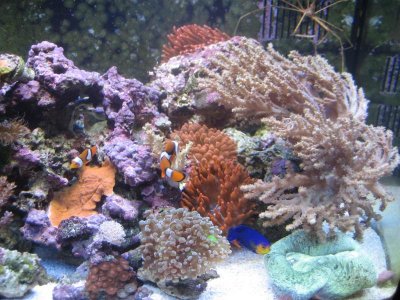
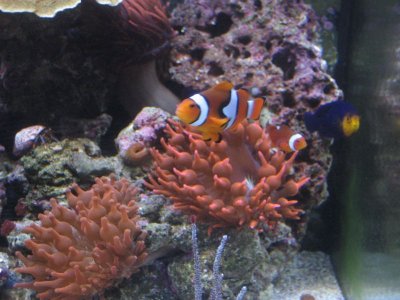
Trying to reason this. So because I added pairs of sexually immature clowns to established tanks with anemones in them than I should not have ended up with breeding pairs in both tank. Both tanks are 24 gal, and had multiple anemones in them before I decided to change from clarkii clowns to another type. I bought juvinile clowns, sexually immature, one pair for each tank and both turned into breeding pairs, without all the aggression. Worked for me, not theory but proof by the pics provided.
It is difficult to reason with clowns, they are victims to their own biology

Most 24gal tanks are small enough to keep the clowns interacting, especially at feeding time. With the species you depict and list, I'd predict exactly the result you describe. But even that size tank will allow a variety of results depending on the specific species and variants involved.
The key point: Don't introduce changes to the tank or community while your clowns are at different bonding stages. The risk is restarting the process with potentially different results.
You might ask, when should you introduce changes? The answer would be when a pairing attempt fails. Such as, removing both the male and female candidates and placing them both in a new environment to sort it out from scratch.
fwiw: The original post does not indicate tank size, proper species name, etc. Such details matter, dramatically.
I'd guess the original posters clowns are Black and White Ocellaris vs. a variant of A. percula with little black and white at a young age(Onyx, PNG, SI, etc.). But they may also be Black and White Saddlebacks(A. polymnus) which are frequently sold as Black and White Perc's.
Black and White Ocellaris have a much rougher courtship then the other color variants of A. ocellaris. Eventually they will calm down, but even after many years of breeding, my females still let the males know who is boss. The males frequently have a chunk of fin missing, a wound, etc.
Black and White Saddleback have a down right abusive courtship/pairing and grow quite large. Pairs should have at least 40gal of space when they mature and be constantly watched.
Net-Net:
Both of the commonly named LFS Black and White "percs" bond more aggressively and more slowly than most A. ocellaris and A. percula. What the original poster described is quite typical and it would not be a good strategy to change anything without providing further information on the setup and a picture of the actual fish.
Cheers and congrats on your breeding pairs, reaching that point is an accomplishment