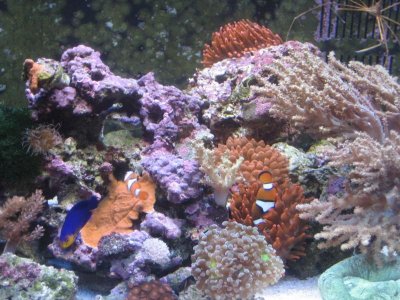
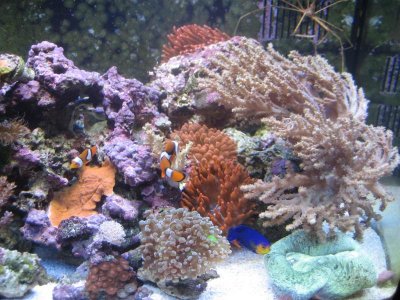
mated pair

My girlfriend got a mated pair of black perc clownfish from the lfs about 6 months ago. When we bought them they were the only two in the tank together and looked to be getting along. We put them in her tank and they seemed alright. After about 2 months though the big woman hosted her bubble tip but wouldn't let the little male near the anemone, now she seems to not like him and usually bullies him to one area of the tank where he is basically forced to hide in some rocks. There are also no other fish in the tank. Are they possibly getting along and thats just the way the are or have they decided to split up? should I try another pair?
 
anemone was added before fish were added, but they didnt host it. Then traded it in for a bubble tip and put it in the same day the old one was taken out. bubble tip was hosted by female within a month
 
Clown

Clown

Normal clown behavior, she may get better or not. Usually it is just a matter of time until she will allow him to come close. Another idea is a BTA of his own.
 
+1 on the other two posts. Itll take time but they will pair up. Maybe the addtion of the bubble tip and their wanting to claim it superseded their desire to pair up. Once she establishes that its her anemone and she knows that he knows theyll go back to pairing up and before you know shell allow him into the anemone too. Good luck! Let me know what happens. Pics woud be cool too.
 
Another idea is a BTA of his own.
Not a good plan during early pairing. Might break the necessary bonding/pairing process.

A mated Pair is an actual breeding pair, the odds of you buying one from a pet store are very low. The odds of buying 2 juveniles or a weakly bonded pair that are swimming together is very high. Changes in accommodations, territory, etc., will upset the pair a bit until they are strongly bonded. Some species don’t take moves well at all and go through rebonding frequently.

I'd expect the dominant fish to claim the anemone, keep pressure on the submissive clown(s), and complete the transformation into a mature female. The aggressive interaction with the remaining clown(s) will likely reduce over time and the next in fish in the pecking order will become a mature male. Without the aggression of some sort, i.e., separating the clowns, no pairing and a possibility of both becoming female increases dramatically.

Keep the clowns together unless the smaller one is getting fins torn off, body wounds, is not allowed to eat at all(feed more food and siphon leftovers), etc. The pairing can sometimes look very abusive, but it is nature’s way.

Good luck.
 
Also make sure you have tight cover over your tank. I lost a clown once who jumped, presumably because he was being chased by the female.
 
yeah the little guy is still eating and fins are intact, although I have seen her try to nip at them. There are no other fish in the tank so I guess that's good. I will be happy to post some pics later for everyone.
 
Clowns

Clowns

Not an early pairing, the clowns have been in the same tank for 6 months. Allowing the male some room of his own is not going to alter their status as a pair. It will give him a rest and hopfully save his life. See pics below, I speak from years of experience. Pics of breeding pairs.
 

Attachments

  • 20091121 0031.jpg
    20091121 0031.jpg
    97.1 KB · Views: 8
  • 20091121 0051.jpg
    20091121 0051.jpg
    101.5 KB · Views: 6
  • 2009122213 0421.jpg
    2009122213 0421.jpg
    87.3 KB · Views: 6
Not an early pairing, the clowns have been in the same tank for 6 months. Allowing the male some room of his own is not going to alter their status as a pair. It will give him a rest and hopfully save his life. See pics below, I speak from years of experience. Pics of breeding pairs.

I respectfully disagree. This is an "early pairing", whether or not hes had the animals for 6 months doesn't matter because it is just now that the female is Maturing, and therefore the bonding is taking place. They were most likely both juvies until now.
I also disagree with adding another bta just to "help" along the process. In my experiences, even in actual mated pairs, the female re-establishes her dominance every time she gains new territory. In other words, if you throw a new bta in the tank she will claim that one also and continue to bully the other clown even more while going back and forth between the btas, which means more stress.
The original poster has described a typical pairing process and nothing seems out of the norm, just let nature take its course.
 
Clowns

Clowns

Trying to reason this. So because I added pairs of sexually immature clowns to established tanks with anemones in them than I should not have ended up with breeding pairs in both tank. Both tanks are 24 gal, and had multiple anemones in them before I decided to change from clarkii clowns to another type. I bought juvinile clowns, sexually immature, one pair for each tank and both turned into breeding pairs, without all the aggression. Worked for me, not theory but proof by the pics provided.
 
My girlfriend got a mated pair of black perc clownfish from the lfs about 6 months ago.
I hope the LFS didn't charge you a premium because they claimed they were "mated".

were they the same size when you purchased them 6 months ago?
 
Trying to reason this. So because I added pairs of sexually immature clowns to established tanks with anemones in them than I should not have ended up with breeding pairs in both tank. Both tanks are 24 gal, and had multiple anemones in them before I decided to change from clarkii clowns to another type. I bought juvinile clowns, sexually immature, one pair for each tank and both turned into breeding pairs, without all the aggression. Worked for me, not theory but proof by the pics provided.
It is difficult to reason with clowns, they are victims to their own biology :) Most 24gal tanks are small enough to keep the clowns interacting, especially at feeding time. With the species you depict and list, I'd predict exactly the result you describe. But even that size tank will allow a variety of results depending on the specific species and variants involved.

The key point: Don't introduce changes to the tank or community while your clowns are at different bonding stages. The risk is restarting the process with potentially different results.

You might ask, when should you introduce changes? The answer would be when a pairing attempt fails. Such as, removing both the male and female candidates and placing them both in a new environment to sort it out from scratch.

fwiw: The original post does not indicate tank size, proper species name, etc. Such details matter, dramatically.

I'd guess the original posters clowns are Black and White Ocellaris vs. a variant of A. percula with little black and white at a young age(Onyx, PNG, SI, etc.). But they may also be Black and White Saddlebacks(A. polymnus) which are frequently sold as Black and White Perc's.

Black and White Ocellaris have a much rougher courtship then the other color variants of A. ocellaris. Eventually they will calm down, but even after many years of breeding, my females still let the males know who is boss. The males frequently have a chunk of fin missing, a wound, etc.

Black and White Saddleback have a down right abusive courtship/pairing and grow quite large. Pairs should have at least 40gal of space when they mature and be constantly watched.

Net-Net:

Both of the commonly named LFS Black and White "percs" bond more aggressively and more slowly than most A. ocellaris and A. percula. What the original poster described is quite typical and it would not be a good strategy to change anything without providing further information on the setup and a picture of the actual fish.

Cheers and congrats on your breeding pairs, reaching that point is an accomplishment :)

 
I hope the LFS didn't charge you a premium because they claimed they were "mated".

were they the same size when you purchased them 6 months ago?

when bought 6 months ago, they were not of same size, the famale was much bigger than the male, the male still had some orange on his face and still has a little to this day. I believe they were listed as black percs?

207w3gl.jpg

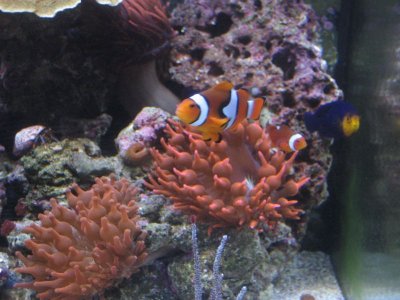
below is rough pic
 
Looks like a B&W Ocellaris from that picture. Not likely A. percula of any variant.

If they never had any yellow nose, fin edges, etc., they are not likely B&W saddlebacks.
 
Back
Top