
You are using an out of date browser. It may not display this or other websites correctly.
You should upgrade or use an alternative browser.
You should upgrade or use an alternative browser.
Maxspect Patent Garbage
- Thread starter Kengar
- Start date

kyle.nagel13
New member
So if the patent is issued, the "copying" company could have to pay royalties on US sales?

seamonster124
New member
So Jebao wants to sell us the same stuff cheaper, and maxspects say no! we want to charge more for the same thing! Put some German writing on the box and they'll line up

biecacka
Active member
So how is a Chinese company requesting a US patent? I don't know the laws, nor am I pretending to so I'm sorry if it's a "dumb" question.
So if they are awards the patent as a US patent, they are stating that a(nother) Chinese company cannot make and distribute like products in US.
What does German writing on the box have to do with it? Does it change the patent laws? I'm confused on that as well....I'm a chef-not familiar with the patent laws like you two are.
Corey
So if they are awards the patent as a US patent, they are stating that a(nother) Chinese company cannot make and distribute like products in US.
What does German writing on the box have to do with it? Does it change the patent laws? I'm confused on that as well....I'm a chef-not familiar with the patent laws like you two are.
Corey
A company anywhere in the world can have patents that protect its products in the U.S. Similarly, a U.S. company can have patents that protect its products in other countries around the world. You select where to file for patent protection based on where you have markets. As noted above, the scope of protection afforded by a given patent is limited to the particular issuing country, so if I sell product in U.S. and Canada and want to have protection in both, I file for patents in both U.S. and Canada.
Re paying royalties, your question appears to be prompted by my explanation of provisional patent rights. IF the company that has been copying the ultimately patented product had ACTUAL knowledge of the published patent application that covers the product, and IF the claims in the ultimately granted patent are substantially identical to the claims as shown in the published version of the application (published while the application is still pending), then the patentee can recover from the copying company "a reasonable royalty" for the copying company's activity that occurred before the patent actually issued. In other words, the patentee will be able to get a little more from the copying company than ordinarily would be the case, since generally speaking a patent does not have any protective effect until it actually issues. (The patentee will also be able to recover "damages" from the copying company, e.g., profits it lost due to the copying company's activity, as measured from the time the patent issued going forward; the provisional rights simply extend the benefit of the patent "forward" slightly, to a time before the patent actually issued.)
As noted, however, in order for the patentee to avail itself of the provisional rights provision and get such pre-patent-grant royalties, the infringing company has to have ACTUAL knowledge of the published application (which ultimately issued as a patent). And one way to demonstrate that a competitor has ACTUAL knowledge of a published application is to send it to them. That is what Maxspect is doing here. The text of Maxspect's letter (one version, at least), reads as follows:
Dear Sirs:
Guangzhou Maiguang Electronic Science Technology Co., Ltd., d.b.a. Maxspect (hereinafter “Maxspect”) is the owner of a utility patent application, which includes claim coverage directed to a cross-flow wave making pump. As a reference, enclosed is U.S. Patent Application Publication No. US 2015/0292507 A1.
I note from two articles in ************.com that industry intelligence indicates that Jebao Co., Ltd. or related entities have designed and may offer a Jecod CP-45, a Jecod CP-25, or other related equipment which is described and illustrated as a “Cross-Flow Wave Pump”. As a reference, enclosed are copies of the two articles as well as a portion of the website at the aboveidentified URL. This equipment may ultimately infringe one or more claims of the pending patent application of the above-identified U.S. patent application publication. Under the provisional rights provisions added to the Patent Act in 1999, a claimant can recover damages (after the patent issues) if it gives notice to the target of the claims after the pending application is published. See, 35 USC 154(d).
At this time, Maxspect would be pleased to discuss various options to provide you with the ability to avoid liability for infringement under provisional rights provisions related to the above-identified patent application. If you are of the opinion that you do not need to take any action at this time with Maxspect, it would be helpful if you could give us some insight into your reasons. Infringement may occur through making, using, or selling a product in conflict with the claims of the above-identified patent application publication. Maxspect may elect to seek damages from one or both of sellers or manufacturers of infringing products.
Please contact me at your earliest convenience to address this matter.
Sincerely,
James A. Sheridan Sheridan Law LLC
NOTE WELL: Nowhere does Maxspect tell anyone to stop selling their product, or that they (Maxspect) has an actual issued patent in hand. This is something the people railing against the Maxspect letter don't understand, and which the people no longer selling the Jaebo product don't seem to understand, either. If my client received such a letter, I would look at the application and the prior art and assess whether, in my opinion, Maxspect will be able to secure allowance of the claims as published (or any claims at all, ever, for that matter) and advise them accordingly. I REALLY wish folks from the industry would contact a competent attorney -- me or someone else -- before simply dropping a product line, so that they can make properly informed business decisions.
Furthermore, as noted, in order to recover under the provisional rights provisions of the patent laws, the claims of the issued patent (if one ever issues in the first place) must be substantially identical to the claims of the published application. This, of course, raises the question of what claims are.
The claims of a patent are found at the end of the document, and they define the precise scope of what is protected in a way similar to a piece of real property that has been described by metes and bounds. In general, a patent claim can be thought of as a checklist of elements or features a competitor’s product must have in order to infringe the patent and subject the competitor to liability. If the competitor’s product is missing even one feature or element of a given claim, either literally or by “equivalents,” the competitor’s product does not infringe the given claim. There can (and usually are) multiple claims of varying scope in a given patent, and a competitor will be liable for infringement of the patent if any single claim is infringed, regardless of how many other claims in the patent are not infringed.
So the question now is whether Maxspect will be able to secure allowance of claims “substantially identical” to the claims as per the published application. If they do secure allowance of such claims, and assuming such claims actually do cover the competitors’ products, then Maxspect will be able to recover “reasonable royalty” for the competitors’ activity from the time they were informed of the published application until the time the patent actually issues. That, then, raises the question of whether the claims in the published application – or ANY claims, for that matter – will be allowed. That is where comparison to the prior art comes in.
If what is described in a given claim is shown identically in a given prior art reference (something that shows what was known prior to the application being filed), then the reference is said to “anticipate” the claimed invention, and the invention as claimed cannot be patented. Alternatively, even if the invention as claimed is not “anticipated” by any single reference, if the differences between what is claimed and what is shown in the prior art would have been “obvious” to a person having “ordinary skill in the art,” then the claimed invention still cannot be obtained. (This analysis is done on a claim-by-claim basis, and you may have some claims allowed in an application and other claims not allowed.)
So, if you compare the claims (sample provided in first post) of the Maxspect application to the prior art (sample provided in the graphic) and the prior art shows everything recited in the claims, the claims are anticipated and cannot be obtained. In that case, if possible, an applicant (e.g., Maxspect) can amend the claims to recite features that are not shown in (or obvious in view of) the prior art in order to differentiate their claimed invention from the prior art. (Any feature an applicant wants to add to the claims in order to “get around” the prior art has to have been disclosed in the application as filed; the applicant cannot just make up some ostensibly distinguishing feature and add it to the claims.) Notably, however, if the claims are so amended after the application has been published, the ultimately granted claims will not be “substantially identical” to those in the published application, and the ability to recover a reasonable royalty based on the competitor’s pre-patent-grant conduct will have disappeared. Moreover, if the applicant adds some feature to the claims in order to secure allowance of their claims but the competitor’s product does not literally include that feature, the competitor’s product will not infringe the claim an there will be no liability at all. (The keen-eyed reader may notice that above I referred to infringing a claim if your product includes every element recited in a claim, either literally or “by equivalents,” but here I only refer to “literally.” If you amend your claims to recite an additional element, the presumption is that you can no longer rely on the “Doctrine of Equivalents” to show that a competitor’s product includes the feature that you amended your claim to recite.)
So, coming back to the Maxspect matter, the pressing question is whether Maxspect will be able to secure allowance of their claims as published in view of the prior art. Or, if not, will Maxspect be able to add any feature that is disclosed in their application to secure any sort of patent protection at all. Time will tell…….
Finally, contrary to Seamonster124’s suspicious assertions, I do not work for Jaebo. Rather, I have my own patent firm (www.kmfpatent.com). Nor have I ever represented Jaebo. I’m just trying to help folks understand so that they can argue with knowledge instead of damning the devil they know nothing about.
Time to get back to work…..
Re paying royalties, your question appears to be prompted by my explanation of provisional patent rights. IF the company that has been copying the ultimately patented product had ACTUAL knowledge of the published patent application that covers the product, and IF the claims in the ultimately granted patent are substantially identical to the claims as shown in the published version of the application (published while the application is still pending), then the patentee can recover from the copying company "a reasonable royalty" for the copying company's activity that occurred before the patent actually issued. In other words, the patentee will be able to get a little more from the copying company than ordinarily would be the case, since generally speaking a patent does not have any protective effect until it actually issues. (The patentee will also be able to recover "damages" from the copying company, e.g., profits it lost due to the copying company's activity, as measured from the time the patent issued going forward; the provisional rights simply extend the benefit of the patent "forward" slightly, to a time before the patent actually issued.)
As noted, however, in order for the patentee to avail itself of the provisional rights provision and get such pre-patent-grant royalties, the infringing company has to have ACTUAL knowledge of the published application (which ultimately issued as a patent). And one way to demonstrate that a competitor has ACTUAL knowledge of a published application is to send it to them. That is what Maxspect is doing here. The text of Maxspect's letter (one version, at least), reads as follows:
Dear Sirs:
Guangzhou Maiguang Electronic Science Technology Co., Ltd., d.b.a. Maxspect (hereinafter “Maxspect”) is the owner of a utility patent application, which includes claim coverage directed to a cross-flow wave making pump. As a reference, enclosed is U.S. Patent Application Publication No. US 2015/0292507 A1.
I note from two articles in ************.com that industry intelligence indicates that Jebao Co., Ltd. or related entities have designed and may offer a Jecod CP-45, a Jecod CP-25, or other related equipment which is described and illustrated as a “Cross-Flow Wave Pump”. As a reference, enclosed are copies of the two articles as well as a portion of the website at the aboveidentified URL. This equipment may ultimately infringe one or more claims of the pending patent application of the above-identified U.S. patent application publication. Under the provisional rights provisions added to the Patent Act in 1999, a claimant can recover damages (after the patent issues) if it gives notice to the target of the claims after the pending application is published. See, 35 USC 154(d).
At this time, Maxspect would be pleased to discuss various options to provide you with the ability to avoid liability for infringement under provisional rights provisions related to the above-identified patent application. If you are of the opinion that you do not need to take any action at this time with Maxspect, it would be helpful if you could give us some insight into your reasons. Infringement may occur through making, using, or selling a product in conflict with the claims of the above-identified patent application publication. Maxspect may elect to seek damages from one or both of sellers or manufacturers of infringing products.
Please contact me at your earliest convenience to address this matter.
Sincerely,
James A. Sheridan Sheridan Law LLC
NOTE WELL: Nowhere does Maxspect tell anyone to stop selling their product, or that they (Maxspect) has an actual issued patent in hand. This is something the people railing against the Maxspect letter don't understand, and which the people no longer selling the Jaebo product don't seem to understand, either. If my client received such a letter, I would look at the application and the prior art and assess whether, in my opinion, Maxspect will be able to secure allowance of the claims as published (or any claims at all, ever, for that matter) and advise them accordingly. I REALLY wish folks from the industry would contact a competent attorney -- me or someone else -- before simply dropping a product line, so that they can make properly informed business decisions.
Furthermore, as noted, in order to recover under the provisional rights provisions of the patent laws, the claims of the issued patent (if one ever issues in the first place) must be substantially identical to the claims of the published application. This, of course, raises the question of what claims are.
The claims of a patent are found at the end of the document, and they define the precise scope of what is protected in a way similar to a piece of real property that has been described by metes and bounds. In general, a patent claim can be thought of as a checklist of elements or features a competitor’s product must have in order to infringe the patent and subject the competitor to liability. If the competitor’s product is missing even one feature or element of a given claim, either literally or by “equivalents,” the competitor’s product does not infringe the given claim. There can (and usually are) multiple claims of varying scope in a given patent, and a competitor will be liable for infringement of the patent if any single claim is infringed, regardless of how many other claims in the patent are not infringed.
So the question now is whether Maxspect will be able to secure allowance of claims “substantially identical” to the claims as per the published application. If they do secure allowance of such claims, and assuming such claims actually do cover the competitors’ products, then Maxspect will be able to recover “reasonable royalty” for the competitors’ activity from the time they were informed of the published application until the time the patent actually issues. That, then, raises the question of whether the claims in the published application – or ANY claims, for that matter – will be allowed. That is where comparison to the prior art comes in.
If what is described in a given claim is shown identically in a given prior art reference (something that shows what was known prior to the application being filed), then the reference is said to “anticipate” the claimed invention, and the invention as claimed cannot be patented. Alternatively, even if the invention as claimed is not “anticipated” by any single reference, if the differences between what is claimed and what is shown in the prior art would have been “obvious” to a person having “ordinary skill in the art,” then the claimed invention still cannot be obtained. (This analysis is done on a claim-by-claim basis, and you may have some claims allowed in an application and other claims not allowed.)
So, if you compare the claims (sample provided in first post) of the Maxspect application to the prior art (sample provided in the graphic) and the prior art shows everything recited in the claims, the claims are anticipated and cannot be obtained. In that case, if possible, an applicant (e.g., Maxspect) can amend the claims to recite features that are not shown in (or obvious in view of) the prior art in order to differentiate their claimed invention from the prior art. (Any feature an applicant wants to add to the claims in order to “get around” the prior art has to have been disclosed in the application as filed; the applicant cannot just make up some ostensibly distinguishing feature and add it to the claims.) Notably, however, if the claims are so amended after the application has been published, the ultimately granted claims will not be “substantially identical” to those in the published application, and the ability to recover a reasonable royalty based on the competitor’s pre-patent-grant conduct will have disappeared. Moreover, if the applicant adds some feature to the claims in order to secure allowance of their claims but the competitor’s product does not literally include that feature, the competitor’s product will not infringe the claim an there will be no liability at all. (The keen-eyed reader may notice that above I referred to infringing a claim if your product includes every element recited in a claim, either literally or “by equivalents,” but here I only refer to “literally.” If you amend your claims to recite an additional element, the presumption is that you can no longer rely on the “Doctrine of Equivalents” to show that a competitor’s product includes the feature that you amended your claim to recite.)
So, coming back to the Maxspect matter, the pressing question is whether Maxspect will be able to secure allowance of their claims as published in view of the prior art. Or, if not, will Maxspect be able to add any feature that is disclosed in their application to secure any sort of patent protection at all. Time will tell…….
Finally, contrary to Seamonster124’s suspicious assertions, I do not work for Jaebo. Rather, I have my own patent firm (www.kmfpatent.com). Nor have I ever represented Jaebo. I’m just trying to help folks understand so that they can argue with knowledge instead of damning the devil they know nothing about.
Time to get back to work…..
Last edited:
thejuggernaut
Member
It may be fun for you!, but not really for all the people who did the original design of the Gyre, and all the people who make their living and feed their families because this products.
People like you that is part of this knock off on intellectual property is the disgrace of your profession, just sad
I think personally you should move to China and work more closely with your people, and forget that at any point you belong to a country of entrepreneurs, and people who want to make a living with their originality, not abusing the inventions of others.
Here we go, no wonder your Avatar is a pirate, and you really make the lawyer profession look like they really are pirates, let me know if you need some money.
Good Lord. You don't quite get it. It is just business and the law. If they have a product that is original enough, they will get a patent, and will be able to get money back out of Jebao. Until then, what is their reason not to make them, cause Maxspect asked?! With that logic, Good Year shouldn't make tires, because someone else invented the wheel before them..... Do you think Bose complains because other companies make speakers also? No, they just try to improve upon either their product or in their case, their brand name to out compete them for customers. If Maxspect wants to outsell Jebao, then maybe they should think about making a product that can actually talk to other units, or include 0-10V inputs from the factory without gouging me for another $100. Congrats, they were first to the market with this product. Now that there is competition, instead of complaining, improve upon your design so that your product is more attractive to consumers. But they don't want to do that. Or how about having waited to see if you could even get a patent issued BEFORE releasing your product into the wild. That is what drug companies do. Releasing a product before trying to protect it, then complaining when others make similar products doesn't make Jebao thieves, it makes Maxspect dumb.

dabob79
New member
Good Lord. You don't quite get it. It is just business and the law. If they have a product that is original enough, they will get a patent, and will be able to get money back out of Jebao. Until then, what is their reason not to make them, cause Maxspect asked?! With that logic, Good Year shouldn't make tires, because someone else invented the wheel before them..... Do you think Bose complains because other companies make speakers also? No, they just try to improve upon either their product or in their case, their brand name to out compete them for customers. If Maxspect wants to outsell Jebao, then maybe they should think about making a product that can actually talk to other units, or include 0-10V inputs from the factory without gouging me for another $100. Congrats, they were first to the market with this product. Now that there is competition, instead of complaining, improve upon your design so that your product is more attractive to consumers. But they don't want to do that. Or how about having waited to see if you could even get a patent issued BEFORE releasing your product into the wild. That is what drug companies do. Releasing a product before trying to protect it, then complaining when others make similar products doesn't make Jebao thieves, it makes Maxspect dumb.
Very well said! It will definitely be interesting to see how all this plays out. In the meantime, I may be picking up one of Jebao's crossflow powerheads! lol
REEFCHITOWN
New member

sixpackgarage
reef mechanic
Interesting stuff, but is a public forum a place for an attorney to discuss pending cases? Kind of seems odd. If I were your client, I'd want my case kept private.
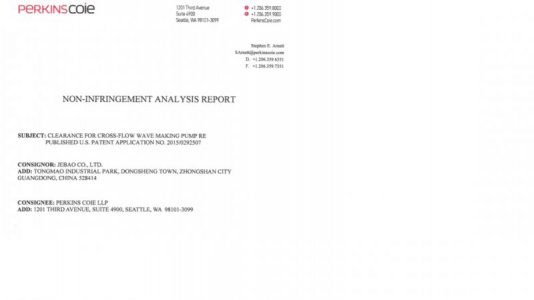
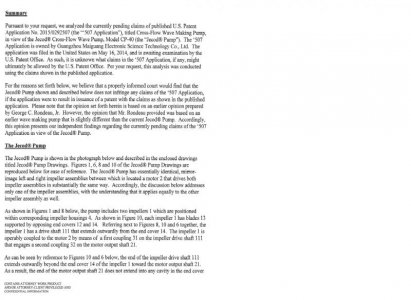
He put up a document from counsel. I'm trying to figure out whether it was prepared for him or someone else from whom he received it. SOMEone pretty much forfeited privilege, and I was surprised to see this letter showing up here. I'm not looking to discuss the merits of it.

xeniabelgium
New member
got this document also by mail earlier this week.
send by Eric W.
i'm not the only one over here that received this mail.
document has 35 pages with the tech details on the jebao cp pump
PDF file is to large to post.
can't figure out how to...
sacha
send by Eric W.
i'm not the only one over here that received this mail.
document has 35 pages with the tech details on the jebao cp pump
PDF file is to large to post.
can't figure out how to...
sacha
Similar threads


- Replies
- 24
- Views
- 7K
- Replies
- 7
- Views
- 5K