

FishMann
Member
A few years ago I started diving Venice FL for Megalodon teeth. The dives are shallow with usually very poor visibility. You dive solo because if you try to stay with a buddy that is what your dive will consist of rather than looking for teeth. I use a compass to have some basic navigation but I will surface a few times to see where the boat is.
The area is a gold mine for not only shark teeth but also many other fossils.


Small sample. Millions and millions and millions of years old. Just sitting there until I came along.
I haven't gone the last two years, but I hope to go again this summer.
The area is a gold mine for not only shark teeth but also many other fossils.
Geology of Florida
So, how did Venice, Florida become the "Shark Tooth Capital of the World"???It started in the Cretaceous around 50 million years ago, when high sea levels kept Florida submerged. Florida stayed submerged for many millions of years. During this time at the bottom of the ocean, Layers of limestone accumulated on the sea floor, creating the "bed rock" of Florida.
Starting in the Oligocene, about 30 million years ago, the global climate cooled, and sea levels began to drop. An island of limestone emerged in north central Florida called Orange Island. This was the first appearance of today's Florida. Rains eroded the porous limestone, creating the cave systems and sink holes common to Florida.
Jumping ahead to 20 million years ago, into the next Epoch, the Miocene, tectonic activity deep beneath the Earth's surface caused uplifting around Florida. Orange Island slowly grew in size as it was raised from the ocean. Although the sea levels were in constant flux during the Miocene, Florida started to get its modern appearance. During this time land animals roamed central Florida, while a very shallow sea covered the coastal areas. At this time nutrient rich deposits washing from the Appalachia mountain building event created heavy sediment laden and nutrient rich waters. These sediments sank to the bottom entombing dead marine animals, countless teeth from sharks (including the Megalodon Sharks), and also land animals when the sea levels would rise. This trend continued until the Early Pliocene, about 5 million years ago. Today the sediments form the phosphate rich formations, including the Peace River Formation. This formation is mostly underground, but rivers, such as the Peace River, expose this formation. Also just off the beach near Venice, this formation is exposed. Fossils from this formation weather out and wash ashore in the Venice area.
Besides for the Peace River fossils, there are also fossils from the Pleistocene.In the Pleistocene, from 2.5 million until about 11,000 years ago the Earth was (and still is) in constant glaciations events. During glacial periods, the sea levels would drop, and Florida's land would double in size. Ice Age animals lived here including Mammoths, Dire Wolves, Glyptodonts, Horses, and Giant Ground Sloths. At interglacial periods, the sea levels would rise, covering much of Florida. Sediments would bury and preserve the remains of these Ice Age animals.
So, today, one can find a variety of fossils, from Miocene and Pliocene to Pleistocene fossils all intermixed by erosion. Venice Beach is a wonderful place to search for these fossils. The shark teeth are so numerous because they are very dense and fossilize easily.Also, sharks constantly lose and replace teeth. Over a lifetime, just one shark can lose over 10,000 teeth. That's a lot of teeth!
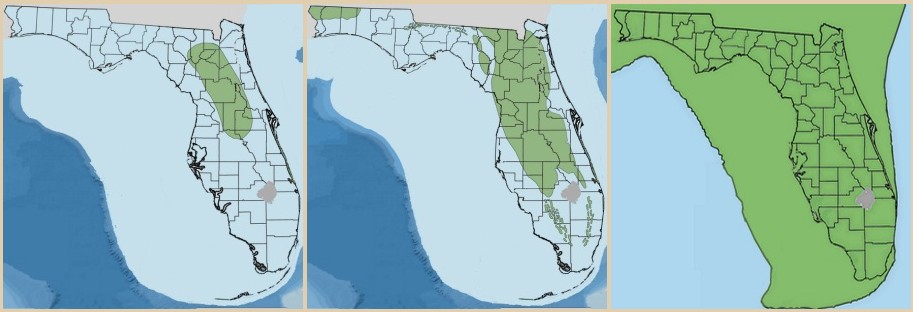
Left Image: Florida in the Oligocene, showing the emergence of Orange Island.
Center Image: Florida in the Early Miocene, during the Miocene uplift event.
Right Image: Florida in the Pleistocene during maximum glaciation/low sea level.
Small sample. Millions and millions and millions of years old. Just sitting there until I came along.
I haven't gone the last two years, but I hope to go again this summer.


