Multi Tank Sump

Malign Reefer

New member
Hi Guys and Gals,

Does anyone here have a multi tank system running off of 1 sump? What I mean is you have a display tank and lets say a frag tank plumbed into one sump for filtration in the same area but obviously separate return lines. If so, can you please post up some pics of how you designed and what it looks like after install?

I did a search but didn't really come up with anything.

Thanks
-John
 
I'd say visit 90% of any LFS and see how they do it. With the exception of one store in the state of Colorado, every store seems to link their displays together with one sump. You just go to home depot and buy a bunch of PVC 'T's and hook the drains together. Twice the overflow means you obviously need more return volume than before, so either 2 pumps, or one really big pump with 'T's in the return to both tanks.
 
I'd say visit 90% of any LFS and see how they do it. With the exception of one store in the state of Colorado, every store seems to link their displays together with one sump. You just go to home depot and buy a bunch of PVC 'T's and hook the drains together. Twice the overflow means you obviously need more return volume than before, so either 2 pumps, or one really big pump with 'T's in the return to both tanks.

Thanks for the reply CleanReef. I'm looking for something in a smaller scale then a LFS. Just mostly looking for some plumbing ideas and such. Don't want to reinvent the wheel here, just want to see what works and what others suggest that have done it.
 
My System has several tanks.. My Display thank is the highest one. Then a breeder coral tank ... then the 75 gallon refugium and the sump in the basement..

The Return pump pushes the water up to the Display tank.. The over flow from there drops into a manifold that splits the water between the Fuge and the coral tank.. there over flow water drops back into the Drain line 2 1/2 in pvc taking the water to the sump...
The pond is pumped to the sump with its own Return pump as its over flow is almost the same level as the sump......
I did it this way to utalize gravity instead of multiple pumps or return manifolds to adjust for each tank, I Do however have a bypass on the Display tank so i can feed water directly from return pump the coral tank. this is only in case i want to work on the skimmer box on the reef without shutting down the whole system...

Hope this helps
 
If you're going to do it, you need to keep in mind the amount of water volume that you will have to contain in the event there is a power outage and make sure that there is enough room in the sump to hold it all, otherwise, you will have a flood on your hands. There is a calculation that you can use to figure out how much available space that you need (if you already know it, I apologize for the repetitiveness). Take the length x width of (each) the tank and multiply it by the height of the waterline to the bottom of the overflow (or return line if you're not running a check valve) divide that by 231 and that will give you total volume that you need to compensate for.

Example, I'm building a 300gal FOWLR 96"x 30"x 24". There is 2" of water between the waterline and the bottom of the overflows and I'm running a check valve on the return.

96x30x2=25 gal to be safe, I'm calling it 30 gal just in case stuff happens.

My sump is a 65 gal (36"x 24" x 18") with normal operating water level at 9" which leaves me just over 32 gal of reserve space. I'm eventually going to add an external 40b fuge which will give me an additional 20 gal of reserve space, give or take a few gal.

Also, if you're going to do a common sump, you want to consider the fact that if something bad gets introduced to one tank, it gets introduced to the whole system.

Jax
 
If you're going to do it, you need to keep in mind the amount of water volume that you will have to contain in the event there is a power outage and make sure that there is enough room in the sump to hold it all, otherwise, you will have a flood on your hands. There is a calculation that you can use to figure out how much available space that you need (if you already know it, I apologize for the repetitiveness). Take the length x width of (each) the tank and multiply it by the height of the waterline to the bottom of the overflow (or return line if you're not running a check valve) divide that by 231 and that will give you total volume that you need to compensate for.

Example, I'm building a 300gal FOWLR 96"x 30"x 24". There is 2" of water between the waterline and the bottom of the overflows and I'm running a check valve on the return.

96x30x2=25 gal to be safe, I'm calling it 30 gal just in case stuff happens.

My sump is a 65 gal (36"x 24" x 18") with normal operating water level at 9" which leaves me just over 32 gal of reserve space. I'm eventually going to add an external 40b fuge which will give me an additional 20 gal of reserve space, give or take a few gal.

Also, if you're going to do a common sump, you want to consider the fact that if something bad gets introduced to one tank, it gets introduced to the whole system.

Jax

Thanks for the feed back Jax.

Correct me if I'm wrong but incase of a power outage arent all tanks that are gravity feed subject to overflow if there is not a check valve present? And I totally get the statement about needing enough room for the total water volum and I think i have that covered but still in the design stages.
 
Last edited:
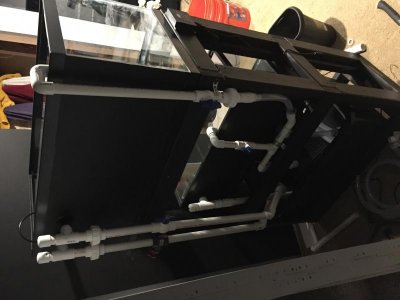
I am currently building a 40breeder with 20L frag tank and ~30gal sump all plumbed together on one stand. water level will be ~9in so roughly 20 gallons in the sump for total system volume of 80gallons :) I just finished the plumbing last night and everything is curing, so I have to wait a few days before the first fill and startup (wait is killing me!)
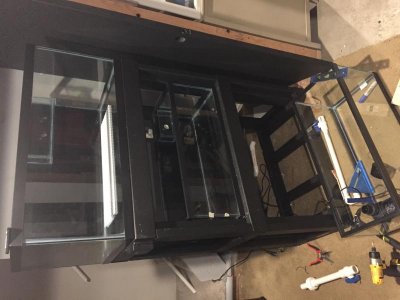
Exactly what they said above, you have to take into account how much will drain from the plumbing and leave some wiggle room in your sump...ie only run it 1/2-3/4 full to leave room for any overflow from display tanks.

I also built my own sump and diy overflow on my 150 african cichlid tank with a 55gallon tank as the sump. water level is about 2/3 full and roughly 4 gallons drains from the overflows/return line when I turn the pump off leaving me plenty of room for error.
 
Heres some pics. Pm me if you would like anymore help on plumbing design or little tips/tricks I have learned during my last 2 builds
 

Attachments

  • IMG_6225.jpg
    IMG_6225.jpg
    51.8 KB · Views: 7
  • IMG_6231.jpg
    IMG_6231.jpg
    43.9 KB · Views: 4
Using a check valve is bad; relying on one is worse.

I think that I'll agree and then agree to disagree. Check valves are useful but can leak back into the sump if you don't keep the flapper clean. They will buy you time to make sure that you're not going to overflow the sump if you don't have sufficient available volume to absorb the amount of water between the bottom of the overflow and the top return (where a vacuum break would occur). Depending on how a system is set up, this could be a significant amount of water.

I actually saw something neat last night during a presentation where someone had installed a check valve in their return line backwards above their return line. Pressure on the system holds it shut (make sure that the discharge would be directed into the tank or overflow just in case it leaked). Turn the pump off and the suction will open the check valve creating the vacuum break.
 
All I will say is that check valves usually fail to do the very thing you bought them to do. I'd suggest that a design that cannot hold all of the potential back siphon is a bad design. Check valves also put extra back pressure on the pump - the 'gift' that keeps on giving. Stopped using them 20 years ago.
 
All I will say is that check valves usually fail to do the very thing you bought them to do. I'd suggest that a design that cannot hold all of the potential back siphon is a bad design. Check valves also put extra back pressure on the pump - the 'gift' that keeps on giving. Stopped using them 20 years ago.

I'm going to over design the sumps to accommodate the extra water in-case of such an event.
 
Yes, size your sump on the assumption that all mechanical aids will fail (check valve, siphon breaks, etc.).
 
I agree with the idea of a check valve I would not use one in this situation..


Plan out your returns to go over the top of the tank and have air gaps on top of each of them.. Make the water level in your Over flow boxes the least amount you can..
My sump is a 75 gallon tank that is 4 feet long.. I have it in 3 chambers.
1. Skimmer chamber . the water level is 16 inches deep and the chamber is 14 inches wide.. then the middle section. (not measured bout about 24 inch . then a single baffle that has a screen to protect the pump in the last small chamber.. The water level runs about 8 inches . when i shut my return pump off it will fill all the way to about 1 inch below the skimmer chamber baffle .... This is how i set the min water level ... Its about 40 gallons of drain back water . for a example of what you might be dealing with ...
 
I agree with the idea of a check valve I would not use one in this situation..


Plan out your returns to go over the top of the tank and have air gaps on top of each of them.. Make the water level in your Over flow boxes the least amount you can..
My sump is a 75 gallon tank that is 4 feet long.. I have it in 3 chambers.
1. Skimmer chamber . the water level is 16 inches deep and the chamber is 14 inches wide.. then the middle section. (not measured bout about 24 inch . then a single baffle that has a screen to protect the pump in the last small chamber.. The water level runs about 8 inches . when i shut my return pump off it will fill all the way to about 1 inch below the skimmer chamber baffle .... This is how i set the min water level ... Its about 40 gallons of drain back water . for a example of what you might be dealing with ...

Thanks for the info, good stuff.
 
Back
Top