Mysterious Fish disease in LFS

RoTTen2TheCore

New member
Hello all,

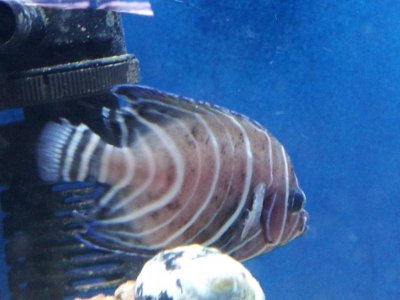
So I work in a LFS and for the past couple of months I have been noticing some strange sort of disease in some of the fish. At least I think it is a disease. One thing is for sure, it is in my system and not in the fish when they come in. To test it, I ordered 2 koran angels and put one in my display tank and the other in my system. The one in the display tank is thriving, while the one in my system has caught the disease and started displaying the symptoms a few days later. Mind you, not all the fish in the system seem to catch it, and those who do, have roughly about a week to live. The symptoms are they begin to lose their color (look very dull) then develop fine white spots (doesn't seem to be ick though) then their fins start to melt away, then death. Their appetite is not affected and they are active until the day before or the very day they die. I attached a pic, hope it helps.

My water parameters are normal:
Salinity: 1.023
PH 8.3
Amonia: 0
Nitrite: 0
Nitrate: 20ppm

The system itself has 8X 14 Watt UV bulbs (which were changed about 2 months ago and are changed every 12 months) and is about 1000Gals total, so I am not sure why the disease hasn't been sterilized by it. A colleague suggested that it may be due to excess electrons in the water due to lack of a grounding probe, I installed one this morning, as I am willing to try just about anything right now.

Any ideas/input appreciated.
 

Attachments

  • 20130402_164835 (1).jpg
    20130402_164835 (1).jpg
    50.7 KB · Views: 28
I have not a clue, but usually when the fins start eroding, ime, a bacterial infection plays some part in it. Whether primary or secondary, no knowing at this remove.

My own inclination would be to treat all species where this has been a problem with Stress Coat, and do anything you can to get the fish to slime up. Feed garlic: no, I don't think it cures it, but if it affects fish the way it does me, it'll prompt them to tear-up or maybe to slime, or it'll just stimulate their appetites.

Angels are sensitive. I'd suspect some general preventative---people dump Prazipro into tanks in hopes of shotgunning anything that's wrong, but if some species are sensitive or allergic to it, a general treatment could be to blame. If there's anything like that going on, I'd stop it and see if that's so. And I'd call the distributor and ask them if they're treating with anything: it could be an interaction, if they're doing one thing and you're doing another.
 
I agree that the bacterial infection might be secondary. I would probably look into it being some toxin causing the issue if it was my shop.

I would add (a lot of) activated carbon and also consider running ozone in the system.

If that doesn't help you might consider sending a water sample to a lab to test for toxins and pathogens. It might be expensive but if you think of all the potential livestock losses as well as the reputation with customers it's worth it imho.

Edit: you would have noticed cirolanid isopods or similar? I'm just asking because the fins of the angel in the picture do look a bit like they were chewed upon by some other animal, not necessarily bacteria.
 
Do some FW dips and check for flukes. They can do that sort of skin damage, and can infect systems.
 
Rotten, were you able to do a FW dip?
Bill's suggestion seems a good one, would be very interested to hear if it turned out to be flukes.
 
I haven't tried any medications just yet, other than dipping certain specimens in some paraguard, which had no effect. I haven't noticed any isopods or any other parasite that would eat away at their fins. It would also seem that certain species of fragile fish are affected more than others, such as butterflies, tangs and anthias (especially square backs, who get it so bad that even their scales are affected and develop gaping holes in their body). Perhaps attempting to "shotgun" the problem would be a good start? Or should I begin by dumping a bunch of carbon in?

I will definitely start giving a few fish a freshwater dip, as it seems like a definite possibilty. Thanks Bill!
 
You won't see anything "jump" off the fish. But after at least a solid minute in the dip, you should start seeing some opaque spots on the fish that start falling off after another minute or so. It's also good to take a good look at the bottom of the dip container for signs of any "dust" or "snow flakes".
 
OK, so I have been giving a few fish some freshwater dips the past week and they have been doing noticeably better. So I do believe that flukes may be the culprit. I will give prazipro a shot. Any suggestions on how to dose the system? I have live sand and rock in all the tanks. Also, do i have to shut off the protein skimmers and uv sterilizers?

Thanks for all the help guys!
 
Its not velvet, right? FW dips can help with it temporarily, since the parasites are usually shallow enough to be affected. Are you seeing any breathing problems? Given they're active, it doesn't sound like something attacking the gills.

If you're losing a lot of livestock, it might be worth draining the system, sterilizing with bleach, then drying and refilling. If you did it just after closing and has the water pre-mixed, you could probably do it in under 24 hours.

You could create new biomedia beforehand by taking a small sample from the clean tank, using it to seed some fresh media, and setting it in a big Rubbermaid filled with freshly mixed SW. Add enough ammonia (ammonium hydroxide works) to keep the level at 5-10ppm. That's low enough that it won't harm nitrifying bacteria. Try to keep it there until nitrates are around 50ppm, let the bacteria eat all of it, and you'll have some potent media. It may take a couple weeks assuming you maintain high flow and oxygen saturation along with temps in the low 80s.
 
I have already tried emptying the entire system, somehow it managed to come back after 6 months (possibly just a re-infestation from another fish). I don't think it is velvet since the fish do not always display white spots, but always get paler and their fins start to get eaten away.
The system is just over 1000 gallons, so emptying it and re filling is quite the chore, but i get where you are coming from in the sense that losing a lot of live stock is worth the time, effort and materials. However, I don't think I am there yet. I am thinking more for my clients, as i certainly don't want to be selling them sick fish.
 
Hello all,

So I work in a LFS and for the past couple of months I have been noticing some strange sort of disease in some of the fish. At least I think it is a disease. One thing is for sure, it is in my system and not in the fish when they come in. To test it, I ordered 2 koran angels and put one in my display tank and the other in my system. The one in the display tank is thriving, while the one in my system has caught the disease and started displaying the symptoms a few days later. Mind you, not all the fish in the system seem to catch it, and those who do, have roughly about a week to live. The symptoms are they begin to lose their color (look very dull) then develop fine white spots (doesn't seem to be ick though) then their fins start to melt away, then death. Their appetite is not affected and they are active until the day before or the very day they die. I attached a pic, hope it helps.

My water parameters are normal:
Salinity: 1.023
PH 8.3
Amonia: 0
Nitrite: 0
Nitrate: 20ppm

The system itself has 8X 14 Watt UV bulbs (which were changed about 2 months ago and are changed every 12 months) and is about 1000Gals total, so I am not sure why the disease hasn't been sterilized by it. A colleague suggested that it may be due to excess electrons in the water due to lack of a grounding probe, I installed one this morning, as I am willing to try just about anything right now.

Any ideas/input appreciated.

How are the UVs set up?

What is the flow rate thru each?
 
Given the significant overhead on live fish even without having to deal with a disease like this, it's probably worth the money to have it cultured.
 
Does this issue come from one wholesaler or does it effect all fish equally? I had this horrendous issue and when I switched wholesalers to a better one (slightly more expensive) the mortality rate subsided.

Since you said it effects angels, anthias, and butterflies I am inclined to believe you have a fluke infestation. Those fish in particular frequently come in with flukes (depending on your wholesaler, they may be more or less infested). Use praziquantel (prazipro) in the system and dose slightly more than recommended. Turn off ozone, uv, skimmer, carbon, and any other chemical filters you are running during treatment. I recommend a good dose every 5 days for 3 weeks. One 35%+ water change at the end of each week with 24 hrs of skimming (it will go nuts). On the 3rd week do a massive water change (70%+), resume all filtration, and add carbon. Flukes come and go with the seasons so you may have to wipe them out periodically. I find I have to do this with my systems about every 4-6 months. I know when I have to do this when most of my established fish start showing flukes on their weekly dip. Finally, make sure you use prazipro on all new orders during drip acclimation to reduce fluke numbers. Routinely dip all fish after they are stabilized in a freshwater pH adjusted prazipro dip once a week. I do not dip my fish longer than 2 minutes with sensitive fish getting a dip of 45seconds to a minute. I find this reduces the shock to their system when the flukes are getting dislodged.

Sent from my HTC One X using Tapatalk 2
 
How are the UVs set up?

What is the flow rate thru each?

it is a 440 watt system, ip64 class 1 with 8 x 55w UV bulbs. For the flow rate, really not sure as i did not build it, but i think it is about 2000 gph.

I did suspect poisoning and put in a bunch of activated carbon, but no effect.

The problem definitely does not come from the wholesaler, as i bought 2 of the same fish from the same tank (koran angels). I put one in my system and another in the display tank. The one in my display tank is thriving and the one I put in my system developed the symptoms within one week and died after another week.
 
First off, I'm no UV expert, but 2000GPH may be too fast. Even with 440 watts of UV. You may only be killing off diatom algae passing through the contact chambers, but allowing pests and parasites to survive and pass right through. See if you can isolate the UV with its own circulation pump. I'm thinking somewhere around 200-400GPH would kill some serious parasites as long as the contact chambers are in a series. I'm sure a UV expert will chime in soon to give you the recommended GPH and UV contact times.
 
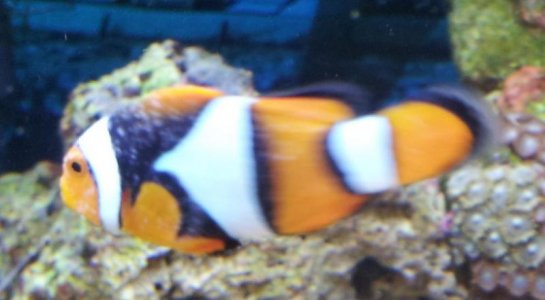
Alright, so I dosed the entire system with Prazipro last Friday, and it would seem that whatever is infecting my fish just got ****ed off because of it. I noticed today that a percula and an orange back fairy wrasse started to develop the symptoms. Here is a picture of the percula. I have the percula with a bunch of cleaner shrimp, and whatever it is the cleaner shrimp are not eating it. Going to try giving them a freshwater dip. I think I might just pour a barrel of bleach into the whole system :spin2:
 

Attachments

  • 20130417_171635.jpg
    20130417_171635.jpg
    37.4 KB · Views: 28
I just lost an emperor angel and a couple of clownfish to something very similar. At first I thought it was marine ich, and am still not sure if it was or was not. I also thought it may be flukes. Mine had spots on the eyes at first, then just a cloudy eye. They all had a healthy appetite until the day before they died. Still concerned and looking into it. I completely drained and bleached the tank just to be safe.
 

Similar threads

Back
Top