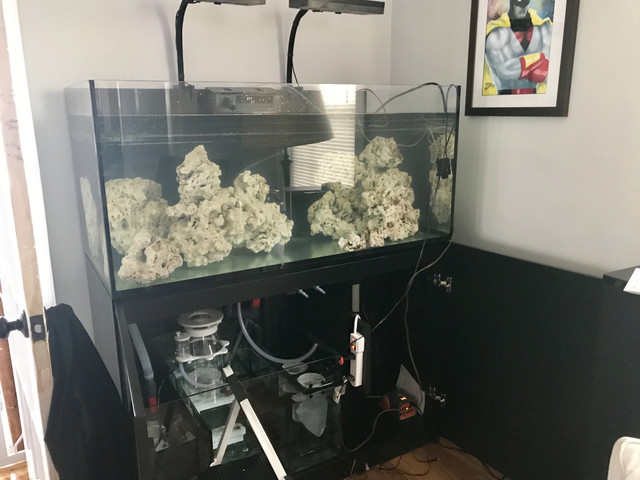
We're in the process of setting up a new salt water tank (Reefer 425) and we're not exactly sure how to proceed. Here's a rundown of where we currently are:
- Tank is setup in terms of plumbing, sump tank, pumps etc. We need to do a leak test on the overflow but assuming that's okay the tank should be good to go from a hardware perspective.
- For live rock we're using pukani. We soaked it in a bleach bath for a few days and then in regular water for a few more. We put the live rock in the tank about 4 days ago with RODI water and there haven't been any problems with smell and the water is pretty clear.
- Tonight we're planning on adding a little bit more water to the tank and making sure that the overflow works correctly so the water starts to cycle from the tank through the sump. We'll also be turning on the skimmer.
Here's what we're not sure about:
- When should we add the salt? Since the take is already full with RODI water we were going to do this in the tank.
- When should we add the live sand?
- What do we need to test for and when? We have testing kits for Ammonia, Nitrates, Nitrites, and Phosphate. Should we test for anything before adding the salt?
- We also bought some Bio-Spira to help start the cycling process. But we're not sure when we should add this in, obviously the salt should already be mixed in but what should we test for to determine when it's time to add the Bio-Spira?
Thanks for any advice!
Hey there,
I'm not sure how much advice I should be giving out because I am very much new to this, but I have completed cycling process successfully and using just a can filter, not a sump. Since I am new please be sure to get verification from someone much more educated here, but based on my experience here it goes..
- Tonight we're planning on adding a little bit more water to the tank and making sure that the overflow works correctly so the water starts to cycle from the tank through the sump. We'll also be turning on the skimmer.
I would leave the skimmer off as it removes a lot of 'good' while cycling your tank, once it is cycled I would then turn on the skimmer. I ran my Octo 2K Classic for about 3 days before being told to shut it off here, and I did shut it off.
- When should we add the salt? Since the take is already full with RODI water we were going to do this in the tank.
The correct way would be to mix it in a 5 gallon bucket or trash can (if you are sucking the water out into the tank). Get your temp and Salinity as close as you can. I would recommend getting a refractometer when testing your salt - I had two of those plastic ordeals and it's garbage (both were way off). After I got the refractometer I picked up some calibration solution and calibrated to 35ppm, and then got my salinity right.
Here is the thing though, if your rock has live organisms or your sand does then you do not want to mix in the tank - but if you are starting 'dry' then you can mix in the tank. Always mix less, it's easier to add then remove (but when fish or any life are in it keep it near perfect before adding)
- When should we add the live sand?
Your first question in my opinion would be when do you add live or dry rock to it? You should add your live rock to the glass (1lb per gallon) and create lots of 'cave' like holes that specific fish really enjoy having in the tank. The reason you do this is because some fish are 'diggers' and little big of sand taken out in the wrong corner could topple your design and potentially crack your glass - the odds are not that 'great', but it's best to be safe.
After adding your rock you would then add your sand, and you should have anywhere between 2-3 inches of sand bed across the bottom of your tank. This allows tiny organisms to grow under there that helps your cycle, and the health of your fish later (especially if you ever get a fish similar to a Mandarin or Goby), once your sand is down and your water/salt mix has sat for about 2 hours - it should be safe to add to the tank (be sure to add at least two power heads one on each side of the tank), it helps stir everything up. I've seen them added to buckets/trash cans on videos to help mix in those as well.
- What do we need to test for and when? We have testing kits for Ammonia, Nitrates, Nitrites, and Phosphate. Should we test for anything before adding the salt?
I went out and got myself a Red Sea Marine Test. I would not worry about testing for Phosphates, Alkalinity or PH right away. The first thing you need ot test for is Ammonia, and then Nitrites and then Nitrates. The way this cycle works if you're unfamiliar is the the fish do the nasty in the water, and then nitrites eat the (Ammonia(nasty)), and then nitrate eat the nitrites. Ammonia is really bad, once you pour your bottle of yuck in there it's going to take several weeks or several months to create the cycle. I would wait a week and take your first test, and then test every night afterwards until you see this happen.
Ammonia is going to spike, be really high
Nitrites are going to spike and be really high
eventually over time your Ammonia is going to down to zero, followed by your nitrites to zero and then your Nitrates will probably go up to about 20 or more - once this occurs (after weeks or months) 30-50% water change to get those Nitrates out of there, once they are down to around 10 you are good to go! Take a bottle of your water to LFS and ask them to test your water and only add a few fish at a time so you can get a feel.
As mentioned I am really new - so I tried to put this into my experience for you, and what I've learned from these very smart people

Hope you have a lot of luck