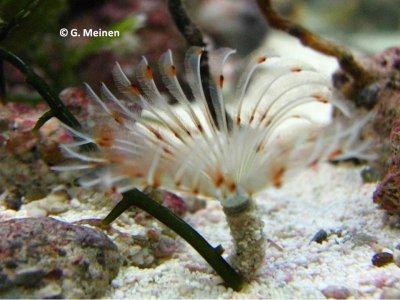
Need Feather duster ID

GerritM

New member
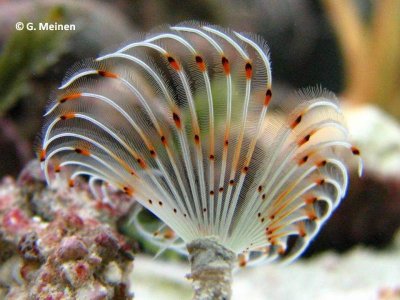
How knows the complete name of this Feather duster?

Genus: Bispira
Species: ?? (viola?)

<object width="480" height="390"><param name="movie" value="http://www.youtube.com/v/RUoGvt0iSBE?fs=1&hl=de_DE"></param><param name="allowFullScreen" value="true"></param><param name="allowscriptaccess" value="always"></param><embed src="http://www.youtube.com/v/RUoGvt0iSBE?fs=1&hl=de_DE" type="application/x-shockwave-flash" allowscriptaccess="always" allowfullscreen="true" width="480" height="390"></embed></object>


Leslie?
 

Attachments

  • Bispira sp.  (1).jpg
    Bispira sp. (1).jpg
    78.6 KB · Views: 19
  • Bispira sp. (2).jpg
    Bispira sp. (2).jpg
    66.2 KB · Views: 14
Hi Gerrit -- Unless that's a european specimen it's not going to be Bispira viola.

Few sabellids can be identified from images. Only a couple of genera have a unique, easily observed character that will separate the from the other genera. Most generic characters are within the tube or microscopic. Species are even harder. Color is often variable as is the number of rows of eyes (in those genera that have eyes).

One of the generic characters for Bispira is the presence of paired eyes; another is a flattened "w" shape on the collar. You can see both of these on my photo - http://www.flickr.com/photos/86448061@N00/2573617428/ From your photo I'm not sure if there's one big eye with posterior extensions or 2 eyes that are nearly fused & the collar is completely hidden by the tube. Something that seems odd is what appears to be eyespots on a few of the radioles (the "feathers') on the right side. Distal eyespots are only found in the genus Megalomma. So my best answer is that I really don't know what it is other than a sabellid. Sorry!
 
Hi Leslie!
Unless that's a european specimen it's not going to be Bispira viola.
Ups, of course not. Distribution of Viola B. completely overlooked . Sorry.

Few sabellids can be identified from images. Only a couple of genera have a unique, easily observed character that will separate the from the other genera. Most generic characters are within the tube or microscopic. Species are even harder. Color is often variable as is the number of rows of eyes (in those genera that have eyes).
Ok, I thought so.


One of the generic characters for Bispira is the presence of paired eyes; another is a flattened "w" shape on the collar. You can see both of these on my photo - http://www.flickr.com/photos/86448061@N00/2573617428/ From your photo I'm not sure if there's one big eye with posterior extensions or 2 eyes that are nearly fused & the collar is completely hidden by the tube. Something that seems odd is what appears to be eyespots on a few of the radioles (the "feathers') on the right side. Distal eyespots are only found in the genus Megalomma.
So far as i can see, is it one big eye.

So my best answer is that I really don't know what it is other than a sabellid. Sorry!
Thats OK so.

Thanks for the reply and input for me. Again something learned.

Sabellida sp. :fun4:
 
Back
Top