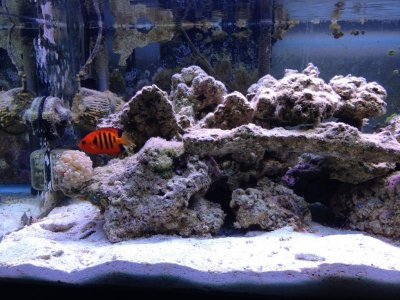
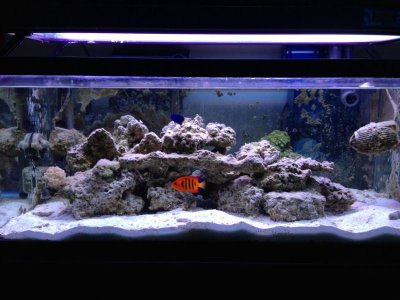
Need help from experienced reefers!!

Louis72c

New member
Ok so I've had my tank for 5 years now and never had a problem until last year. I had a green hair algae bloom. I Checked phosphates and they were at 0.15... Way too high so I tried to get them down with Rowaphos but I never could get under 0.1 so I used phosphate-E and after 2 weeks my phosphates were down to zero. The GHA disappeared but now I'm left with this pink fuzz all over my rocks for now almost 6 months and I can't get it to go away. I even cut down on feeding to twice a week.
Also... My coralline wich was thriving before is now slowly dying off.

Here are my water parameters (All checked with salifert)

alk 3.6 meq/l
Ca 390
Mg 1250
Nitrates 0
Phosphates 0 (Hanna checker)
I use only Ro/Di water
 

Attachments
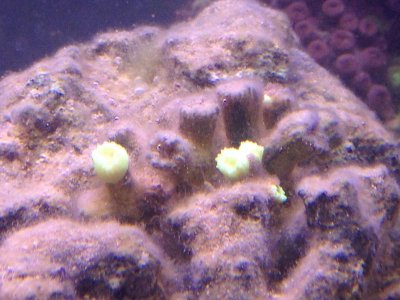
  • IMG_4354.jpg
    IMG_4354.jpg
    71.8 KB · Views: 6
Last edited:
Here is what the tank looks like
 

Attachments

  • IMG_4360.jpg
    IMG_4360.jpg
    91.8 KB · Views: 7
  • IMG_4363.jpg
    IMG_4363.jpg
    64.6 KB · Views: 9
Hard to tell from the pictures but the pink fuzz could be cotton candy algae. Get some Mexican turbo snails. If it's the cotton candy stuff, it should be taken care in short order by the turbo's.
 
Your po4 is not 0.

Remove all po4. Po4 test are telling you nothing. Sell it. Use your eyes to test for po4.

Keep doing w/c's
Get an ATS
Run GFO
 
There's a few programs out there now that don't suggest zero phosphates. In hindsight I found its easier than zero and my corals appreciate it too.

But +1 to the cotton candy
 
I am not a big believer in PO4 causing hair algae or anything else as my PO4 is double that (.25) and I have no hair algae. My nitrates are also 40. I realize most people will tell you, and they believe that those things cause hair algae but I disagree.
You asked for an experienced hobbiest and I have been doing this for over fifty years. You can have hair algae with high or low nutrients, high nutrients will make it greener but they won't cause it. I do not like to get involved in hair algae threads because now the arguments will start which is why I am getting out of here. I also "don't" know why you had hair algae as I can't see your tank from here or know your procedures so I can't give an opinion, but I can tell you that it is not a disease and grows on every healthy reef in the world so it can't be cured, only controlled. I am also not a big fan of Rowaphos.
I recently took this in Hawaii, yes it is hair algae. I hope you fix your cotton candy or whatever it is problem. Good luck.

 
I am not a big believer in PO4 causing hair algae or anything else as my PO4 is double that (.25) and I have no hair algae. My nitrates are also 40. I realize most people will tell you, and they believe that those things cause hair algae but I disagree.

Despite your attempted "drive by" post :D, I gotta' ask... Why doesn't algae grow in your tank?
 
It does, grows like crazy, but I have an agreement with algae, it grows where I want it to grow, in a lighted trough above the water. The conditions are better there for algae and I want algae growing. I love algae and if no algae is growing, something is wrong as it grows everywhere on all healthy reefs and if it were not for algae eating creatures, you would see it everywhere. Here is that same reef in Hawaii. Hair algae all over the place because for some reason the tangs are gone. I don't know why but the place is just filled with Moorish Idols and urchins. If the tangs come back, the algae will be gone. That doesn't work in a tank so IMO it is best to get along with algae and let it grow someplace besides on your corals. I realize I am in the vast minority which is the reason for my "drive by post" As I have posted my theories many times.

 
+1

I noticed when I stopped trying to have a sparkling tank and just left the back wall alone it was much easier to not worry about algae growth since its "controlled" by the back wall. Random mass growths around the tank stopped at that point.
 
+1

I noticed when I stopped trying to have a sparkling tank and just left the back wall alone it was much easier to not worry about algae growth since its "controlled" by the back wall. Random mass growths around the tank stopped at that point.

If you are growing algae on the back wall, then yes, it is acting as a 'sink' for nutrients somewhat like Paul's ATS. As your fish and inverts nibble on it, they translocate most of the nutrients into fecal pellets that end up as detritus...which can then be removed by various means to remove nutrients from the system. I ran a 50g tank 9+ years in exactly this way without a skimmer or media.

If one wants to keep a 'sparkly' tank, as I do today, then algae can be removed regularly from the back wall and tank, literally, and not just scraped off and left to refuel the system. Just another option to keep nutrients in check.
 
Ok so I've had my tank for 5 years now and never had a problem until last year. I had a green hair algae bloom. I Checked phosphates and they were at 0.15... Way too high so I tried to get them down with Rowaphos but I never could get under 0.1 so I used phosphate-E and after 2 weeks my phosphates were down to zero. The GHA disappeared but now I'm left with this pink fuzz all over my rocks for now almost 6 months and I can't get it to go away. I even cut down on feeding to twice a week.
Also... My coralline wich was thriving before is now slowly dying off.

Phosphate removers were originally developed for occasional use for special situations. Somehow, they have become mainstream and often used on a continuous basis, which in many ways is a shame since phosphate (and nitrate) are easily controlled in a properly functioning and maintained reef aquarium. Such natural control of these substances (mainly via detritus removal by whatever means one wishes to deploy) means that changes are gradual and the system has time to adapt properly.

When phosphate is lowered very quickly the tank's balance (read as all the organisms that make up the ecosystem) is upset. Phosphate is required by all living organisms for life processes, so when not enough is available only certain organisms, those who are experts at assimilating it and/or those that need the least, thrive. In your case, the 'pink cotton' is outcompeting the competition and assimilating what little phosphate is left. By reducing feeding you are actually making it worse.

Try slowly adding a bit more food each week. When you start to see that a thin film of brown algae develops only every 3-4 days, then you are in the ballpark as far as phosphate goes. You should then be providing enough nutrients for periphyton, coralline, other types of algae and the other inhabitants to make a comeback and hopefully outcompete the pink cotton organism.

As Paul mentioned, don't be afraid of a bit of algae as it's very natural on a reef (we just don't see it those pristine reef pictures because it is cropped daily by fish and inverts).

Good luck!
 
Last edited:
OK, way too much kissy-kissy agreement going on here.

Yes, phosphate is required for life, but free phosphate means the system is producing more than needed. Binding free phosphate in algae is a perfectly good remedy for some. Unfortunately for me, algae just doesn't behave. I suppose my negotiation skills are lacking. A little GFO and vinegar seems to be the leverage I need to keep it in its place without too much labor.
 
OK, way too much kissy-kissy agreement going on here.

LOL, it's all in good fun :)

Yes, phosphate is required for life, but free phosphate means the system is producing more than needed. Binding free phosphate in algae is a perfectly good remedy for some. Unfortunately for me, algae just doesn't behave. I suppose my negotiation skills are lacking. A little GFO and vinegar seems to be the leverage I need to keep it in its place without too much labor.

As they say "Whatever works". GFO, as in most of these products, can and is used effectively by some experienced reefers in moderation. The danger is when it is used incorrectly by mostly novice aquarists who think it is a 'must have' component of reefing, use too much too frequently, and then wonder why their animals are pale and starving.
 
Last edited:
I am not a big believer in PO4 causing hair algae or anything else as my PO4 is double that (.25) and I have no hair algae. My nitrates are also 40. I realize most people will tell you, and they believe that those things cause hair algae but I disagree.
You asked for an experienced hobbiest and I have been doing this for over fifty years. You can have hair algae with high or low nutrients, high nutrients will make it greener but they won't cause it. I do not like to get involved in hair algae threads because now the arguments will start which is why I am getting out of here. I also "don't" know why you had hair algae as I can't see your tank from here or know your procedures so I can't give an opinion, but I can tell you that it is not a disease and grows on every healthy reef in the world so it can't be cured, only controlled. I am also not a big fan of Rowaphos.
I recently took this in Hawaii, yes it is hair algae. I hope you fix your cotton candy or whatever it is problem. Good luck.

couldnt agree more.
 
Back
Top