never saw this......

They all changed names........

for exemple....

Saddlebacks are Genus (Paramphiprion)

Skunks are Genus (Phalerebus)

Spinecheeks are Genus (Premnas)

Tomato Complex are Genus (Amphiprion)

Ocellaris - Percula are Genus (Actinicola)

the rest are needing a revision..........

Chrysogaster - Fuscocaudatus

Latifasciatus - Allardi

Bicinctus - Omanensis - Chagosensis - Nigripes

Chrysopterus group

Clark´s (Yellow tail group)

Chrysagyrus (White tail group)

Latezonatus

Akindynos - Mccullochi

Leucokranos - Thiellei

this is what exists today...........


Saddlebacks are Genus (Paramphiprion)

Skunks are Genus (Phalerebus)

Spinecheeks are Genus (Premnas)

Tomato Complex are Genus (Amphiprion)

Ocellaris - Percula are Genus (Actinicola)


the others have to be created.........

Those are not genera but just clades or sub-clades within the genus Amphiprion.
Given how clownfish can interbreed with each other and create fertile offspring it is rather doubtful that there is any justification, let alone need, to break up Amphiprion in favor of a multitude of micro genera.

However, an argument that could be made is that either Premnas should be merged (back) into Amphiprion or that ocellaris, percula, and "darwiniensis" (the black "ocellaris" from Darwin) are moved into to Premnas or an it predating older genus. The latter case may actually make sense in the light that these 4 share more similarities with each other than with the rest of Amphiprion.
 
Split them in new Genus......is according to their evolution........

Join them into a single Genus is to go back to ancestrality..........

Look at their Juveniles..........there´s a huge morphological diferences between Juveniles of each group that I pointed.............

Relationship with anemones too.......few groups show signs of melanism while others do no show..........

There´s a huge diference between them...........

I do not agree in put them together.............its the easy way to do anemonefish taxonomy...................

I´m not fan of the easy way...........I like to explore the details..............specially the Juveniles morphology.......
 
It seems that melanopus and maroons sharing anemones is by no means rare:
Cohabitation promotes high diversity of clownfishes in the Coral Triangle

For the two most common interspecific social groups (A. clarkii
with A. perideraion, and Premnas biaculeatus with Amphiprion
melanopus
), a two-way ANOVA with post hoc Tukey Kramer
test was used to compare the Index of Dispersion between
inter- and intraspecific social groups for each social group
member. ...

And it turns out that maroons are generally the subordinates in these anemone sharing agreements.
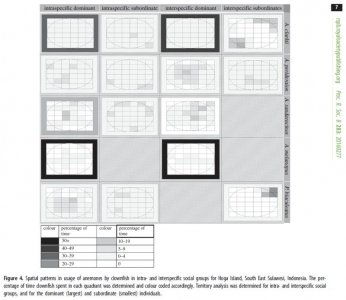
Interspecific cohabitation altered the spatial use of host
anemones by the subordinate species while dominant individuals
maintained similar spatial habitat usage (figure 4).
Analysis on the subordinates (A. perideraion and P. biaculeatus)
of the two main social groups (A. clarkii"“A. perideraion and A.
melanopus"“P. biaculeatus) demonstrated significant clustering
on the outer edge of the anemone...

attachment.php
 

Attachments

  • Capture.jpg
    Capture.jpg
    69.5 KB · Views: 5
this is not taxonomy......

I don´t understand the link with taxonomy.........

Reticulated Evolution exists..........its a way to creation of new species........

But all these taxa was evolved during a huge period of isolation..........specially before the end of Glacial Era and the raise of the Sea level..........

the Sea level raise unite these taxa that was separated........

but you have to consider the time of the isolation that lead to the speciation...........
 
Back
Top