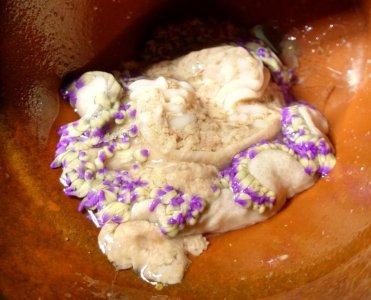
I got a bunch of acros and only one died from boring algae.
Further I got a gigantea and 2 plain green BTAs. The gigantea needed treatment and completely bleached, but the BTAs were solid and even survived a crispa turning into mush in their tank. That 29 gallon tank is one of the 3 sump/refugium/acclimatization tanks connected to my 100 gallon tank. It gets about 1/2 of the return flow from the main tank - which is quite a bit. As such these tanks have no powerheads inside.
For about a month they were crawling around and most of the time hiding somewhere in the rock pile, just once in a while sticking out their "heads" to catch some rays. But then they found their places and stayed put. The one that settled in the back I only see when I turn the return pump off, but the other closer to the front. That one sits at the entrance to the main cave and pretty much blocks that entrance for the first half to two thirds of the light period. When it has collected enough energy it just retracts into its little niche and stays out of sight until the next day.
So yes, I think that BTAs can be reasonably easy, but they can also be difficult. I think one of the key points for all anemones is where they came from and how they got treated on the way.
With BTAs I think one big mistake might be feeding them too much and too much at once. Those 2 BTAs I have in that tank only get what they catch when I feed the fish and Tubastrea corals.
The biggest danger for BTAs are powerhead pumps in the tank in which they often end up during their walkabouts.
Sent from my XT1254 using Tapatalk

 .. I might try to get him a bigger home/pvc lol. maybe 3" :-D ..But I want more tentacles and less mouth lol. Maybe over time. I'll try to feed him today also.