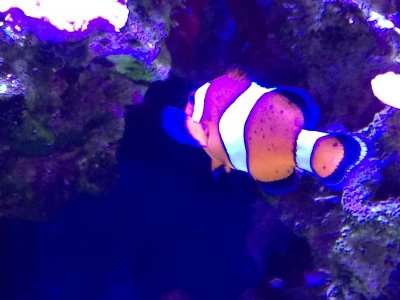
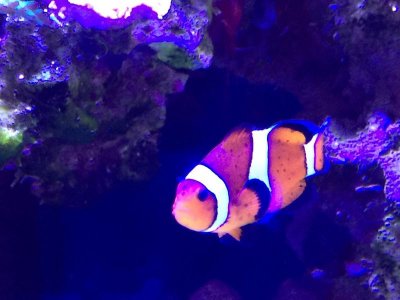
Oscellaris Clownfish with Black Spots???

Tuffloud1

New member
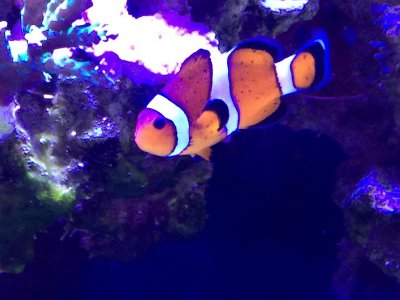
My Oscellaris started with 1 black spot about 4 months ago and slowly started getting more and more.

It is growing and eating like crazy. I have a frogspawn although he has never gone near it, and I watch my tank A LOT.

None of my other 8 fish have anything like this.

What is it?
 

Attachments

  • image.jpg
    image.jpg
    56.2 KB · Views: 6
It isn't likely that this is a Turbellaria worm infection (black ich).

First, there is nothing on the white bars but "black ich" would be there too.

Second, the spots are on the fins as well where Turbellaria is less comon, especially close to the fin's outer edges.

Third: these spots have not sharp borders like a Turbellaria spot would have and vary largely in size and shape.

I would say they rather look like spots of dark pigmentation.

If he was in a Stichodactyla anemone I would say it is the start of melanism and he is turning black. Some corals can have the same effect.
 
Dark spots on fish are usually one of two things... Black ich or flukes, both of which are worms and can be treated with Prazipro. The only other thing that it could be is stings from a anemone or other LPS, but this is much less likely. How long have you had the fish and when did you notice the spots? Did they show up overnight? Add any new fish or corals to the tank/when was the last one added?
 
I've had this clown for 5 months. 1 spot appeared a month after I got him and the other spots slowly started appearing since. He only seems to get more and more spots over time. No change in behavior, he eats like crazy at every feeding.

I put a black Oscellaris in a few months ago which is larger than this guy. He shows no black spots, although he is black, there are no spots on the white stripes.

None of my other fish have these spots which include - Copperband, Mandarin, McCosker's Wrasse, Lawnmower Blenny, Midas Blenny, Flame Angel.
 
It isn't flukes or black ich if the fish doesn't show any signs of distress - especially if it goes on for several months.
Against both also speaks the complete absence of spots on the white bands. Flukes and black ich would be there too.

Also to consider here is that the fish in question is a clownfish. Several species of clownfish (usually those with at least some black pigmentation in their normal color scheme) are known for varying degrees of melanism (turning dark or black).
Even though it normally occurs in relation with certain host anemones (usually Stichodactyla species) it can sometimes occur by itself (possibly triggered through other environmental factors)
 
It isn't flukes or black ich if the fish doesn't show any signs of distress - especially if it goes on for several months.
Against both also speaks the complete absence of spots on the white bands. Flukes and black ich would be there too.

Also to consider here is that the fish in question is a clownfish. Several species of clownfish (usually those with at least some black pigmentation in their normal color scheme) are known for varying degrees of melanism (turning dark or black).
Even though it normally occurs in relation with certain host anemones (usually Stichodactyla species) it can sometimes occur by itself (possibly triggered through other environmental factors)

I really appreciate all the info and help.

Just curious about black ich, are certain fish more prone to black ich than others? How likely would it be to spread to other fish in a tank?
 
I really appreciate all the info and help.

Just curious about black ich, are certain fish more prone to black ich than others? How likely would it be to spread to other fish in a tank?

It is most common on tangs and most often found on yellow tangs. I personally never had any fish with it (in about 30 years I only kept 2 tangs) but have seen it at dealers and a friends fish.

Here is a short article about it:Black Spot or Tang Disease
And here you find a few good images of it: http://www.reefcentral.com/forums/showthread.php?t=1792310
The picture later in the thread shows nicely that these spots are not flat (like on your clown) but raised.
 
As a rule of thumb:

Black spots on a tang
- most likely black ich = parasitic worm infection

Black spots on a clownfish, especially ocellaris or percula
- hypermelanism = harmless pigmentation due to stings of unusual hosts like for example corals
 
Back
Top