over lighting tanks?

:headwally:so much to take in....

It is a lot to take in and I find it helps to think about the natural processes that occur on the coral reefs.

Lighting Cycle: Having spent many days snorkeling the rock islands of Palau at relatively shallow depths (up to 25'), I found that the most healthy, largest and intensely pigmented corals (mostly LPS) were found in locations where bright, direct sunlight was limited to just a few short hours due to the rock islands themselves causing shaded conditions for much of the day (much of the time the corals received indirect sunlight or even partial to full shade in some locations). As the morning sun's light first strikes the water there is no penetration of visible light until around 15 degrees when the most energetic, shorter wavelengths (violet, hyper violet) penetrate first, followed by longer and longer wavelengths as the angle of incidence increases in respect to the horizon, culminating in a full spectrum when the sun is overhead. The same effect occurs in the afternoon as the sun begins to set. This is the daily cycle that we are trying to emulate in a reef tank.

Spectrum and Pigmentation: As can be seen in the example above, colorful corals occur when a full spectrum is present for a relatively short period of time and a gradual transition from the shortest wavelengths to full spectrum and the back towards the shortest wavelengths occurs. Since different coral pigments respond to different wavelengths, providing full spectrum lighting (of sufficient intensity) for a few hours a day provides the best chance of triggering non fluorescent coral pigmentation. Fluorescent pigmentation tends to be excited by the shorter wavelengths which we know as 'violet', 'hyper violet', 'royal blue', 'blue' etc.

Turbidity and Nutrients: The most colorful corals in these partially shaded conditions were subject to mostly laminar flow and the water was somewhat turbid. For much of the day they were bathed in particulates, much of it produced by the rock islands themselves. Having near constant access to nutrients undoubtedly assisted with growth and rich pigment production.

Of note is that the least colorful corals were most often found in open, clear relatively shallow areas with medium to strong current where sunlight was most intense for the longest period of time. Mostly cream and brown Acropora predominated in such areas.
 
Nano sapiens touched on something that's very important........the sun in reference to the coral is moving throughout the day. It's not static like our lights over our tanks.

If you run high par levels you have to consider shorter time spans and setting your lights up in a cycle so that they hit the coral from different angles throughout the day. You can't just dim them in a sunrise to sunset effect. A coral can reach photo inhibiton in an hour if the par is high enough and hitting it for another 7 hours or more at lower levels isn't going to change anything when it's already damaged. The coral spends the whole night trying to repair itself and the next day the damage is done all over again.

This results in pale/bleached corals or no growth if it does survive...........a lot times the coral just withers away and dies over many months.

This issue has come to the fore front since LEDs have been around because of the hot spots a lot of these fixtures create.

The other option is to run lower levels of par and work to have a smooth consistent level of par across the tank. A good range is between 200-400 from bottom to top.

Spectrum is very important too as mentioned above for color and growth.
 
Last edited:
I see all these new fixtures led hybrids,other led fixtures out with a lot of watts.iam curious are some of these fixtures just overkill.one comes to mind ati powermodule hybrid. its bad enough I torched corals when I had a t5 fixture now ya add leds to the mix for even more power.there is a guy from my area that has a 75 gallon tank all sps and all he runs is 4 4ft t5 bulbs on a icecap ballast and he gets crazy growth and color.is there going to come a point where enough is enough.i read somewhere corals can take only so much light before it comes more harm then good.

Personally I think you may be making a very valid point. When is enough enough?


It's highly unlikely that an aquarist could generate light levels that match 5-15 feet deep under an equatorial sun. And 5-15 feet is where most of the corals that we keep are collected, or maricultured.


Just to be clear this is 100% incorrect . . .

The first quote below is from the owner of Pacific Sun lighting. As you can see he too over 1000 PAR readings in Bali and he highlights his findings below. The second graph was produced by Dana Riddle and represents PAR readings in a Hawaiian tidepool which is not at the equator but then these readings were at a depth of 2 inches. The third picture shows PAR readings from an ATI LED Powermodule posted on RC. Clearly aquarium fixtures today easily match PAR levels found 15 feet underwater. Perhaps not at the surface where readings are 2000 umol/m2/sec but most definitely at 15 feet where readings are less than 500 for sure.

@JPMagyar
In 2011 year, during our experiment trip to Indonesia(Bali, on north and south coast Bali Island(also Palau Salobi) we did almost 1100 measurment (spectrum and PAR).
We noticed that corals exporter kept corals for best growth about 1.5-2m under water surface(and they never was so exposed like on your photo) - for best pigment intensification - the was moved to other areas, to colder water with much more food and kept on depth about 3.5-4m - even 5 meters.
You will be suprised, but during 11 days spent during that experiments we never have higher readings(on 4m) than ....200 umol/m2/s.
Average about 160 - betwee 11:30 and 12:00
Suprised? :-)
So - PAR(and strong light) is only ONE of many important factors of corals lighting.
Of course - spectrum "built" by sun on 4m is completly different than from any type of lighting hanged 20cm above water - and measured 50cm under water - even if PAR is the same.
Thats why we "moved" some ideas with our LED panels to "discrete" spectrum more channels without "wide" single light emitter offer possibility to better adjustment artifical lighting.

Edit:
Above water PAR reading was higher than 2.000 umol/m2/s - average 1.40h daily(without clouds).


image007.png


012-12_zps603149f3.jpg
 
Don't forget Photo-period. Anything more than 5-6 hours causes extra energy devoted to cellular repair instead of growth.


Past a point, the corals will fluoresce brighter as they are receiving too much light. IMO, the overall goal is to get them JUST above the point where they are "full" (my guess is about 105-110% their needed light intensity) - then we will get amazing colors as that small extra energy is completely reflected/refracted/fluoresced back. But much more past this point, and they will suffer from photo-inhibition and cellular degradation and start going downhill.

It's a tight balance to walk.

I totally agree it is a tight balance to walk; what I don't agree with is your claim that a 5 to 6 hour photoperiod is the maximum we should all use. I believe the topic is little studied and one can not draw a conclusion for all acropora based on the findings of one or two species. Here are two papers that studied response to light and heat stress in corals. What is interesting is they found that a) corals could adapt to stress if given a chance and b) the responses among different species was highly variable. In light of these facts and in the absence of broad research on acropora response to variable photoperiods I do not feel you can say anything specific about what the "ideal" photoperiod is for the entire group of acropora we as aquarists are keeping in our captive reefs. In my personal experience I have varied the maximum lighting photoperiod over my reef from 10 hours to as little as 4 hours and through personal observation of my corals I believe the best photoperiod for my corals to be somewhere between 7 and 8 hours. In my reef the maximum light levels have been around 400 to 500 umol/m2/s for the last 3 years and perhaps someone with levels above 700 would make a different observation, but to imply a universal maximum photoperiod of 5 to 6 hours is the answer is I think not accurate.


Effects of Temperature and UV Radiation Increases on the Photosynthetic Efficiency in Four Scleractinian Coral Species

Species–specific interactions between algal endosymbionts and coral hosts define their bleaching response to heat and light stress
 
Last edited:
Just to be clear this is 100% incorrect . . .

Actually, no. Penetration by sunlight in water is very dependent on the concentration of particulates in the water, the size of those particulates, the incidence angle of the sun, and the surface water agitation (among other things). For a counterpoint, see this article, graph 13. Note that approximately 40% of the sunlight in the blue-green spectrum at the surface is present even at 6 meters. Approximately speaking, that would be about 800 umol/m2/s.

http://www.reefkeeping.com/issues/2002-09/atj/feature/

That's a boatload of light, guys. And while some fixtures might be able to produce this at the surface, this degrades very rapidly underneath the water. For example, the Radion XR30w Pro is one of the most powerful LED fixtures in common usage by aquarists. Equipped with the TIR lens, the PAR tops out at about 700 PAR, but that is immediately under the light, 12" distance and in air.

Don't get me wrong - I am not suggesting that one cannot bleach the living crap out of the corals in our care with aquarium fixtures. But that's not the same as saying one can easily reproduce the intensity of the equatorial sun in clear water on most (pristine) reefs.
 
I am curious to know if the light source matters?

Is 400umol/m2/s from an led source the same as 400 from MH and how does spectrum effect the equation? Example - is 400umol/m2/s from led that produces a spectrum between 400 and 500nm the same as 400 from a full spectrum MH lamp?
 
Actually, no. Penetration by sunlight in water is very dependent on the concentration of particulates in the water, the size of those particulates, the incidence angle of the sun, and the surface water agitation (among other things). For a counterpoint, see this article, graph 13. Note that approximately 40% of the sunlight in the blue-green spectrum at the surface is present even at 6 meters. Approximately speaking, that would be about 800 umol/m2/s.

http://www.reefkeeping.com/issues/2002-09/atj/feature/

That's a boatload of light, guys. And while some fixtures might be able to produce this at the surface, this degrades very rapidly underneath the water. For example, the Radion XR30w Pro is one of the most powerful LED fixtures in common usage by aquarists. Equipped with the TIR lens, the PAR tops out at about 700 PAR, but that is immediately under the light, 12" distance and in air.

Don't get me wrong - I am not suggesting that one cannot bleach the living crap out of the corals in our care with aquarium fixtures. But that's not the same as saying one can easily reproduce the intensity of the equatorial sun in clear water on most (pristine) reefs.


If you are arguing that the sun can produce greater spectral irradiance than most aquarium lights then I agree. If you are arguing that aquarium lights do not duplicate or exceed typical photon flux measured as PAR that occurs normally on tropical reefs then I must continue to disagree.

The Graph 13 you reference above was actually taken from this article:

Depth-Dependent Photoadaption by Zooxanthllae of the Reef Coral Montastrea annularis

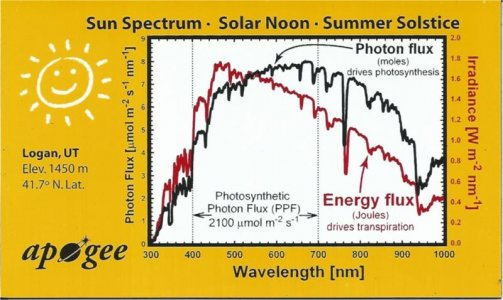
The study was conducted in the waters off Jamaica and the graph you refer to was created using a very early Spectral Irradiance meter that gives Irradiance readings and not Photon Flux readings. The roughly 1 Watt/m2 you see in the graphs is the rough equivalent of 2000 uMol/m2/sec. A much reported light level found on reefs worldwide. Your conversion to 800 uMol/m2/sec at 6m is off by a factor of 10.

You are correct that incidence, turbidity, and defraction can cause wide variation of the amount of light that reaches the lower depths as you can see from the wide fluctuation of PAR shown in Dana Riddles graph. This does not alter the fact that in general aquarium lights today easily achieve PAR readings in excess of 1000 uMol/m2/sec which FAR exceeds the light normally seen on reefs worldwide even equatorial reefs at noon on a clear day in clear calm water.

Finally, I'm not sure what your friends are using but I know literally dozens of reefers worldwide and not one of them is using a Radion light. Lots and lots of T5 lights and lots and lots of metal halides, but none of my old time reefing buddies are using LEDs. In fact in my group of reefers I think I am the outlier with my new Hybrid LED/T5 lights.

Irradiance_zpsafab6b95.jpg
 
Last edited:
This chart came with the Apogee meter I have. It hurts my head just to look at it so I'll let you guys sort it out if it helps the discussion. I'm still trying to figure out my lighting :(

PARchart.jpg
 

Attachments

  • PAR chart.jpg
    PAR chart.jpg
    60.7 KB · Views: 6
When comparing natural sunlight to any aquarium light, PAR levels are often compared since that's the best measurement hobbyists have at the moment. However, PAR is a measurement of ALL wavelengths in the visible spectrum (400nm to 700nm) and natural sunlight produces a greater variety of wavelengths, the majority in greater intensity at relatively shallow depths, than any typical aquarium light can.

As an example, a measurement of 800 PAR in nature can be measured for a shallow water 'coral XYZ' and the same coral can do just as well at 400 PAR in an aquarium with an artificial light source. What we typically have in our tanks is a lot of the shorter wavelengths (violets, blues) which the coral's zooanthellae use, but not a lot of the less useful wavelengths that the coral's zooanthellae don't need for photosynthesis (but may still be required for some non-fluorescent pigmentation production). In some instances when more intense lighting is used, we are actually giving a coral more 'usable' light than it would receive in nature even if we think that PAR numbers are low in respect to the natural environment.

As depths increase in nature many of the sun's longer wavelengths (reds, oranges, yellows, etc.) become less apparent because they just can't penetrate as far as the more energy intensive, shorter wavelengths (blues, violets). At greater depth, natural light and an aquarium fixture can produce a roughly similar spectrum and PAR reading.

So in a nutshell, this is why comparing PAR in an aquarium to what is seen in nature should not be taken literally as a '1 to 1' UNLESS the spectrum and intensity of both light sources at a specific depth are similar.

For more detailed reading with charts and graphs, this is an excellent article:

http://www.advancedaquarist.com/2013/12/lighting
 
If anyone is interested in PAR measurements with metal halides, here's one hobbyist's measurements with a fairly typical reef tank setup:

http://www.melevsreef.com/par_readings.html

One thing that's a bit surprising is the rather low PAR readings just 12" below the surface with a rather intense MH setup.

Also useful is Sanjay Joshi's comprehensive (ridiculously comprehensive!) lighting guide:

http://www.manhattanreefs.com/lighting

One thing worth noting is that none of the MH setups, even 400W MHs, come anywhere close to even 500 PAR, measured 12" away from the light source. So no, we really don't come close to natural irradiation in a typical tank set-up, even with modern, highly-focused LED fixtures.
 
Last edited:
I read that thread Melev posted a few weeks back when I was uncertain about what I was doing with the LED fixtures I have. I've used MH and T5 in the past and was surprised by his testing results. I never owned a par meter so I was unable to quantify the light I ever had in the tank. Basically I set those lighting systems up as others have done and it worked.

LED present very different issues and are not just plug and play option. For some, that might be added complexity they don't want to deal with. I know I'm having second thoughts. The only thing preventing me from going to a LED/MH combo, using the LED to supplement rather than primary lighting, is the heat issue. I'm not concerned with cooling the tank. I'm more concerned about heat dissipation from the fish room coming off of the lights and the chiller. I have not figured a way around that yet as the room is windowless and does not have an exterior wall to penetrate. Not interested in changing T5 bulbs any more, so I think they're out. Maybe plasma is an option :)
 
Well, one potential solution would be to pipe the chiller into another room. While that's not as helpful as being able to exhaust the heat outside or to a basement, it will potentially keep your fish room from overheating.

I'm with you on the complexity of LEDs. I've gotten mediocre results with my tank that has two Vega fixtures over it. But in the past, my tanks with MH and/or fluorescents have been pretty bullet-proof; I never had to really think about the lights.

I may try to upgrade my Vega fixtures with violet diodes and see if I get better/acceptable growth/survival/color, because the I definitely like the controlability, sunrise/sunset and low power consumption. But in the end, it's about the coral, so if necessary I will just go back to 12k MHs/actinic fluorescent.
 
Well, one potential solution would be to pipe the chiller into another room. While that's not as helpful as being able to exhaust the heat outside or to a basement, it will potentially keep your fish room from overheating.

I'm with you on the complexity of LEDs. I've gotten mediocre results with my tank that has two Vega fixtures over it. But in the past, my tanks with MH and/or fluorescents have been pretty bullet-proof; I never had to really think about the lights.

I may try to upgrade my Vega fixtures with violet diodes and see if I get better/acceptable growth/survival/color, because the I definitely like the controlability, sunrise/sunset and low power consumption. But in the end, it's about the coral, so if necessary I will just go back to 12k MHs/actinic fluorescent.
If you look at my sig, you see the fixtures I have over the tank. I'm actually getting good growth with them. Colors are even pretty good for those that I didn't make pale from over lighting them. I'm pretty sure that's what happened, as some of the frags I purchased did indeed lose all of their color. But they seem to be rebounding. Maybe it's too soon for me to come to a conclusion. I guess it's just finding a good combination to get it right.

There are some pretty nice tanks only utilizing LED. For me, in addition to the things you listed about LED, are not having to change bulbs and the heat. The ramping is a bonus as is the glitter in the water column. I think the next gen of lights will hit on all cylinders and be much easier to dial in when the emitters are right. Kessil seems to be a good player as they understand the science of light as it relates to growing. Unlike many of the mfg.s that produce lights with chips available from the lighting industry, they make the chips they put in their fixtures based on their own R&D in marine biology and horticulture. At least that's my understanding.
 
Havent read entire thread yet but in am lps tank deff overkill...i have a diy 2 50w blue 2 20w and at full power alot of the lps dont like it...36 gal 6months old and the two acros i have are doin awesome, colored up like crazy after a few weeks...their about 12" from the light so i cant say if its overkill for sps but the lps def dont need that much, my chalices are in the shade lol...have to say everythings growing very fast, acros the fastest by far
 
What about the natural pigments corals produce to protect themselves from photon radiation? Are they protiens like p565 etc or the actual dinoflagellates colors? I've always thought that it was both the coral tissue pigment and the algae together that yields the visible color we see in them (or captives).

I'm thinking like an artist who blends color together to reach green let's say. Isn't green every color but green?

Sry: edited for hindsight.
 
Spectrum has to be considered. Lots of people running LEDs have more 450nm light than even full sunlight in the tropics, even if overall PAR is much less and just PAR in the blue range is less.

Almost no one runs as much green part of the spectrum as natural sunlight. It is less efficient for corals, less efficient to produce with LEDs (hard to find at all without LEDs) and makes everything generally less colorful and kind of washed out. I think a little more greatly adds to the natural look (I don't like having a purple reef tank), but going anywhere near natural sunlight levels in just not practical (unless using natural sunlight).

Red can go either way. It makes colors "pop" but looks unnatural. It might be useful for photosynthesis, but unless you are comparing to very shallow water (in which case you should have a lot of yellow-orange), it is unnatural to have any.

Infrared is probably not worth adding intentionally.

So then we have the question of whether to include MORE blue, violet and/or UV light than full sunlight - either to compensate for the lack of Green-Red PAR or because we think we can get more colorful and faster growing corals than under natural light.

IMO it is still unlikely anyone supplies too much light, providing they choose only livestock that needs high light (shallow water Acros and clams) and acclimate animals slowly. You certainly can go past the point of reason as far as cost goes though.
 
Back
Top