Pod Populations

When we speak of nutrient levels in a reef environment we are talking about dissolved nutrients. Nutrients that are bound are not of concern as they are not available to fuel algae growth or inhibit calcification of corals. Following your logic the reefs of the world are huge nutrient sinks due to all the nutrients bound in the life found there.

All our filtration methods simply trap the nutrients. You trim algae, throw away GFO, and empty your skimmate. They all remove available nutrients from the water. We can argue the efficiency of each method but none are adding to the nutrients of our systems.

I love a good debate:D

Yes, the problems occur when you stop removing the nutrients. If you only rely on nutrients being trapped somewhere, then you will eventually run out of room. In the ocean this is not a problem, on the longest geological scale, sediments on the ocean floor are eventually subducted at trenches, thus removing them from the system.
 
I am in the process of adding a fuge to my sump which is below my tank. In order to get pods to my DT I built 2 pod condos. Once the pods start multiplying in the condo's I will rotate them one at a time to keep a good supply in DT. Hope it works.
 
i also love a good debate. :D i am glad there are still that like to do that here on RC. i left RC long ago because debating was not the norm, flamethrowing was the norm. i decided to poke my head in again to see if things have changes.

dissolved nutrients are the immediate problem when we think about nutrient levels, but they are not the biggest problem. as long as the biomass is growing the system is becoming more eutrophic. this includes fish, corals, whatever. the amount of material in the system is becoming greater with respect to the volume present.

bound/trapped nutrients are a concern. they have the potential to become available at any time. an accidental swish of hand/knocked powerhead in a lives sump with sand. a light bulb burning out over a macro live sump. these can all cause a sudden release of these formerly trapped nutrients into the water column. if these were not there in the first place, then this would not be of a concern.

the wild reefs work by exporting the nutrients into the abyss. the abyss for us is the skimmer or the siphon. gotta love marine snow. :D

the current thinking with husbandry is about reacting to a problem instead of thinking the setup through from the beginning. though there have been signs lately that this thinking is beginning to go away. (about time)

G~
 
I am in the process of adding a fuge to my sump which is below my tank. In order to get pods to my DT I built 2 pod condos. Once the pods start multiplying in the condo's I will rotate them one at a time to keep a good supply in DT. Hope it works.

Are your pod condos something besides chunks of live rock? This sounds like a good idea.

Pods may represent food you've added to the aquarium bound in a different way, but if the fish prefer it bound in pods before they will eat it, then so be it!
 
Ive seen people make pod condos out of plastic gutter guard before. Basically you make a tube and fill it with live rock rubble and zip tie it together. I've never used one but they look like they would be a great way to transport pods .
 
anything that is able to trap detritus in a contained area will make a good pod condo. the object is to collect nutrients in a contained area so that the food source for the pods is contained and not able to be removed by the actions of the system.

the object is to work with what is needed and not against it. though i do suggest not pod condos in a reef top biotope (oligotrophic), where keeping nutrients down is the greatest concern.

G~
 
Ive seen people make pod condos out of plastic gutter guard before. Basically you make a tube and fill it with live rock rubble and zip tie it together. I've never used one but they look like they would be a great way to transport pods .

it is that exactly

podcondo-M.jpg
 
dissolved nutrients are the immediate problem when we think about nutrient levels, but they are not the biggest problem. as long as the biomass is growing the system is becoming more eutrophic. this includes fish, corals, whatever. the amount of material in the system is becoming greater with respect to the volume present. (about time)

G~

This is true, but isn't that what we want? Our corals and fish to grow. The excess nutrients are a byproduct of all animals being unable to utilize 100% of the food/nutrients they take in. The skimmer can never get rid of everything, so the rock or sand or whatever, must accumulate nutrients in the form of bacteria at the very least.
 
The adult pods don't have to travel to the DT. The larvae are free swimming and less than 200 microns long. These can then feed corals and other filter feeders and repopulate the DT. I think you would have trouble seeing them in a filter sock unless you went through the detritus with a microscope. It may be anecdotal but I've seen others experience a more robust population after adding a refugium just as I have.

A refugium is a good thing, but the real food biomass it produces may be very small. Myself, I don't want to just assume that even if there isn't visible food, there is invisible food. I have experimented with a special refugium that produced 16000 adult harpacticoid copepods (the type we are talking about here) per day, to the DT. The water in this refugium was murky from phytoplankton. When I analyzed the samples in the microscope I found mostly adults, very few nauplii, and nothing I could identify as eggs. That was just one experiment, but it clearly indicates you can't assume anything.
 
Great discussion here. This is what I was hoping for. All sides of the hobby trying to get some answers. That pod condo sounds interesting, I would be interested in that. Do you clean it out or let the detritus pile up indefinitely?
A refugium is a good thing, but the real food biomass it produces may be very small. Myself, I don't want to just assume that even if there isn't visible food, there is invisible food. I have experimented with a special refugium that produced 16000 adult harpacticoid copepods (the type we are talking about here) per day, to the DT. The water in this refugium was murky from phytoplankton. When I analyzed the samples in the microscope I found mostly adults, very few nauplii, and nothing I could identify as eggs. That was just one experiment, but it clearly indicates you can't assume anything.

May I ask what "special" refugium you were running? Thats a lot of pods
 
Reefin' dude, might I ask how you run your system?

Can I take a guess and say huge skimmer and bare bottom?

yep. only because i have been in this hobby longer than in would like to admit and have done every conceivable methodology, and realized that the only important thing to keeping a successful reef system is to flush the toilet as often as possible in order to support the biotope you want to emulate. still trying to figure out how people in this hobby ever thought not cleaning the tank was a good idea, when every other industry or hobby knows that in order to keep your animals healthy you must clean the pen, cage, tank, rotate fields, etc...

This is true, but isn't that what we want? Our corals and fish to grow. The excess nutrients are a byproduct of all animals being unable to utilize 100% of the food/nutrients they take in. The skimmer can never get rid of everything, so the rock or sand or whatever, must accumulate nutrients in the form of bacteria at the very least.

the question is, where do we want our biomass. a system can only handle so much biomass. the more biomass you use up for silly stuff like refugiums, the less biomass available for the corals and other critters we may actually want. everything is a give and take here.

lets go back to this part again. not picking on anybody, just want to think a bit more on this. except for the disagree to agree part. :D

The source of nutrients in our tank is primarily food. If my population of "life" is limited by my food additions then adding a refugium will not increase nutrient levels unless I increase feeding. I would argue that if your macroalgae is growing then it is reducing dissolved nutrients in the water. It isnt truly exported unless it is removed but nothing in our tank exports nutrients without some end product being removed. It does however reduce the nutrients available in the water column. Phosphates in rock will contribute to nutrients no matter where it is placed so that is a moot point.

All our tanks accumulate nutrients. We can remove them many ways. Skimming, GFO, carbon dosing, refugiums, and many many more. None of these can add nutrients to the system that weren't put into it in the first place. They may not remove any if run improperly or not maintained. In a poorly maintained refugium the nutrients "trapped" in macroalgae and DSB's can even leach back out. These nutrients were added to the tank through food additions, not because the refugium was installed. I would also agree that certain set-ups could negatively impact other phases of your nutrient export plan but I will never agree that adding a refugium increases nutrients.

But I can agree to disagree

there is no way to increase the biomass without also increasing the amount of available food in the system. all of this biomass has to be feeding on something. whether it is bacteria, pods, macro, corals, fish, phytoplankton, plankton, whatever. if the food is not there to support them, they will die. where is all of this "food" coming from if the amount of food going into the system remains constant? lets ponder that for a minute.

G~
 
A refugium is a good thing, but the real food biomass it produces may be very small. Myself, I don't want to just assume that even if there isn't visible food, there is invisible food. I have experimented with a special refugium that produced 16000 adult harpacticoid copepods (the type we are talking about here) per day, to the DT. The water in this refugium was murky from phytoplankton. When I analyzed the samples in the microscope I found mostly adults, very few nauplii, and nothing I could identify as eggs. That was just one experiment, but it clearly indicates you can't assume anything.

That was a very interesting read. Thank you. I noticed the experiment was done at lower temperatures than we keep our tanks at. I'd be interested in doing this experiment with a refugium kept at tropical temperatures. May I ask why you think you saw so few larvae and eggs? With the production in the refugium it would seem there would have to be large amounts of larvae and eggs somewhere.

Now to look for a microscope....
 
there is no way to increase the biomass without also increasing the amount of available food in the system. all of this biomass has to be feeding on something. whether it is bacteria, pods, macro, corals, fish, phytoplankton, plankton, whatever. if the food is not there to support them, they will die. where is all of this "food" coming from if the amount of food going into the system remains constant? lets ponder that for a minute.

G~

I never agreed that our tanks are nutrient limited. The fact that we export nutrients daily to keep the levels close to NSW proves this. I agree in our system adding a refugium will allow the biomass to increase. Where i disagree is that the refugium is adding nutrients. I believe it is merely making more space available for organisms to feed on the excess nutrients that we are constantly removing. I think it is unrealistic to keep an eye on our biomass to water ratio with the goal of replicating nature. If we wanted to keep this ratio near something found in the ocean we would be lucky to keep a copepod in a 120 gallon tank.
 
I never agreed that our tanks are nutrient limited. The fact that we export nutrients daily to keep the levels close to NSW proves this. I agree in our system adding a refugium will allow the biomass to increase. Where i disagree is that the refugium is adding nutrients. I believe it is merely making more space available for organisms to feed on the excess nutrients that we are constantly removing. I think it is unrealistic to keep an eye on our biomass to water ratio with the goal of replicating nature. If we wanted to keep this ratio near something found in the ocean we would be lucky to keep a copepod in a 120 gallon tank.

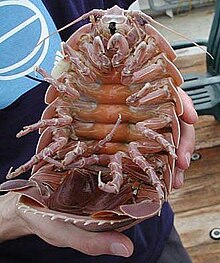
That had better be one awesome copepod. Maybe you should try an isopod instead.
220px-Giant_isopod.jpg


there is no way to increase the biomass without also increasing the amount of available food in the system. all of this biomass has to be feeding on something. whether it is bacteria, pods, macro, corals, fish, phytoplankton, plankton, whatever. if the food is not there to support them, they will die. where is all of this "food" coming from if the amount of food going into the system remains constant? lets ponder that for a minute.

G~

We have to feed our system more food than it needs due to the efficiency limitations of the creatures consuming it. If we assume everything in the tank needs 10g of nutrients per day to survive, then they probably need to eat 100g or more of food to get the 10g. If our protein skimmer was 100% efficient at removing waste products before they had a chance to be used by secondary consumers, that would be ideal. But the protein skimmer must have minimum threshold of nutrients for it to remove anything. The rest has to go somewhere right?

If we assume it is possible to get a significant pod population into the tank (perhaps an above tank refugium), and those pods are consuming waste from the fish or coral and subsequently getting eaten by those fish and coral, have we not increased the amount of added food being utilized by the primary consumers?

I don't really know the numbers here, perhaps it is too small of an increase to matter, but we need something to deal with the nutrients the skimmer can't pull.
 
the real numbers do not really matter. the thought process is sound. lets use your number just cause they are there. 100g of food. 10g is actually used by the critters we bought and are the primary reason why we have the system. that leaves 90g doing something, but still in the tank. the important critters are still not going to use all of that 10g, they are going to poo out another lets say 2g. we now have 92g of stuff in the system, that is not doing anything for the critters we really want in our system.

where does it go? the skimmer will get a good amount of it, hopefully, if the skimmer is properly sized. the rest becomes detritus, unless there are other primary consumers (i put the critters that eat left over food in this group) and secondary consumers. those that make use of other critters wastes products. why have these other primary and secondary consumers? what are they doing? they are just up taking the left over food, correct? what if you were able to remove all of this left over food, would all of these other consumers be necessary? how much of the food chain do we really need? every level of food chain requires its own food, and produces wastes. the more of these critters we have the more food and waste produced. where does it stop? even if we use 100% efficiency of the critters, there would still be an increase in food needed. then there is the whole problem of what happens when these other primary and secondary consumers die? what consumes them, and is it the same critters that consume the others.

G~
 
yep. only because i have been in this hobby longer than in would like to admit and have done every conceivable methodology, and realized that the only important thing to keeping a successful reef system is to flush the toilet as often as possible in order to support the biotope you want to emulate. still trying to figure out how people in this hobby ever thought not cleaning the tank was a good idea, when every other industry or hobby knows that in order to keep your animals healthy you must clean the pen, cage, tank, rotate fields, etc...

I understand your philosophy. If I was keeping a tropical coral reef tank, had 100% focus on the colorful display corals and fish, and tried to make a "Tank of the month style" aquarium, I think I would have used that philosophy too. It seems like almost all those tank of the month keepers use it. That is not my hobby though.

jerpa: It seems like the females are carrying the eggs with them. Why I didn't see any nauplii I just don't know.
 
my philosophy does not matter what type of system you are trying to replicate, that is the point. you match your toilet flushing habits to the environment you are trying to replicate. if you are going for an eutrophic environment, then the flushing is going to be significantly less than somebody who is going for an oligotrophic environment. the important thing is that nutrients increase in our systems with every feeding we do. the increase in biomass shows us this. it is up to the aquarist to decide how much biomass they would like to keep and what is the purpose of the extra biomass.

G~
 
Back
Top