Gary Majchrzak
Team RC
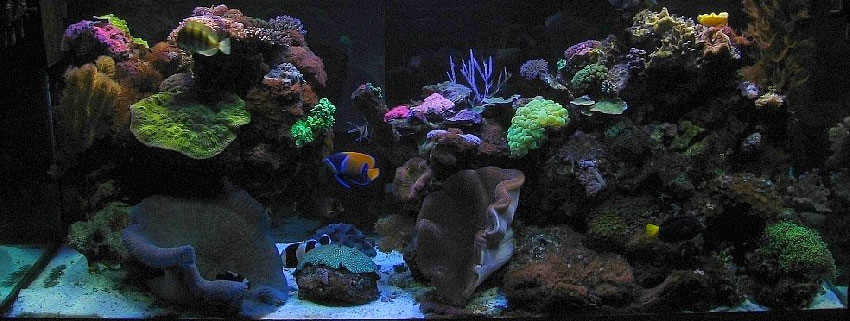
this is a thread to share methods, techniques and suggestions for harmoniously maintaining marine Angelfish with Tridacna clams in reef aquariums.
Please feel free to share your experiences with others here.
A few things might seem obvious for success, but some might not be so obvious to others so let's try to include all factors for success.
First off I'd like to quickly list some of the more obvious:
*aquarium size matters
this is probably the most obvious factor. You can't keep a large clam or large Angelfish in a very small aquarium by itself let alone together. Purchase species that are appropriate for the size of aquarium you're placing them in. Angelfish predation usually increases as the aquarium size decreases- bigger is better!
*species matter
this applies to every animal you place in your aquarium. Some species of Angelfish stay under two inches length while some species grow to around two feet in length. Some Angelfish species are planktivores and some are herbivores. The family varies greatly in habits. IME any Angelfish that's very hungry is a potential threat to clams. Tridacna clams also vary in size with species.
*animal size matters
ties in with species. Small (less than 2") Tridacna can be a challenge to grow even if you don't have an Angelfish in the same aquarium. The success rate is likely to be better if you obtain a clam larger than 2" IME.
The opposite is true with Angelfish- the larger the species/individual fish the easier it is for it to make a quick snack out of your clam.
*placement matters
this is a not-so-obvious factor. Tridacna clams such as maxima and crocea often bore into the substrate (rock/coral) below them in the wild. This leaves only the upward section of their light sensing mantle exposed to fish predation. In nature, as soon as the clam senses something above it retracts it's mantle.
It's usually a different story in reef aquariums. Clams are usually exposed to attack from fishes from the underside. It won't take long for an Angelfish that's hungry to figure out what it needs to do for a free meal of clam chowder.
*feedings matter
pretty obvious. Keep your Angelfish well fed! You might not want to feed it prepared clams (or other meaty seafoods) or it might develop a taste for your Tridacna clam. A refugium and large amount of area (liverock) can also help provide your Angelfish with food.
*luck
every fish has it's own unique "tastes"
more input is always welcome to this thread- it was just a brief summary of some basic advice that might help someone keep these beautiful animals together in their aquarium. In certain cases it might be impossible to keep a Tridacna clam with a certain Angelfish. Each situation is unique.
Please feel free to share your experiences with others here.
A few things might seem obvious for success, but some might not be so obvious to others so let's try to include all factors for success.
First off I'd like to quickly list some of the more obvious:
*aquarium size matters
this is probably the most obvious factor. You can't keep a large clam or large Angelfish in a very small aquarium by itself let alone together. Purchase species that are appropriate for the size of aquarium you're placing them in. Angelfish predation usually increases as the aquarium size decreases- bigger is better!
*species matter
this applies to every animal you place in your aquarium. Some species of Angelfish stay under two inches length while some species grow to around two feet in length. Some Angelfish species are planktivores and some are herbivores. The family varies greatly in habits. IME any Angelfish that's very hungry is a potential threat to clams. Tridacna clams also vary in size with species.
*animal size matters
ties in with species. Small (less than 2") Tridacna can be a challenge to grow even if you don't have an Angelfish in the same aquarium. The success rate is likely to be better if you obtain a clam larger than 2" IME.
The opposite is true with Angelfish- the larger the species/individual fish the easier it is for it to make a quick snack out of your clam.
*placement matters
this is a not-so-obvious factor. Tridacna clams such as maxima and crocea often bore into the substrate (rock/coral) below them in the wild. This leaves only the upward section of their light sensing mantle exposed to fish predation. In nature, as soon as the clam senses something above it retracts it's mantle.
It's usually a different story in reef aquariums. Clams are usually exposed to attack from fishes from the underside. It won't take long for an Angelfish that's hungry to figure out what it needs to do for a free meal of clam chowder.
*feedings matter
pretty obvious. Keep your Angelfish well fed! You might not want to feed it prepared clams (or other meaty seafoods) or it might develop a taste for your Tridacna clam. A refugium and large amount of area (liverock) can also help provide your Angelfish with food.
*luck
every fish has it's own unique "tastes"
more input is always welcome to this thread- it was just a brief summary of some basic advice that might help someone keep these beautiful animals together in their aquarium. In certain cases it might be impossible to keep a Tridacna clam with a certain Angelfish. Each situation is unique.
Last edited: