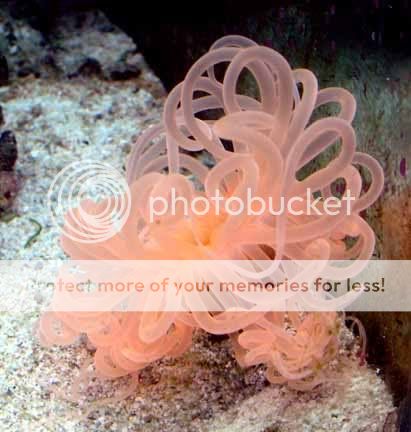
Post your insane anemone pics here!

Steveweast, Nikon_Guy and illcssd;
Wow these RBTAs look fantastic! May I ask, what’s the key to getting such a rosy one? Are some naturally more red than others? (If so I don’t suppose you have any pics of them as babies so we can know what to look for in the shops?) Or do all RBTAs turn this colour when they’re happy? Please let me know! They’re beautiful! :)
 
<a href=showthread.php?s=&postid=9364106#post9364106 target=_blank>Originally posted</a> by maxxII
Not to be rude, but this is incorrect...

Long Tentacled Anemone is a name given to both M.doreensis and H.crispa.

M.doreensis is also known as the curly cue anemone and a few other common names.

H.crispa is known most commonly as Sebae anemone, leathery sea anemone or LTA.

H.malu is also commonly called Sebae anemone...

If someone is calling a M.doreensis a Sebae, they have mis identified the anemone...

Not trying to be argumentative, its just that many people already have trouble identifying anemones properly anyway...

Here are pics of my blue LTA....
This is the true color of the anemone as it appears in my tank under a 175 watt Ushio 10K bulb.

Blue_LTA2-1_02-26-2007.jpg


Here is the anemone w/ lights off, long exposure pic...

Blue_LTA3-3_02-28-2007.jpg


Initially, I was worried the anemone was bleached, but the feeding response is good, tentacles are sticky, etc....

Also, there is a pic in Joyce Wilkerson's book "Clownfish" that shows a purple LTA with the same pale body in the wild with some domino damsels...

Time will tell I guess...

Nick

Correct, M. Doreensis is not called a Sebae and if it is, it has been misidentified.
 
SWG, add (img) and (/img) on the front and back of that link and you'll embed the photo... just replace the (s w/ [ and the )s w/ ]

hth,

Matt
 
<a href=showthread.php?s=&postid=9369020#post9369020 target=_blank>Originally posted</a> by TheVillageIdiot
SWG, add (img) and (/img) on the front and back of that link and you'll embed the photo... just replace the (s w/ [ and the )s w/ ]

hth,

Matt

Like so...

EX: [I M G]LINK[/I M G] (no spaces)

anemone2.jpg
 
These are 3rd, 4th & 5th generation clones of a green bubble tip anemone (had original clone for 2yrs). The seven began as one. Split with multiple water changes within one week, temperature rise, and overfeeding. The weird part is the different in sizes and shapes (one is fat one is skinny and the small clones have retained their bubbles). This is an experiment at a species tank to one day supply NO flourescent anemones (main reason they are not so green). So far so good.
100761IMG14662.JPG
 
MY RBTA hasn't split in a very long time--must be happy! Also, never moved from the rock I bought it on. Here is is today, a foot across. It's so big, only half of it pokes thru the hole in the rock & the other half reaches around the other side, so It actually looks like 2.
RBTA2-27-07.jpg


This is another one I had that was at least a foot across. Looked just like this, the day before it totally disintagrated & dissappeared! It was a really sad day...
AnemoneClownsAvatar-1.jpg


My peach tube anemone:
OrangeTubeAnemone2.jpg
 
species identification

species identification

<a href=showthread.php?s=&postid=9364106#post9364106 target=_blank>Originally posted</a> by maxxII
Not to be rude, but this is incorrect...

Long Tentacled Anemone is a name given to both M.doreensis and H.crispa.

M.doreensis is also known as the curly cue anemone and a few other common names.

H.crispa is known most commonly as Sebae anemone, leathery sea anemone or LTA.

H.malu is also commonly called Sebae anemone...

If someone is calling a M.doreensis a Sebae, they have mis identified the anemone...

Not trying to be argumentative, its just that many people already have trouble identifying anemones properly anyway...

Here are pics of my blue LTA....
This is the true color of the anemone as it appears in my tank under a 175 watt Ushio 10K bulb.

Blue_LTA2-1_02-26-2007.jpg


Here is the anemone w/ lights off, long exposure pic...

Blue_LTA3-3_02-28-2007.jpg


Initially, I was worried the anemone was bleached, but the feeding response is good, tentacles are sticky, etc....

Also, there is a pic in Joyce Wilkerson's book "Clownfish" that shows a purple LTA with the same pale body in the wild with some domino damsels...

Time will tell I guess...

Nick

That is an awesome nem, Nick. I hope it's doing okay. You said it was an LTA, but that means it could be a M. doreensis, sebae, H crispa, but not an H. Malu.... correct? It would be nicer if the LFS labeled their anemones according to their scientific name rather than "LTA, or Sebae"
 
here is mine don't know what it is though.

withflash:
<a href="http://photobucket.com" target="_blank"><img src="http://i148.photobucket.com/albums/s7/saltwaterdragon1086/DSC02985.jpg" border="0" alt="Photo Sharing and Video Hosting at Photobucket"></a>

without flash:
<a href="http://photobucket.com" target="_blank"><img src="http://i148.photobucket.com/albums/s7/saltwaterdragon1086/DSC02984.jpg" border="0" alt="Photo Sharing and Video Hosting at Photobucket"></a>

with my snowfake:
<a href="http://photobucket.com" target="_blank"><img src="http://i148.photobucket.com/albums/s7/saltwaterdragon1086/DSC02990.jpg" border="0" alt="Photo Sharing and Video Hosting at Photobucket"></a>

sorry haven't clean glass...
 
Its an M. doreensis...
Ways to ID this species of anemone...

They have very few tentacles on the oral disc compared to H.crispa, the tentacles are often observed to bend and resemble question marks, and the base is red/orange.

Nick
 
haddoni w/ false percs pair

IMG_0763.jpg


macro :)

IMG_0771.jpg


ps id like to make that ^^^^ my avatar but dont know how to get the sizing right, anyone that can would get a big thumbs up
 
<a href=showthread.php?s=&postid=9597567#post9597567 target=_blank>Originally posted</a> by illcssd
maxxII:
were you reffering to reefdragon's anemone in your last post?

That is what I was wondering. That anemone doesn't look anything like any M. doreensis to me, at least. I think I remember thinking it may be some sort of corallimorph, but I don't really know.
 
<a href=showthread.php?s=&postid=9597642#post9597642 target=_blank>Originally posted</a> by Amphiprion
That is what I was wondering. That anemone doesn't look anything like any M. doreensis to me, at least. I think I remember thinking it may be some sort of corallimorph, but I don't really know.
Excattly my thoughts. I cant remember what kind of anemone it is either, there was a thread about it a little while back but i can't remember what it was called. One thing for 100% certain. That is not a m. doreensis. If thats what was intended by his statement it was complete misinformation.
 
<a href=showthread.php?s=&postid=9597690#post9597690 target=_blank>Originally posted</a> by illcssd
Excattly my thoughts. I cant remember what kind of anemone it is either, there was a thread about it a little while back but i can't remember what it was called. One thing for 100% certain. That is not a m. doreensis. If thats what was intended by his statement it was complete misinformation.

your all right the thread a while ago was about a "chocolate" anemone someone figured out that it was a corallimorph cant remember what kind

i know i would not let a snowflake in it not me risking a 200dollar clown in a freaking mushroom
 
<a href=showthread.php?s=&postid=9366438#post9366438 target=_blank>Originally posted</a> by 55semireef
Correct, M. Doreensis is not called a Sebae and if it is, it has been misidentified.

they are common names and there is no clear definition i have found that says what is what

Is a sebae all Heteractus species or just malu and crispa ??

the unscientific common names mean nothing as a result of mislabeling
common names help but really in the end confuse and make people think other people are wrong when they are not
 
Sebae is nothing, the use should be discontinued. If has always applied to crispa and malu, hence being confusing. And, a lot of other anemones are called that too. I for one refrain from using most common names if at all possible.
 
<a href=showthread.php?s=&postid=9598005#post9598005 target=_blank>Originally posted</a> by illcssd
Sebae is nothing, the use should be discontinued. If has always applied to crispa and malu, hence being confusing. And, a lot of other anemones are called that too. I for one refrain from using most common names if at all possible.

yep what he said

ive also seen H. magnifica labeled as sebae and LTA
 
Back
Top