Randy's vinegar dosing limit. I found it!

That sounds more like dinoflagellates than cyanobacteria, or at least a mix. Dinoflagellates often show that behavior.

Hi Jonathan, I read a little bit more about dinos and found a thread explaining a test ID dinos. Basically, you have to take a sample, shake it, filter it thru a paper towel, and let it sit under lights for an hour and if you have dinos, small clumps will form.

I did the test 2 times and nothing forms.

Your post about dinoflagellates made me question if this is cyano or diatoms or dinos. If not dinos, then what about diatoms? Will silicates pass thru the sediment --> carbon --> RO --> DI?

I already ordered the Chloramine carbon block filter and new DI resin from Buckeye. I think it is work trying. Also, asked a friend that works at the Panama Canal to help me find out if the Miraflores plant adds chloramines to the water.

Any thoughts? I really want to get rid of this brown dust on the sand bed.
 
Diatoms might be part of the mix, but they don't form films, and lots of snails are happy to eat them. You could add a Trochus, for example, if the tank has none. I think cerith snails are more likely to be on the sand, though. I wouldn't count on that test working 100% of the time. Microbes are highly variable. If you want to know what's in the mix, you likely would need to use a microscope and then find some resources on identifying microbes.
 
I get brown film type algae (it might be diatoms, it's a lot like it) when I overdo it with carbon dosing. The zeovit guide talks about it under the zeofood and zeostart sections:

"Similar as with ZEOstart, it is possible that a visible brown or light green bacterial film builds that looks like a diatom bloom. When this occurs, we recommend that dosing of ZEOfood7 and ZEOstart be ceased for a few days until the film is gone. This film usually builds when there is an over dosage. We recommend adjusting your dosing amount accordingly."


https://www.korallen-zucht.de/cms/files/zeoguide_103_english-1.pdf

I use the zeovit system but it's essentially the same thing. In fact, I think I might just be buying really expensive vinegar. Haha! I've just had great success with the system in the past so continue using it.
 
I get brown film type algae (it might be diatoms, it's a lot like it) when I overdo it with carbon dosing.

Ramsey, thanks for the feedback. When this occurs, do you know how is PO4 and NO3?

Mines are zero now and I still have the cyano/diatom "brown stuff" on the sandbed.
 
Hi Jonathan, I read a little bit more about dinos and found a thread explaining a test ID dinos. Basically, you have to take a sample, shake it, filter it thru a paper towel, and let it sit under lights for an hour and if you have dinos, small clumps will form.

I did the test 2 times and nothing forms.

Your post about dinoflagellates made me question if this is cyano or diatoms or dinos.

Having done this under the microscope, paper towel holes (some kinds I guess) are so small they will stop nearly all dinos.
A coffee filter gives better results.

There is a kind of dinos (Amphidinium) that looks brown, dusty not slimy, no bubbles, stays in sand, gets lighter overnight and darker during the day. It loves hanging out in patches of cyano to further complicate things.

Almost any microscope (even "toy" scopes) can distinguish definitively.
 
Having done this under the microscope, paper towel holes (some kinds I guess) are so small they will stop nearly all dinos.
A coffee filter gives better results.

There is a kind of dinos (Amphidinium) that looks brown, dusty not slimy, no bubbles, stays in sand, gets lighter overnight and darker during the day. It loves hanging out in patches of cyano to further complicate things.

Almost any microscope (even "toy" scopes) can distinguish definitively.


Hi Taricha, I have access to a lab microscope. I will take a sample and look at it tomorrow. I think that I can even take pictures using that microscope. Hope you can help me get to the bottom of this.


Sent from my iPhone using Tapatalk
 
Hi Taricha, I have access to a lab microscope. I will take a sample and look at it tomorrow. I think that I can even take pictures using that microscope. Hope you can help me get to the bottom of this.


Sent from my iPhone using Tapatalk
Awesome! If it's the dino I suspect, it'll look like this.
164ad2efcacbd98d9cea62519f612075.jpg

And move like this...
https://youtu.be/Y578C6sd-wY

You can also just put a smartphone camera up to the eyepiece.
 
If they are diatoms, there's a good chance a snail that moves on sand will eat them. I might try a cerith or two.
 
If they are diatoms, there's a good chance a snail that moves on sand will eat them. I might try a cerith or two.

I never thought about Dinos, so I read very little about them. Now that I started to learn a little, I learn that they are poisonous to snails. Coincidentally, my snails always die. I attributed it to a pistol shrimp that I had or to my hermits killing them to get the shells (due to lack of empty ones in the tank), but now I doubt.

In any case, lets see what shows on the microscope tomorrow.

In the meantime, I siphoned out some of it. Left enough to take a fresh sample tomorrow.

Thanks.
 
Last edited:
Awesome! If it's the dino I suspect, it'll look like this.
164ad2efcacbd98d9cea62519f612075.jpg

And move like this...
https://youtu.be/Y578C6sd-wY

You can also just put a smartphone camera up to the eyepiece.

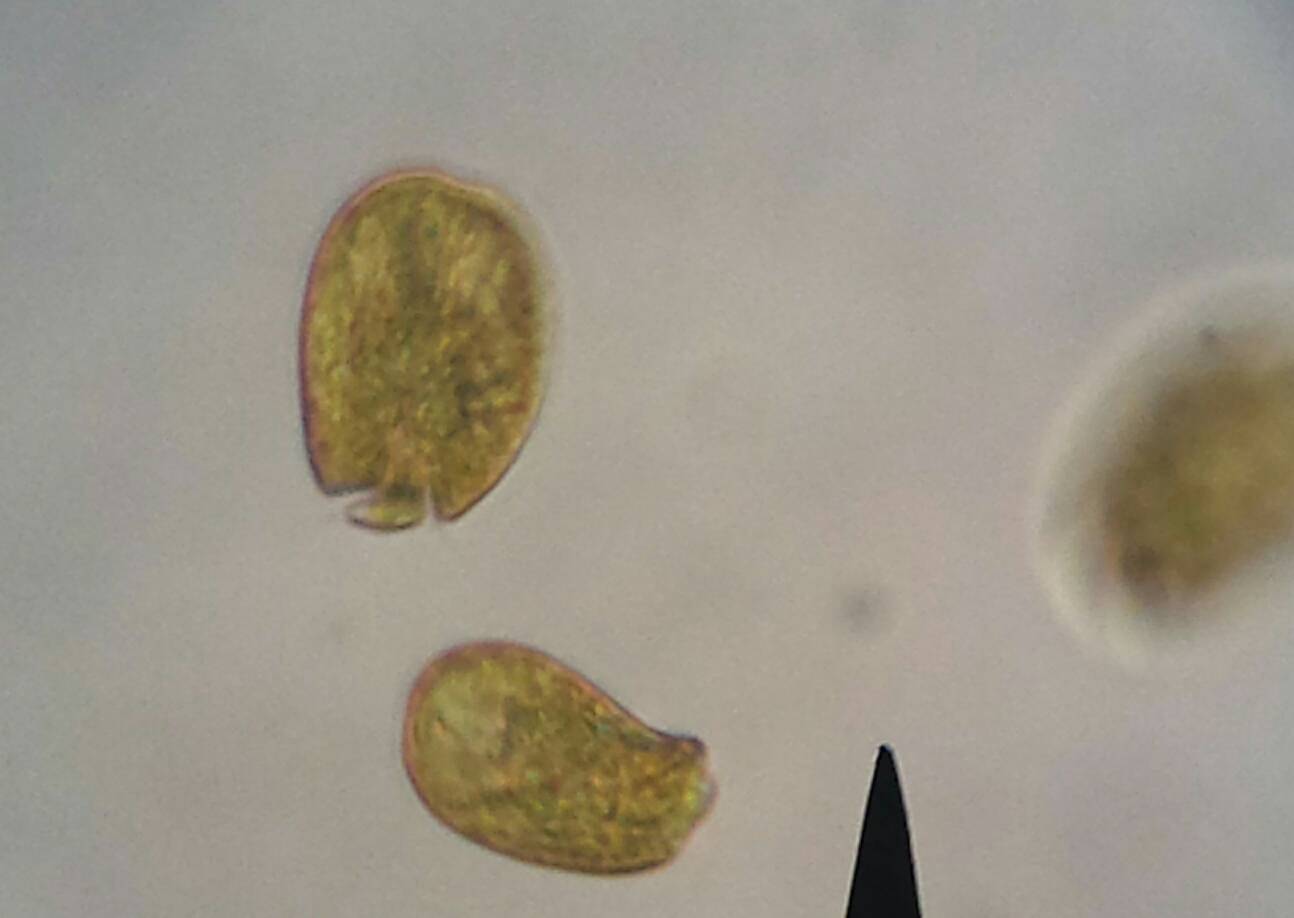
Hi. Here are the pictures of my samples:

HcUTXdD.jpg


Ciko69P.jpg


I'm assuming it is Ostreopsis Dinos. I'm a little overwhelmed by the amount of information and lack of definitive solution. So far, the most convincing I have found is that this is somehow related to very low nutrients creating advantageous conditions for dinos over other species.

Since my PO4 and NO3 have been at zero, I'm going to lower my daily dose of vinegar from 25ml to 20ml and see what happens.

The good thing is that dinos are only on the sandbed and have been slowly coming back after I siphoned a lot of them from the substrate a couple of days ago. So I think this is mild case, not as others report over the rock, slimy, bubbling stuff.

Perhaps I can win this by some tweaking of my tank parameters.

Your feedback is appreciated.

I wonder if this is a common issue with carbon dosing, ULNS and maybe gets worse with vinegar dosing?
 
Something that I have noticed is that my SPS (hammers, frogspawn) have a tendency to be extremely delicate. For instance, if one of them gets a cut (caused by mishandling), then it most likely will get brown slime and end up loosing that head. Could this be related to dinoflagellates?

Now I wonder if this brown slime is caused by dinoflagellates taking advantage of the cut and invading the SPS. I will see if I can take a sample of the brown slime and see it under the microscope.
 
The dinoflagellates might make the situation worse. They could grow on the damaged surface and cause problems, for example. I would work on getting rid of them, in any case. Unfortunately, that is hard to do.
 
I feel like I hijacked this thread........ Do you think I should move to my own thread or is it OK to continue here?

Updated parameters:
NO3: 0.25 ppm
PO4: 0.07 ppm
KH: 8.2 dKH

Currently dosing 20ml vinegar / day. It is almost too predictable and quick how NO3 and PO4 raise when I reduce vinegar dosing and vice-versa.

Dinoflagellates slowly increasing after I siphoned most of it out a few days ago. I will siphon it out again tomorrow.
 
I feel like I hijacked this thread........ Do you think I should move to my own thread or is it OK to continue here?

Yeah, we ought to continue this elsewhere. The things you'll be doing to get rid of them will be opposite of this thread.
The connection to very low PO4 is commonly seen. I myself was pushing big vodka/vinegar doses when I ran across these dinos.
I still like my "pre-ID" of amphidinium best. Look at 10 seconds into your video
https://www.youtube.com/watch?v=up8gUI-gqc4&
the grooves at the "front" outline a tongue or nose like projection (epicone) that is the best indicator of amphidinium.
If you look at the youtube video I linked earlier, you'll see same structure on the front of those cells.
algaeid.com/identification if you want to compare to other common strains. It not ostreopsis.
 
Yeah, we ought to continue this elsewhere. The things you'll be doing to get rid of them will be opposite of this thread.
The connection to very low PO4 is commonly seen. I myself was pushing big vodka/vinegar doses when I ran across these dinos.
I still like my "pre-ID" of amphidinium best. Look at 10 seconds into your video
https://www.youtube.com/watch?v=up8gUI-gqc4&
the grooves at the "front" outline a tongue or nose like projection (epicone) that is the best indicator of amphidinium.
If you look at the youtube video I linked earlier, you'll see same structure on the front of those cells.
algaeid.com/identification if you want to compare to other common strains. It not ostreopsis.

Thanks Taricha. They look very similar. I agree they seem to be Amphidinium. I will read more about them.
 
I just read through this entire thread but didn't see what ml/gallon ratio of vinegar that Randy is ultimately recommending as the high-end or goal.

I am currently using that chart that Randy has said is both low and too slow. I am currently dosing .20ml/g/day.

Any advice? I am only dosing vinegar, no vodka or glucose/etc.
 
I dose the equivalent( vodka and vinegar ) of about .5 ml of 5% acetic acid vinegar per gallon per day. From the large number of anecdotal accounts I've read over the years the normative range is around .3 to .6ml per gallon pr day; however , there are many variables in each tank.
 
Back
Top
