Refractometer advice

I use to use a hydrometer, though i bought a Red Sea Refractometer. they are much more accurate than a hydrometer. it all depends on what you would like to spend, though if you plan on going to a reef in the future then grab a refractometer.
 
Ehhhh .. ..

Go with the fancy Green digital unit from Milwaukee Instruments.

http://www.milwaukeeinstruments.com/MA887.html

You will know your salinity exactly.

If you plan to keep high end corals and be in the hobby for two plus years it will pay for itself with as many water changes you intend to perform.

I agree is it pricy but if you think of it as an investment it's only a dollar and a few cents per water change over two years.

All major online business sell them. I tend to favor BRS.

The $40 will absolutely get the job done but you have to calibrate it and knowing me, I would probably mess it up due to operator error.

I like the reassurance of pressing a button and making it idiot proof.

Once you get above 1.026 corals tend to show signs of stress.

Sometimes peace of mind is worth the extra expense.
 
I have the $30 something one from premium aquatics. Nice easy to read and much easier to see than the Red Sea. I have had many in my old age and this one is as good as one I had years ago.
 
Actually the Milwaukee Instrument Refractometer is not accurate at all.

Its has error margin of 0.002. What does that mean?

If the meter reads 1.026.
It can be off from 1.024 up to 1.028 and still be within spec of the unit.

Better off have a normal Refractometer and do the offset calibration at 1.026. It will be a lot more accurate then that digital meter.
Any Refractometer on market can do this, if used with a calibration fluid to calibrate it. At this point, you want to find a good Refractometer that has good nice readable display.

There are digital meters (MISCO AQUAR-H2O) with accuracy of 0.0005
If the meter reads 1.026.
It can be off from 1.0255 up to 1.0265 and still be within spec of the unit.

Its not cheap, if you are going to test something make sure its accurate.
 
I have the $30 one from premium aquatics. Nice easy to read and much easier to see than the Red Sea. I have had many in my old age and this one is as good as one I had years ago.

Same here, its built very well and the graduations are easy to see and read. I do recommend using calibration fluid to keep any refractometer accurate.
 
Actually the Milwaukee Instrument Refractometer is not accurate at all.

Its has error margin of 0.002. What does that mean?

If the meter reads 1.026.
It can be off from 1.024 up to 1.028 and still be within spec of the unit.

Better off have a normal Refractometer and do the offset calibration at 1.026. It will be a lot more accurate then that digital meter.
Any Refractometer on market can do this, if used with a calibration fluid to calibrate it. At this point, you want to find a good Refractometer that has good nice readable display.

There are digital meters (MISCO AQUAR-H2O) with accuracy of 0.0005
If the meter reads 1.026.
It can be off from 1.0255 up to 1.0265 and still be within spec of the unit.

Its not cheap, if you are going to test something make sure its accurate.

Yea? You have data for this?

Why so angry bro?

:confused:

The manual refractors are subjective, digital is objective.
 
Yea? You have data for this?

Why so angry bro?

:confused:

The manual refractors are subjective, digital is objective.

Your link has the data.

I am in a good mood, so no clue why you think I am angry.
Always been a straight shooter, its never personal.

Yes manual refractors are subjective, but if you buy meter with good readable numbers and calibrate them with the offset its going to be good enough.

A lot people are not sure how calibration works, there are many ways of doing, only going to explain two types.

1) Offset only. You only do this, if you always run at one place of the range.
Example, if you keep salinity at 1.026. Then calibrating at 1.026 will make you accurate at 1.026 only. As soon you start to drift away from 1.026 you will lose the accuracy and it will happen real fast.

2) Offset, and Gain. This type is for to testing a range of measurement.
Example, If you monitor pH, then you want it to accurate from 7.8 to 8.4.

Most of the Refractometer , if not most found in our hobby and the Milwaukee Instrument Refractometer are not accurate with the Offset and Gain.
How do you do a Offset and Gain on a Refractometer and Milwaukee Instrument Meter?
By using DI water for your offset and the Refractometer, Milwaukee Instrument Meter will do the gain.

That is why these meters fail, they cannot adjust the gain correctly.
 
I asked those guys at faios about the Milwaukee bc I'm lazy. They laugh at me. Pretty much sums up the accuracy of the product.
 
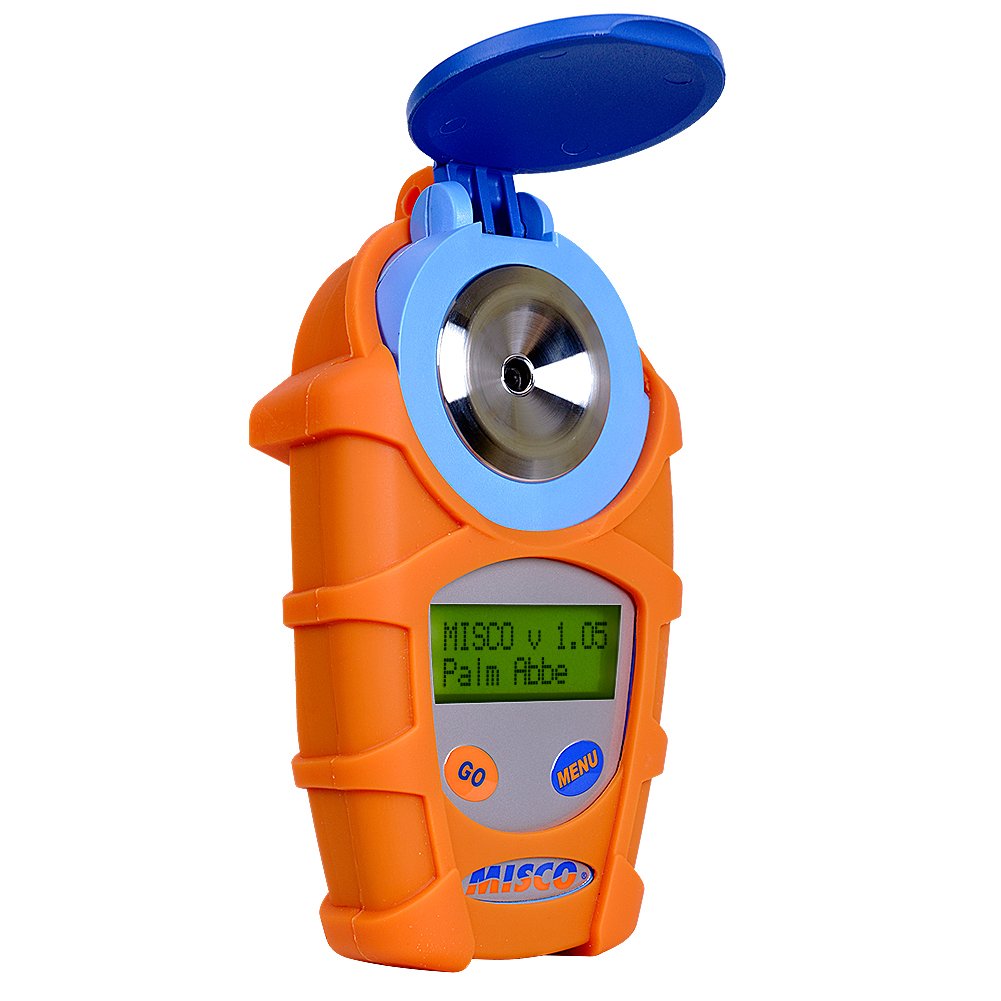
If you want the best, this is it. Look at the zeros, so sexy.
Sexy is not cheap.

The Palm Abbe AQUAR H2O Digital Seawater Refractometer is a professional refractometer for testing seawater, salt water, and brackish ocean water for oceanography, aquaculture, aquariums, desalination plants, and ocean research.

Sea Water; Unit of Measure: Specific Gravity (D20/20); Range: 1.0000 to 1.1180 ; Resolution: 0.0001; Precision: +/-0.0005


61MJCuVn%2B4L._SL1500_.jpg
 
Your link has the data.

I am in a good mood, so no clue why you think I am angry.
Always been a straight shooter, its never personal.

Yes manual refractors are subjective, but if you buy meter with good readable numbers and calibrate them with the offset its going to be good enough.

A lot people are not sure how calibration works, there are many ways of doing, only going to explain two types.

1) Offset only. You only do this, if you always run at one place of the range.
Example, if you keep salinity at 1.026. Then calibrating at 1.026 will make you accurate at 1.026 only. As soon you start to drift away from 1.026 you will lose the accuracy and it will happen real fast.

2) Offset, and Gain. This type is for to testing a range of measurement.
Example, If you monitor pH, then you want it to accurate from 7.8 to 8.4.

Most of the Refractometer , if not most found in our hobby and the Milwaukee Instrument Refractometer are not accurate with the Offset and Gain.
How do you do a Offset and Gain on a Refractometer and Milwaukee Instrument Meter?
By using DI water for your offset and the Refractometer, Milwaukee Instrument Meter will do the gain.

That is why these meters fail, they cannot adjust the gain correctly.

It is soooooo nice to read a post from someone who has thorough knowledge on the topic being discussed.:thumbsup:

and sexy indeed.
 
i've wondered often - why do they not make a aquarium grade refractometer that reads between 1.0 and 1.1 instead of 0 to ? It's so hard to see if your at 1.026 or 1.024 or 1.028 with those refractometers.

that misco refractometer does look sexy indeed. pretty big price tag though.
 
Curious questions to only learn more and encourage more feedback.

By the way, Thank you for posting the information on the Milwaukee.

I agree the Milwaukee is flawed & equally nice to a certain extent.

I agree S.G. + or - .002 is not acceptable.

However:

Taking the probable variance into consideration, I assume the following may help the unit become more accurate.

If the operator presses the read button 3 times and average. Then one would be hopefully getting close to accurate final results.

Yet if the unit reads exactly the same S.G. every time it gives one the impression and confidence that it found the appropriate salanity. Due to constant repeatabilty, one would think it was very close to accurate.

The Aquar Is nice and I also just discovered that it is $455 wow!

Do manual refractors lose calibration? How do you know that your beginning point of calibration is true 1.026?

Due to my personal confidence level as an operator, I initially & subjectively "tuning" the device to "true" 1.026 or 1.025 with not being 100% confident that the unit is accurately being calibrated was a concern of mine.

The Milwaukee convenience of objectively giving me a computer generated result makes me feel better, even if I press the read button three times to be sure.
 
I need to check my D-D with some calibration fluid, I did a quick check lastnight with ro/di lastnight and it was spot on, I do know it's not ideal but at 1am and without the fluid it was my only option.
 
Please keep this in mind, when using calibration fluid, your not really calibrating the Refractometer.

What you are doing, is telling the Refractometer, where the line should be at 1.026

Also temperature is a huge factor with salinity reading.
Would be ideal to store the calibration fluid, Refractometer at the same location, and ideally same temperature as your tank.

When making readings also calibration, make sure to let the ATC work (temperature to equal out).

To answer BobbyV, getting three identical reading means little.
Just means the error is the same at that point of time.

Temperature is huge, and the method of reading salinity is also key.
Just a small note from the manufacture of the meter i have.


It is this seawater basis that separates the MISCO AQUAR Refractometer from other refractometers that are based on only sodium chloride and water. Although sodium chloride is one of the main components of seawater, there are enough other components that render a regular sodium chloride refractometer inaccurate with respect to the physical properties of seawater.


Last note guys, its important to know where your salinity is at, but is more important to keep it stable. So dont freak out too much, just have a good ATO.
 
Back
Top
