RGB LED strength? (Algae scrubber)

stephenhall1987

New member
I'm getting ready to build an algae scrubber and I'm trying to decide on a light. My questions are:

Are RGB color changing leds as strong (effective) as solid color leds?

Are red or white lights better for Algae turf scrubbers? ats
 
I get better growth with a standard compact fluorescent bulb, than I do with my 10 watt led grow light. I just switched back, and there is no comparison.
 
Check out the Advanced Forum for LED /scrubber info. I use LEDs (660nm Red) and they definitely produce more algae than compact fluorescents. Less heat and physical space required.
 
I have not run a algae turf scrubber before so I have no clue.

Yeah. And RGB is what makes white light (the combination of all visible spectrum) and 3 leds with RGB spectrum probably provide a better spread of spectrum than a single white led.
 
Yeah. And RGB is what makes white light (the combination of all visible spectrum) and 3 leds with RGB spectrum probably provide a better spread of spectrum than a single white led.

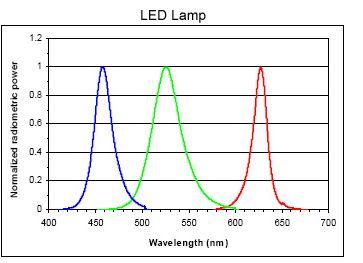
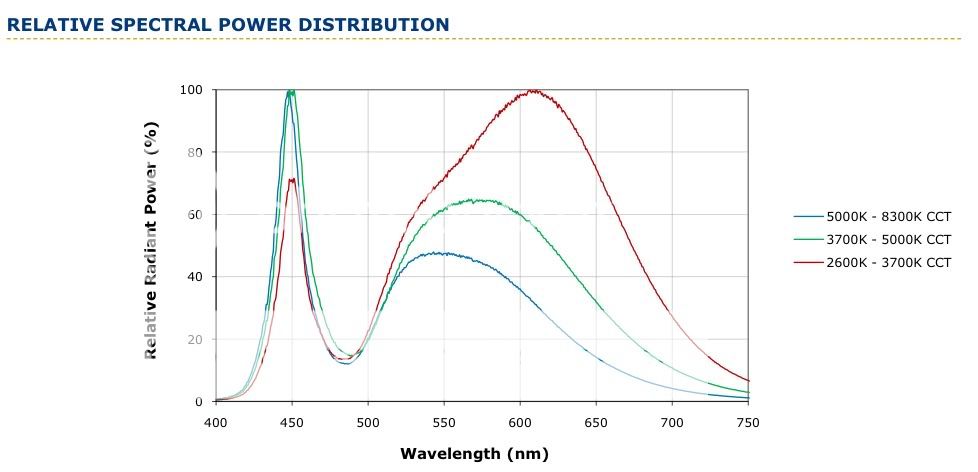
White in appearance but not broad spectrum like a white LED. All colored LEDs are narrow bands. RGB will give you three spikes and lots of gaps. A white LED will give you a more complete spectrum.

RGB plot - note the gaps
LED_Spectrum.jpg


Cree XP-G neutral white
CreeXP-GSpectralPower.jpg
 
Are RGB color changing leds as strong (effective) as solid color leds?

Are red or white lights better for Algae turf scrubbers? ats

RGBs, no. You want primarily 660nm Deep Red. I throw in some violets as well.

I get better growth with a standard compact fluorescent bulb, than I do with my 10 watt led grow light. I just switched back, and there is no comparison.

Not all LED lamps are the same. For instance, I just talked to one guy that got a 40W red/blue LED fixture off ebay (20x 2W) and on the kil-o-watt meter it only pulls 10W. He got another PAR lamp that claims to be a 54W (18x 3W) and it only pulls 12W.

So be careful what you buy. Just because something has "3W" LEDs doesn't mean A) each LED actually is running at 3W consumption and B) doesn't mean that the LED is being driven to the max.

Example: make an array of Philips Luxeon 660nm Deep Reds, 6 of them in series, and drive them to the max (700mA). Now these are called "3W" LEDs, right? But at 700mA the voltage drop is 2.4V, so 2.4V * 0.700 A = 1.67 W of power consumed.

My (current) recommendation is found here:

http://www.reefcentral.com/forums/showthread.php?p=23906862#post23906862

But this is always in a state of flux as I learn more, like what I just posted above about the "40W" and "54W" so-called lamps.
 
Many so called white LEDs of various colour temperatures are merely a blue LED covered by phosphors to produce a whiter light. Not sure if full spectrum LEDs work the same way? Given that, an RGB set up may not be that far off base as a viable light source for algae growth, since the red LEDs are truly red spectrum, as are the green & blue on the same chip.
 
All white LEDs are blue+phosphor. Some full spectrum lights (which are really high CRI lights) fill holes in the white spectrum with a PC Amber or Lime LED.
 
Thanks for all the responses! Always a lot of insight on this forum.


The answer I found on google for my first question is this:
RGB leds aren't color changing leds, but actually 3 leds in one.
help-lm-001.jpg


The lights I was looking at were "10w led chips", which actually are nine 1w leds on a chip. So an RGB 10w chip, running only red, would only have 3 leds lit up.
led-10w-RGB.jpg


So in conclusion, multi led RGB chips are not a suitable alternative to solid color leds.
 
Also these types of chips are typically for architectural lighting and not photosynthetic production. So the individual chips they use are the cheapest available, meaning low quality bin selection (if the even bin them).

This is why I only get my Deep Reds from Steve's LEDs. I've bought thousands from them and they are very consistent and are a good bin.
 
Thanks for all the responses! Always a lot of insight on this forum.

The answer I found on google for my first question is this:
RGB leds aren't color changing leds, but actually 3 leds in one.

The lights I was looking at were "10w led chips", which actually are nine 1w leds on a chip. So an RGB 10w chip, running only red, would only have 3 leds lit up.

So in conclusion, multi led RGB chips are not a suitable alternative to solid color leds.

Not sure I get your conclusion? Suitable for what application? Algae growth? With the appropriate controller you can blend the colours of the 10 watt multi chip to create various colour temperatures by running each row at different levels. Similar to how SMD5050 RGB LED strips with IR controller function. On the SMD5050 RGB strips the Red, Green & Blue LEDs are mounted on the same chip. SMD3528s are less powerful & the LEDs are mounted as individual colours on the strip. Then there are the more powerful SMD5630 strips, but these are not available as RGB.

Waterproof SMD5050 RGB strip with IR controller
P1060144e.JPG


I guess we need someone to give it a go & report on the results! Whether you get solid colour multi chips or the hybrids, you'll still need to control the individual colours to find the spectrum that works best for your application. Once you dial in the best spectrum, I reckon it boils down to how much power you want or need, starting with the tiny discrete LEDs, thru the SMD strip lights, right on up to the 10 watt or larger multis.

If the intent is to grow algae on a turf scrubber, I hardly see the need to get too fancy with the quality of the LEDs. Finding out what works for the least $$$s would be my goal.
 
Last edited:
I guess we need someone to give it a go & report on the results! Whether you get solid colour multi chips or the hybrids, you'll still need to control the individual colours to find the spectrum that works best for your application. Once you dial in the best spectrum, I reckon it boils down to how much power you want or need, starting with the tiny discrete LEDs, thru the SMD strip lights, right on up to the 10 watt or larger multis.

If the intent is to grow algae on a turf scrubber, I hardly see the need to get too fancy with the quality of the LEDs. Finding out what works for the least $$$s would be my goal.

Why bother with this suggestion, when THIS thread has all the test results you will need?

Floyd R Turbo has spent countless hours researching, testing, and posting his results, so why re-invent the wheel?
 
I've had people argue with me about SMD LEDs vs high power PCB mounted LEDs and at this point, here's where I stand with that:

Low power and SMD LEDs do work to grow algae. The issue becomes, how well do they work in the long run? And I'm not referring to length of life, I'm referring to stages of growth of the scrubber.

A low power LED, if they are packed together for good coverage, will cause a new screen to grow algae, now problem. The problem is, from what I am starting to see, that once you reach a certain thickness of growth, the lower power LEDs don't have enough "punch" to get light through the thick growth to the base of the screen where the algae attaches. The result is, die off. So you have to clean the screen when it gets to a thickness that is enough to cause this. This is a bit of trial and error based on your screen and your system, so it's hard to say "X day when using Y LED for Z hours".

A high power LED will have enough "punch" to keep the base growth alive longer, in most cases. The longer you can let a screen grow without die-off, the stronger the scrubber will be over time (long run), because you have a large mat of algae that is growing at every level. When you remove all that algae, yes it grows back but the uptake is likely to be much less for the next few days after cleaning vs what it would have been could you have let it grow for 2 more days.

So here's where the trick comes in. You want a lower power array for starting the screen up, and then when you get to the point where it grows thick enough to self-shade, punch that light intensity up. Around that same point in time is when your screen reaches "maturity", when a good amount of the holes are filled in after you scrape it. That leftover algae is capable of accepting the higher intensity light, and it can grow back fast. Until the screen gets to that point, higher intensity light can easily result in bare spots on the screen (photosaturation).

So the bottom line here is that it is my opinion that lower power LEDs will only be effective at growing algae to a certain point. After that, you need high intensity light to get growth that can stay attached for a longer growth cycle.

Not saying that you can't use lower power LEDs. You certainly can, but there will likely be a limitation on thickness of growth you can achieve compared to high power LEDs.

There are also caveats to all of this, such as an ultra-low nutrient tank, where you just don't have the nutrients to support much algae growth. I've also seen instances where screens seem to be growing fine and then they suddenly turn start white (which I call "whiting")...can't explain that one yet.

 
I've also seen instances where screens seem to be growing fine and then they suddenly turn start white (which I call "whiting")...can't explain that one yet.

When my algae turns "white", it is due to the thickness of the mat of algae against the light covers, and forcing water flow away from directly below it, causing the algae directly below to turn white due to lack of water.
 
Back
Top